

If you are a Commerce student in India, you know the pain.
You finish your B.Com, and the world asks you only one question: “CA kar rahe ho kya?” (Are you doing CA?). If you say “No,” they look at you like you have no future. If you say “Yes,” you enter a grueling cycle of exams where the pass percentage is often single digits.
Millions of young Indians in Tier 2 cities, from Meerut to Madurai, are stuck in this “B.Com Trap.” You are too educated to do manual labor, but you don’t have the “CA” stamp to get high-paying corporate jobs. You end up working in a small shop for ₹10,000 a month, frustrated and underpaid.
But Budget 2026 just threw a lifeline to every Commerce graduate in India.
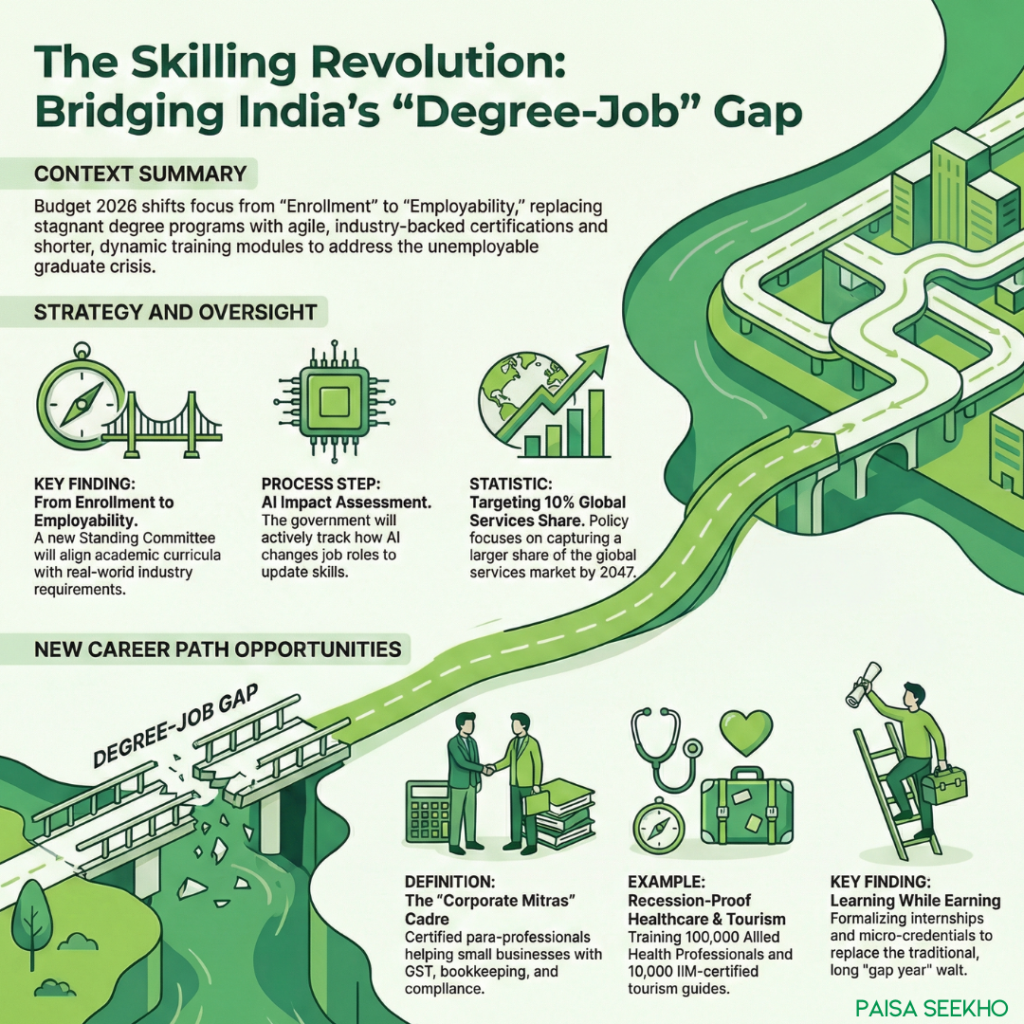
The Finance Minister has announced the creation of a new cadre of professionals called “Corporate Mitras”. This is not just a fancy name; it is a legitimate, government-backed career path designed specifically for Tier 2 and Tier 3 cities.
In this blog, we will decode this new scheme and show you how to build a solid independent practice earning ₹50,000+ per month, without ever cracking the CA final exam.
Part 1: The “Gap” in the Market (Why this Job Exists)
To make money, you don’t need a degree; you need to solve a problem. And right now, India has a massive economic problem.
The Problem:
India has over 6.3 Crore Micro, Small, and Medium Enterprises (MSMEs). These are your local kirana stores, small factories, textile workshops, and trading firms. These businesses struggle immensely with compliance.
- They have to file GST returns.
- They have to file Income Tax returns.
- They have to maintain books of accounts.
The Bottleneck:
For a small business in a Tier 3 town with a turnover of ₹50 Lakhs, hiring a fully qualified Chartered Accountant (CA) is often too expensive. A CA might charge high fees that a small shopkeeper simply cannot afford. Result? The shopkeeper doesn’t file taxes, gets slapped with penalties, and the business suffers.
The Solution:
The government realized: You don’t need a brain surgeon to treat a flu. Similarly, you don’t need a top-tier CA to file a simple GST return. Enter the “Corporate Mitra.”
Part 2: What is a “Corporate Mitra”?
Think of this role as the “Financial Equivalent of a Nursing Assistant”. Just as a nurse is vital to a hospital even though they aren’t a doctor, a Corporate Mitra is vital to the economy even though they aren’t a CA.
The Role:
These individuals will be “Para-Professionals” certified to assist MSMEs with routine compliance tasks. Your daily work would involve:
- GST Filings: Uploading monthly GSTR-1 and GSTR-3B forms.
- Book-keeping: Maintaining basic ledgers for small clients.
- Company Registrations: Helping a new business get its Udyam Aadhar or PAN.
- Basic Tax Returns: Filing ITRs for small proprietors.
The Legitimacy:
This isn’t a random course. The Budget explicitly states that professional bodies like the Institute of Chartered Accountants of India (ICAI), the Institute of Company Secretaries of India (ICSI), and the Institute of Cost Accountants of India (ICMAI) will design these courses. This means you get a certificate with the “ICAI” or “ICSI” logo on it. That stamp builds trust with your clients.
Part 3: The “Paisaseekho” Business Model
Okay, the policy is great. But how do you make money? Here is the blueprint for a “Tier 2 Tax Consultancy” model using this scheme.
The “Volume Game” Strategy: A CA focuses on “High Value” clients (Big companies paying ₹1 Lakh fees). You will focus on “High Volume” clients (Small shops paying ₹3,000 fees).
The Math:
- Target Client: Small mobile shop owner, local garment trader, or a freelance graphic designer.
- Service: Monthly GST filing + Annual Bookkeeping.
- Fee: ₹3,000 per month (Very affordable for a business owner).
- Capacity: As a “Corporate Mitra,” one person can easily manage 15-20 such small clients because the work is standardized.
The Income Calculation:
- 15 Clients x ₹3,000 = ₹45,000 per month.
- Add annual ITR filing fees for individuals during tax season (July), and you easily cross ₹50,000/month.
Why this works in Tier 2 Cities:
In a city like Solapur or Ranchi, the gap between MSME needs and professional availability is widest. There are thousands of small businesses but very few CAs. You become the “Family Doctor” for their finances.
Part 4: Who Should Apply to Be A Corporate Mitra?
This scheme is a game-changer for three specific groups of people:
- The B.Com/M.Com Graduate: You learned accounting in college but never got practical exposure. This course bridges the gap between “Theory” and “Practice.”
- The “CA Dropout”: This is sensitive, but important. Thousands of brilliant students clear CA Inter but get stuck at CA Final. They spend years in depression, feeling like failures. Wake Up: You are not a failure. You have knowledge. The “Corporate Mitra” certification allows you to monetize that knowledge legally and immediately. You can stop studying for the 5th attempt and start earning.
- Women on Career Breaks: If you left the workforce and want to restart, this is perfect. You can work from home, handle 5-6 clients digitally, and earn a respectable supplementary income.
Part 5: How to Get Started (Action Plan)
The Budget announcement is fresh, so the specific enrollment links aren’t live yet. However, based on the policy text, here is your roadmap:
Step 1: Watch the ICAI/ICSI Websites
The government has mandated these institutes to design “short-term, modular courses”. These won’t be 3-year degrees. They will likely be 3-6 month intensive certifications focused on practical tools (like the GST portal, Tally, Excel).
Step 2: Learn the “Tools”, Not Just the Rules
While you wait for the course, start learning the software.
- Master Excel (VLOOKUP, Pivot Tables).
- Learn Tally Prime or Zoho Books.
- Watch YouTube tutorials on how to file a Nil GST Return.
- Tip: The exam will test your knowledge, but your clients will pay for your speed.
Step 3: Start “Interning” Now
The Budget also emphasizes “Internship and Apprenticeship”. Don’t wait for the certificate to get your hands dirty. Go to a local CA firm in your town. Tell them: “Sir, I will do your data entry for free/low cost. Just teach me how to file GSTR-1.” That 3 months of experience + The Corporate Mitra Certificate = Unstoppable Career.
Conclusion: Dignity of Skills > Dignity of Degrees
For too long, we have chased degrees that gave us no skills. We have B.Techs delivering food and B.Coms driving taxis.
Budget 2026 tries to fix this mismatch. The “Corporate Mitra” scheme is a recognition that you don’t need a PhD to be useful. You just need a specific skill that the market values.
For the young commerce graduate in a small town, this is your moment. You don’t have to move to a metro and you don’t have to clear the toughest exam in the world. You just need to learn the system, get certified, and help the shopkeeper next door.
Wealth isn’t just about the stock market; it’s about increasing your income capacity. And this scheme is the best income booster we’ve seen in years.
Next Up on Paisaseekho: We’ve covered Careers (AVGC, Corporate Mitra) and Housing (PMAY). But what about your Gold? In the next blog, we discuss the “SGB Shock” and why you need to change your Gold strategy immediately.
Frequently Asked Questions (FAQ)
Q1: Can I sign Audit Reports as a Corporate Mitra?
Ans: No. Only a Chartered Accountant can sign a Tax Audit. You are a “Para-professional.” Your job is compliance and data preparation. For the final audit signature, you can tie up with a practicing CA (and even earn a referral commission!).
Q2: Is this a government job?
Ans: No. The government is creating the certification and the ecosystem. You will likely work as a freelancer, an independent consultant, or an employee in an MSME. You are building a business, not getting a salary from the government.
Q3: Will CAs hate me?
Ans: Actually, no. CAs want you. Most senior CAs hate doing low-level data entry and basic GST filings. It’s a waste of their time. They would happily refer their smaller clients to a reliable “Corporate Mitra” so they can focus on big corporate audits. You are an ally, not a competitor.
Q4: How much will the course cost?
Ans: Since it is aimed at Tier 2/3 youth and MSME support, the fees will be nominal compared to an MBA or private PGDM. The government wants mass adoption.
Disclaimer: This blog is based on the Union Budget 2026-27 announcements. Course details and eligibility criteria will be subject to official notifications from ICAI/ICSI.