
TL;DR: Buying Gold During Festivals in India – Key Takeaways
- The Cultural Premium: Buying physical gold on Dhanteras or Akshaya Tritiya is an emotional tradition, but mathematically, it is the most expensive time of the year to buy. High demand eliminates your negotiation power.
- The “Making Charge” Trap: During peak festive rushes, jewelers rarely offer genuine discounts on the metal rate. Instead, they lure you in with “discounted making charges” that were artificially inflated to begin with.
- The Token Tradition (The Shagun Hack): If you must buy gold for cultural reasons, separate your emotions from your investments. Buy ₹101 of Digital Gold on an app for the shagun (auspicious token), and invest your actual capital into a Gold ETF.
- The Gold Scheme Reality: 11-month jeweler schemes (where you pay for 10 months and the jeweler pays the 11th) are designed to lock in your festive buying. They offer decent returns but force you to buy high-margin jewelry, not pure investment coins.
- The Golden Rule: Treat festive jewelry purchases as a lifestyle expense, not a financial investment. If you are buying a necklace for Diwali, you are buying art, not an asset.
1. The Clash of Culture and Capital
Every year, as the autumn breeze sets in and the festive season kicks off, millions of middle-class Indian families prepare for the ultimate cultural ritual: buying gold. Whether it is Dhanteras, Diwali, Dussehra, or Akshaya Tritiya in the spring, the scenes are identical across the country.
Jewelry showrooms from Tier-1 metros to Tier-3 towns are packed shoulder-to-shoulder. People wait in line for hours just to hand over their hard-earned cash for a gold coin, a small ring, or a heavy bridal set. We are conditioned from childhood to believe that bringing gold into the house on these specific days invites Goddess Lakshmi and ensures year-round prosperity.
Culturally, it is a beautiful, deeply ingrained tradition. Financially, it is a highly engineered trap.
As young professionals navigating the high-inflation landscape of 2026, you can no longer afford to blindly follow traditional financial advice that was meant for the 1990s. With gold prices consistently breaking historic records, walking into a crowded showroom on Dhanteras without a clear strategy is a surefire way to lose money before you even step back out the door.
This guide strips away the nostalgia and applies pure systems thinking to the festive gold rush. We will break down the hidden economics of festival buying, expose the reality of showroom discounts, and teach you how to honor your family’s traditions without sabotaging your wealth-building journey.
2. The Economics of Festive Gold (Why You Lose Negotiation Power)
To understand why buying gold on a major festival is a mathematical disadvantage, you have to look at the basic economic principle of Supply and Demand.
On a random Tuesday in July (during the monsoon off-season), footfall in a jewelry store is incredibly low. The showroom owner is desperate to make a sale to cover their massive overhead costs (electricity, security, staff salaries, inventory holding costs). Because demand is low, you have all the power. You can sit down, negotiate the making charges from 18% down to 10%, and walk away with a great deal.
Now, fast forward to Dhanteras.
The dynamics completely flip. Suddenly, 1.4 billion people all believe that they must buy gold within a specific 24-hour astrological window.
- Inelastic Demand: Your demand for gold becomes “inelastic.” The jeweler knows you are not going to walk out without buying something because your family is expecting you to bring gold home.
- The Scarcity Premium: Because the showroom is overflowing with buyers, the jeweler has zero incentive to negotiate. If you refuse to pay a 20% making charge, the person standing right behind you will gladly pay it just to complete their pooja (prayer) on time.
By voluntarily choosing to buy your gold on the exact same day as the rest of the country, you are completely surrendering your financial leverage to the seller.
3. The 3 Hidden Costs of Buying Gold During Festivals in India
When you buy physical gold during a festival, you are not just paying for the global spot price of the metal. You are paying a massive “friction tax” that eats directly into your long-term returns.
Cost 1: Artificially Inflated Making Charges
You will see full-page newspaper ads leading up to Diwali screaming: “Flat 50% Off on Making Charges!”
This is the oldest retail trick in the book. A jeweler will simply take a machine-made gold chain that normally carries an 8% making charge, artificially inflate the sticker price to show a 16% making charge, and then magnanimously offer you a “50% discount”—bringing it right back down to the standard 8%. You haven’t saved any money; you’ve just fallen for price framing.
Cost 2: The Mandatory 3% GST
Every time you buy physical gold in India, the government levies a strict 3% Goods and Services Tax (GST).
If you buy ₹1,00,000 worth of gold, you instantly pay ₹3,000 to the government. When you eventually try to sell that gold years later, the jeweler will pay you the market rate for the gold, but you will never get that 3% GST back. It is a sunk cost. Combine a 3% GST with a 15% making charge, and your investment is instantly down by 18% on day one. The global price of gold has to rally by nearly 20% just for you to break even!
Cost 3: Impulsive “Compromise” Purchases
Because inventory flies off the shelves during Akshaya Tritiya and Dhanteras, the specific 5-gram coin or lightweight chain you originally planned to buy might be out of stock by the time you reach the counter.
Caught in the festive frenzy, buyers routinely compromise. They end up buying a heavier, more expensive 10-gram piece, or a stone-studded ornament with exorbitant making charges, completely blowing past their original budget.
4. Smart Strategies: How to Beat the System
At Paisaseekho, we don’t believe in entirely abandoning cultural traditions. You can still participate in the joy of festive buying; you just need to outsmart the system.
Here is the modern playbook for buying gold during festivals without getting ripped off.
Strategy 1: Buy Off-Season, Gift On-Season
This is the ultimate wealth hack. Do not wait for October or November to buy your Diwali gold.
Buy your jewelry during the “dead zones” of the Indian retail calendar—typically mid-July to August (during the monsoons or Shradh period). Showrooms are empty, jewelers are highly motivated to meet monthly quotas, and you can aggressively negotiate making charges down to single digits.
Take the jewelry home, lock it safely in your vault, and simply bring it out for the pooja on Dhanteras. The Goddess does not check the date on your GST invoice!
Strategy 2: The “Price Lock” Advance Booking
If you absolutely must buy fresh inventory released during the festive season, use the advance booking feature offered by large organized retailers (like Tanishq, Malabar, or Kalyan).
- How it works: You visit the store 30 to 45 days before the festival. You select your piece and pay a 10% to 20% advance to lock in the item.
- The Protection: Most major brands offer a price protection guarantee. If the gold rate goes up on Dhanteras, you pay the lower locked-in rate. If the gold rate crashes on Dhanteras, you pay the new, lower rate. You get the best of both worlds, and you completely avoid standing in a three-hour line on the actual festival day.
Strategy 3: Beware of 11-Month “Golden Harvest” Schemes
Many jewelers push systematic investment schemes where you pay a fixed monthly installment (e.g., ₹5,000) for 10 months, and the jeweler contributes the 11th installment as a “bonus.” You can then use the total accumulated amount to buy gold during the festive season.
- The Catch: While the math looks like a great return on investment, these schemes usually have a strict clause: you can only use the maturity amount to buy jewelry, not 24K pure gold coins. The jeweler easily recoups their “bonus” contribution by charging you 15% to 20% making charges on the jewelry you are forced to buy. Use these schemes only if you are absolutely certain you want to buy a heavy ornamental piece for a wedding.
5. The Digital “Shagun”: The 2026 Middle-Class Hack
The biggest mental hurdle young Indians face is separating the cultural requirement of buying gold from the financial goal of investing in gold.
The tradition dictates that you must buy gold on Dhanteras to signify wealth entering the home. Nowhere in the ancient scriptures does it say you must buy 50 grams of physical metal with an 18% making charge!
The 2026 Solution:
Satisfy the cultural tradition with a micro-transaction, and deploy the rest of your capital into smart, frictionless assets.
- The ₹101 Shagun: On the morning of Dhanteras, open a trusted app like Google Pay, PhonePe, or Jar. Buy exactly ₹101 (or ₹501) of 24K Digital Gold. You have officially purchased pure gold on an auspicious day. The tradition is honored, and you haven’t paid exorbitant showroom premiums.
- The Real Investment: Take the ₹50,000 you originally planned to spend at the jeweler and log into your Demat account (like Zerodha or Groww). Buy units of a Gold ETF (like Nippon India Gold BeES).
- You pay zero making charges.
- You pay zero GST on the ETF units.
- Your money accurately tracks the live global price of physical gold.
- You can sell it instantly with one click whenever you need emergency cash.
6. Conclusion: Jewelry is Not an Investment
As we wrap up this guide, you must internalize the single most important rule of precious metals: Jewelry is a lifestyle expense. It is not a financial investment.
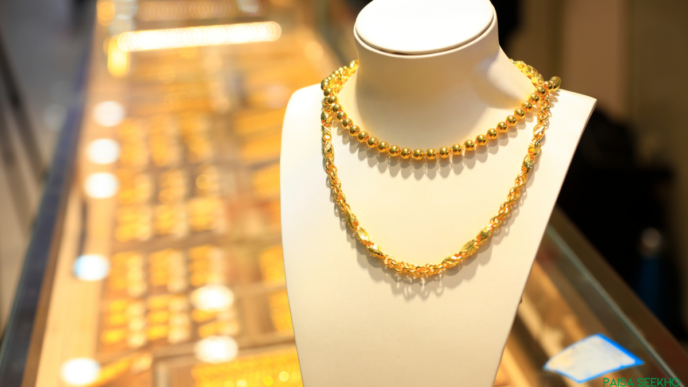
When you buy a beautifully crafted 22K gold necklace, you are buying wearable art. You are paying for the artisan’s time, the brand’s marketing, and the joy of wearing it to a family wedding. There is absolutely nothing wrong with spending your money on things that bring you joy.
However, you must stop lying to yourself by calling it an “investment.”
An investment is an asset that puts money back into your pocket with minimal friction. Physical jewelry carries too many sunk costs (making charges, GST, storage locker fees, and melting deductions upon resale) to ever be an efficient wealth-building tool.
If your goal is to grow your net worth, use modern tools like Sovereign Gold Bonds (SGBs) or Gold ETFs. If your goal is to celebrate a festival, buy the jewelry you love—but do it off-season, negotiate aggressively, and never let the festive frenzy dictate your financial decisions.
Top 15 Frequently Asked Questions (People Also Ask)
1. Is it actually auspicious to buy gold on Dhanteras and Akshaya Tritiya?
Culturally and religiously, yes. In Hindu tradition, Dhanteras (dedicated to Lord Kubera and Goddess Lakshmi) and Akshaya Tritiya (a day of endless prosperity) are considered highly auspicious times to invite wealth into the home by purchasing precious metals.
2. Should I buy a gold coin or gold jewelry during festivals?
If your goal is pure wealth accumulation, a 24K gold coin or bullion bar is vastly superior. Coins carry minimal making charges (usually 2% to 3%) and have near 100% resale value. Jewelry carries high making charges (10% to 25%) and loses value instantly due to “melting charges” when sold.
3. Do gold prices naturally go up during Diwali?
Historically, yes. India is the second-largest consumer of gold in the world. The massive surge in physical demand from 1.4 billion people during the autumn festival and wedding season often drives up local spot prices and retail premiums compared to the rest of the year.
4. Are jeweler “Making Charge Discounts” real?
Rarely. While some jewelers offer genuine minor discounts to drive footfall, many artificially inflate the baseline making charge a few weeks before the festival only to “discount” it back to the normal rate during the sale. Always compare the final per-gram price against the live MCX spot rate.
5. What is “Muhurat Trading” for Gold ETFs?
Muhurat Trading is a special one-hour trading session hosted by the Indian stock exchanges (NSE and BSE) on the evening of Diwali. It allows investors to make auspicious purchases of stocks or Gold ETFs (like Gold BeES) directly from their Demat accounts while the regular market is closed.
6. Can I buy Digital Gold on Dhanteras?
Yes! Digital gold platforms operate 24/7. You can buy 24K Swiss-grade digital gold via UPI on apps like GPay or PhonePe at the exact live market rate, even at midnight on Dhanteras, making it the most convenient way to honor the tradition.
7. What happens if I buy unhallmarked gold during a festival rush?
It is illegal for jewelers in 380+ districts in India to sell non-hallmarked gold in 2026. If you buy a piece without the 3-mark BIS hallmark and 6-digit HUID code, you are likely being scammed on the purity and will suffer massive losses when you try to resell it.
8. Are Sovereign Gold Bonds (SGBs) available during festivals?
SGBs are issued by the RBI in specific tranches throughout the year. The government sometimes times a tranche to align with the festive season, but it is not guaranteed. If a tranche is open, it is the mathematically best way to invest in gold (offering 2.5% annual interest and tax-free maturity).
9. Why do jewelers push stone-studded jewelry during festivals?
Margins. Pure 22K gold has a relatively transparent price. When jewelers add synthetic stones, enamel (meenakari), or uncut diamonds (polki), it becomes incredibly difficult for the consumer to calculate the actual gold weight vs. the stone weight, allowing the jeweler to charge exorbitant hidden premiums.
10. Can I negotiate making charges on Dhanteras?
It is extremely difficult. Because showrooms are operating at maximum capacity and have a line of willing buyers out the door, the jeweler has zero incentive to drop their prices for you. Your negotiation power is highest during the monsoon off-season.
11. Is it better to buy 18K or 22K gold for festive wear?
If you are buying a heavy traditional necklace or bangles, 22K (91.6% purity) is the Indian standard and holds its resale value best. If you are buying diamond-studded jewelry or sleek modern office wear, you must buy 18K (75% purity) because 22K is too soft to securely hold expensive stones.
12. Does buying gold on EMI make financial sense?
Never. Taking a high-interest personal loan or using a credit card EMI (which can charge 15% to 18% interest) to buy a non-yielding asset like physical gold is a massive wealth destroyer. Only buy physical gold with money you have already saved.
13. What is a “Gold Harvest” or 11-month scheme?
It is a savings plan where you pay fixed monthly installments to a jeweler for 10 months, and they cover the 11th month’s installment as a bonus. Upon maturity, you must use the total pool to buy jewelry from their store. Be careful, as you are forced to pay their specific making charges.
14. Should I exchange my old gold for new festive designs?
Exchanging old gold is expensive. Jewelers will deduct a “melting loss” (usually 2% to 5%) from your old gold’s value and then charge you fresh making charges and 3% GST on the new piece. Only do this if you genuinely hate your old jewelry and want a lifestyle upgrade, not as a financial move.
15. How do I verify my festive gold purchase using my phone?
Before paying the bill, ask to see the 6-digit alphanumeric HUID code engraved on the jewelry. Download the official government BIS Care App, tap “Verify HUID,” and enter the code. The app will instantly display the jeweler’s name, testing lab, and exact purity (e.g., 22K916) to ensure you aren’t being cheated.
⚠️ Disclaimer
At Paisaseekho, our mission is to make you financially literate, not to dictate your cultural or religious traditions. The information provided in this article is for educational and informational purposes only and should not be construed as professional financial, investment, or tax advice. Gold prices are highly volatile and subject to global market risks. We strongly recommend that you do your own research (DYOR) and consult with a SEBI-registered financial advisor before making any major investment decisions.