

TL;DR: Key Takeaways on the 2026 Housing Market Slowdown
If you are short on time, here is the quick summary of what is happening in the Indian real estate market right now:
- The Overall Drop: Housing sales across India’s top 8 cities fell by 4% annually in Q1 2026 (January to March), dropping to 84,827 units.
- The Biggest Losers: The major metro markets took the hardest hit. Sales crashed by 11% in Delhi-NCR, 11% in Pune, and 7% in Mumbai.
- The Surprise Winners: Not every city is suffering. Bengaluru, Kolkata, and Chennai saw modest sales growth between 5% and 9%.
- The Affordability Crisis: After years of aggressive price hikes by builders, properties have simply become too expensive for the average middle-class buyer’s salary.
- The War Impact: The escalating conflict in West Asia (Iran) has caused stock market crashes and inflation fears, making buyers hesitant to take on massive 20-year home loans.
- Supply is Shrinking: Builders are also getting cautious. The launch of new housing projects fell by 2% in the same quarter, indicating that developers are focusing on clearing old inventory rather than building new towers.
Introduction
If you have been hunting for a new apartment in Mumbai, Delhi-NCR, or Pune recently, you’ve probably noticed two things: the prices are astronomically high, and yet, the sales offices seem slightly less crowded than they were last year.
After a massive, multi-year boom that saw real estate prices shatter records across the country, the Indian housing market is finally showing signs of fatigue.
According to a highly anticipated April 2026 report by international property consultancy Knight Frank India, housing sales across India’s top eight major cities fell by 4% in the January-March quarter. While a 4% drop might sound small, in the trillion-rupee real estate sector, it represents thousands of unsold apartments and a significant shift in buyer psychology.
Why are buyers suddenly stepping back? The answer is a painful combination of skyrocketing property prices, exhausted homebuyer budgets, and the sudden shock of the West Asia (Iran) conflict causing global economic panic.
In this comprehensive guide, we will break down the latest Knight Frank data, explain exactly which cities are crashing and which are surviving, and explore what this 2026 slowdown means for you if you are planning to buy or sell a home this year.
The Data: Which Cities Are Crashing and Which Are Growing?
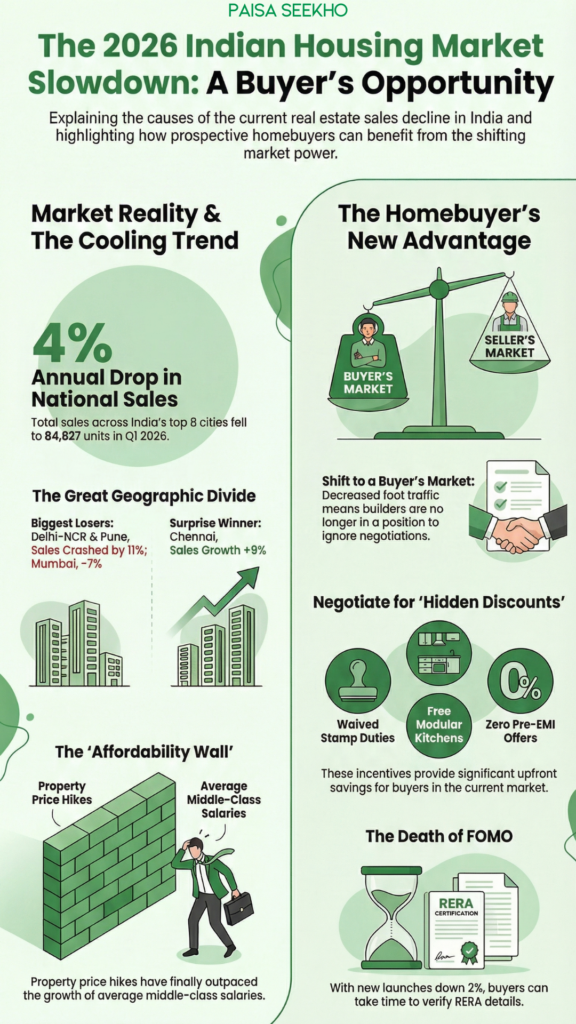
To truly understand the slowdown, we cannot look at India as one single market. Real estate is highly localized. The Knight Frank report reveals a fascinating divide between the expensive “Mega-Metros” and the growing tech hubs.
The Markets Facing Severe Declines
The cities that saw the most aggressive price hikes over the last three years are now facing the sharpest corrections in buyer demand:
- Delhi-NCR: The National Capital Region took a massive hit, with sales plummeting by 11% annually, down to 12,734 units. Overpriced luxury segments and stalled infrastructure projects have cooled buyer enthusiasm.
- Pune: Mirroring Delhi, Pune also saw an 11% drop, with sales falling to 12,711 units.
- Mumbai: The undisputed king of expensive real estate saw its sales drop by 7%, falling to 23,185 units. Even with new infrastructure like the Metro Line 9 opening, the base cost of a 2BHK is pushing average salaried professionals completely out of the city limits.
The Cities Bucking the Trend
Interestingly, the southern and eastern markets are still showing resilience, largely driven by stable IT sector hiring and relatively better pricing compared to Mumbai or NCR:
- Chennai: Saw the highest growth, jumping 9% to 4,763 units.
- Bengaluru: The tech capital grew by 5%, selling 13,092 units.
- Kolkata: Also recorded a solid 5% growth, hitting 4,043 units.
- Ahmedabad and Hyderabad: Saw mild, stable growth of 2% and 1%, respectively.
Reason 1: The Affordability Wall
So, why did sales drop so aggressively in the biggest markets? According to Shishir Baijal, Chairman & Managing Director of Knight Frank India, the market is facing “growing pressure on affordability.”
For the last three years (2023 to 2025), the Indian real estate market was on an absolute tear. Builders were increasing prices by 10% to 15% every single year. For a while, buyers absorbed these price hikes because their post-pandemic salaries were growing and interest rates were somewhat manageable.
But in early 2026, the market hit a brick wall.
Salaries are no longer growing at 15% a year. If a 2BHK flat in Gurugram or Mumbai jumps from ₹1.5 Crore to ₹2 Crore in just 24 months, the required down payment and the monthly EMI completely detach from reality for a normal corporate employee.
Buyers have simply reached their mathematical limit. They want to buy houses, but the banks will not approve the massive loans required to match the builders’ inflated prices. This forced affordability crisis is the primary reason foot traffic in sales offices has dropped.
Reason 2: The Shockwave of the Iran War
Real estate is not just about bricks and mortar; it is highly dependent on buyer psychology. You do not sign a contract for a 20-year home loan if you are terrified about the future of the economy.
In early 2026, the geopolitical conflict in West Asia (specifically involving Iran) escalated severely. As we have discussed in previous articles, this war disrupted global shipping routes, causing crude oil prices to spike.
This global chaos directly poisoned Indian homebuyer sentiment:
- The Inflation Fear: When oil prices spike, domestic inflation rises. Buyers know that if inflation stays high, the Reserve Bank of India (RBI) will likely increase home loan interest rates, making their EMIs much more expensive.
- Stock Market Losses: Many affluent buyers rely on their mutual fund portfolios to fund their massive real estate down payments. With the Indian stock market experiencing severe, war-induced volatility, much of that paper wealth temporarily vanished, forcing buyers to delay their property purchases.
As Baijal noted, this “volatile geopolitical situation has also resulted in subdued interest,” as buyers prefer to hold onto liquid cash rather than lock it into an illiquid asset during a global crisis.
Reason 3: Natural Market Consolidation
It is important not to panic. A 4% drop does not mean the real estate market is going to crash to zero.
Experts point out that this slowdown is actually a very healthy, natural “consolidation phase.” Real estate operates in cycles. You cannot have explosive, double-digit sales growth every single quarter for ten years straight. After the massive buying frenzy of the last few years, the market needs a breather to digest the high prices and clear out existing inventory.
In fact, developers themselves are recognizing this shift. The Knight Frank data shows that the launch of new housing supply also fell by 2% (down to 94,855 units). Builders are deliberately slowing down the construction of new towers to ensure they do not flood the market with empty apartments, which helps keep property prices relatively stable even as sales drop.
What Does This Mean for You?
If you are a prospective homebuyer sitting on the sidelines in 2026, this slowdown is actually the best news you have had in years.
1. The End of Builder Arrogance
During the boom years, builders had all the power. They refused to negotiate on price, demanded massive upfront payments, and treated buyers poorly because there were 10 other people waiting in line to buy the same flat.
With sales dropping 11% in markets like NCR, the power is slowly shifting back to the buyer. You now have room to negotiate.
2. Expect Better Offers, Not Massive Price Cuts
Do not expect builders to suddenly slash their sticker prices by 20%. Builders hate officially lowering prices because it angers their past buyers. Instead, expect them to offer aggressive “hidden discounts.” You will likely start seeing offers like:
- “Free modular kitchen and ACs included.”
- “Zero stamp duty and registration fees.”
- “No pre-EMI until possession.”
These offers save you lakhs of rupees in upfront costs without the builder having to lower the official per-square-foot rate of the property.
3. Take Your Time
The fear of missing out (FOMO) is dead. You no longer need to rush and sign a booking cheque on your first site visit because you are terrified the flat will be gone tomorrow. Take your time, verify the RERA registration carefully, negotiate aggressively, and ensure the EMI fits comfortably within your household budget before committing.
Conclusion: A Healthier Market Ahead
The April 2026 data from Knight Frank confirms that the Indian housing market has finally stepped off the accelerator. While the toxic combination of extreme price inflation and global geopolitical anxiety has temporarily frozen the massive markets of Mumbai, Delhi, and Pune, this slowdown is a necessary medicine.
It forces builders to stop blindly raising prices and forces the market to return to realistic valuations. If you are an investor looking to flip a property in six months for a massive profit, the current environment is highly dangerous. But if you are a genuine end-user looking to buy a home for your family to live in for the next decade, the power balance has finally tilted in your favor.
Frequently Asked Questions (FAQs): Indian Housing Market Slowdown 2026
Q1: Did property prices drop in Q1 2026?
Not necessarily. The Knight Frank report highlighted that sales volume (the number of houses sold) dropped by 4%. Property prices have not crashed yet, but the aggressive price hikes by builders have stalled, and buyers are now able to negotiate better deals.
Q2: Why did housing sales drop so heavily in Delhi-NCR and Pune?
These markets saw some of the most aggressive price inflations over the last three years. The prices simply hit an “affordability wall,” meaning the average salaried professional could no longer qualify for the massive home loans required to buy properties at these inflated rates.
Q3: Is the real estate market crashing?
No, a 4% drop in sales is a correction, not a crash. Real estate experts view this as a natural “consolidation phase” following a multi-year boom. It is a healthy cooling-off period that prevents the market from turning into a dangerous, speculative bubble.
Q4: How does a war in Iran affect Indian real estate?
The war causes global crude oil prices to spike, which drives up domestic inflation in India. High inflation forces the RBI to keep interest rates high. When home loan interest rates are high, EMIs become too expensive, causing buyers to delay purchasing a house.
Q5: Why did sales grow in Chennai and Bengaluru while Mumbai fell?
Real estate is highly localized. Markets like Bengaluru and Chennai did not see the extreme, irrational price spikes that Mumbai and NCR experienced. Their property prices remain relatively affordable for the local IT workforce, allowing sales momentum to continue.
Q6: Are builders still launching new housing projects?
Yes, but at a slower pace. The report showed that new housing supply launches fell by 2% in Q1 2026. Builders are intentionally slowing down new construction to focus on selling their existing, unsold inventory.
Q7: Is this a good time to buy a house in India?
If you are an “end-user” (buying to live in it), this is a great time to hunt for deals. Because builders are facing a slowdown in sales, you have much more negotiating power to demand freebies, stamp duty waivers, and better payment plans.
Q8: Will home loan interest rates go down in 2026 to help sales?
It is highly unlikely in the short term. Because the West Asia conflict is threatening to increase inflation, the Reserve Bank of India (RBI) is expected to keep the Repo Rate high. Home loan EMIs will likely remain expensive throughout most of 2026.
Q9: What should I negotiate for since builders won’t lower the base price?
If a builder refuses to drop the per-square-foot rate, negotiate on “soft costs.” Ask them to waive the Floor Rise Charges (PLC), demand free parking space, ask them to absorb the Stamp Duty costs, or ask for a fully furnished interior package.
Q10: Should I wait another year for prices to crash further?
Trying to “time” the real estate market is very risky. Because India has a massive housing shortage and a growing population, a complete collapse in property prices is highly improbable. If you find a house you love from a reputable builder, and the EMI is less than 35% of your in-hand salary, it is usually better to buy and negotiate hard today rather than waiting indefinitely.