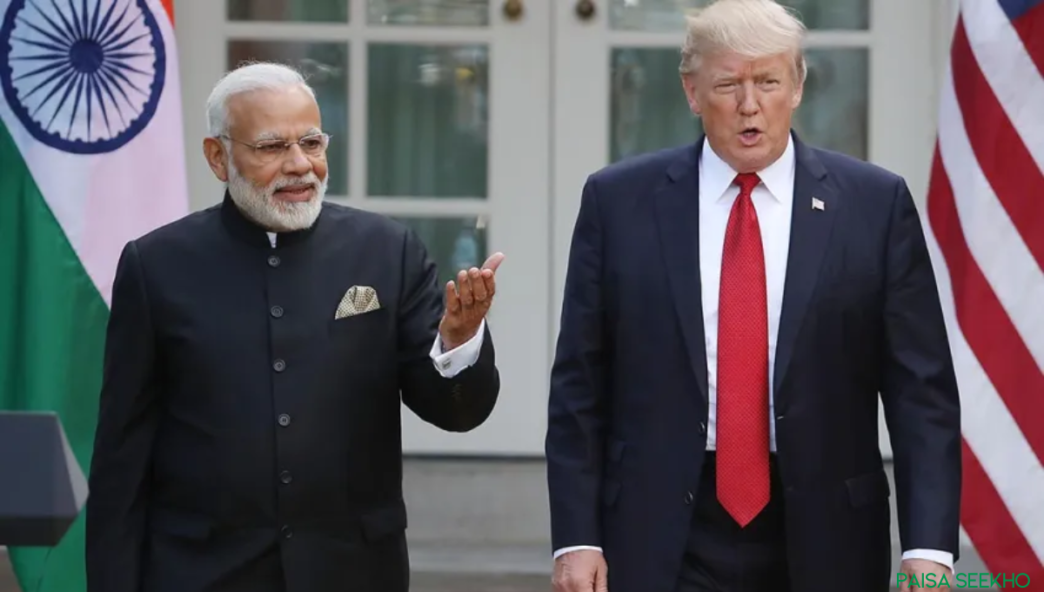
If you checked your stock portfolio this morning, you probably saw a sea of green. The Sensex surged over 3,600 points, and the Nifty jumped nearly 5%, a historic rally that has investors buzzing. The reason? A game-changing phone call between Prime Minister Narendra Modi and US President Donald Trump that resulted in a sudden and massive India-US trade deal.
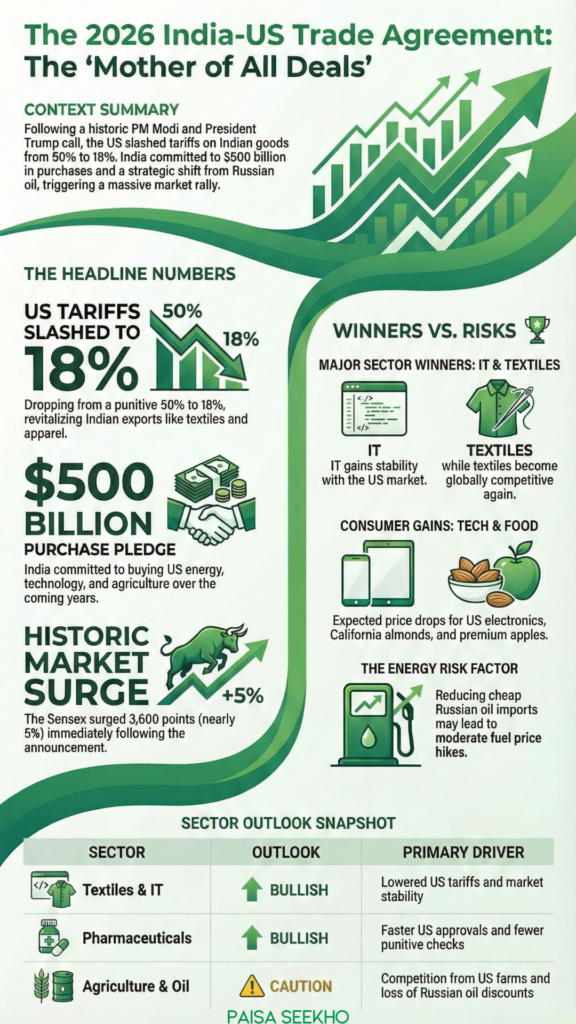
For the past year, trade tensions had been high. Tariffs were climbing, and uncertainty was the only certainty. But in a move that surprised global analysts, the US announced a dramatic slash in tariffs on Indian goods, dropping them from a punishing 50% to just 18%.
But as with any financial news, the headlines only tell half the story. What did India give in return? Will your petrol bills go up if we stop buying Russian oil? Will iPhones finally get cheaper? And most importantly, how does this affect the paisas in your pocket?
In this comprehensive guide, Paisaseekho breaks down the “Mother of All Deals”, from the fine print to the impact on your job, your investments, and your monthly budget.
1. The Deal at a Glance: What Just Happened?
To understand the impact, we first need to look at the raw numbers. This agreement isn’t just a handshake; it’s a structural shift in how the world’s largest democracy trades with the world’s largest economy.
The Headline Numbers
- US Tariffs on Indian Goods: Slashed from roughly 50% (25% reciprocal + 25% punitive) to a flat 18%.
- India’s Commitment: India has agreed to lower its trade barriers and tariffs on US goods (Trump claims to “ZERO,” though details are evolving).
- The Russian Oil Condition: A critical part of the deal is India agreeing to stop or significantly reduce buying crude oil from Russia.
- The $500 Billion Pledge: India has committed to purchasing $500 billion worth of US energy, technology, agriculture, and coal over the coming years.
Paisaseekho Insight: Think of this as a “bulk discount” deal. India promised to buy more from the US (energy and tech) and stop buying from a competitor (Russia), and in exchange, the US lowered the entry fee (tariffs) for Indian products.
2. Impact on the “Aam Aadmi”: Your Wallet and Daily Life
Macroeconomics often feels distant, but this deal has direct pipelines to your household budget. Here is how the average Indian will feel the ripples of this agreement.
A. Will Petrol and Diesel Prices Rise?
This is the biggest worry. For the last few years, India managed to keep fuel prices relatively stable by buying discounted oil from Russia.
- The Risk: If India stops buying cheap Russian oil as per the deal, our refineries (like Reliance, IOCL) will have to buy more expensive oil from the US or the Middle East.
- The Offset: A stronger Rupee (which appreciated significantly after the deal) makes buying foreign oil cheaper.
- Verdict: There is a moderate risk of fuel price hikes in the short term, unless the government cuts domestic excise duties to cushion the blow.
B. Cheaper American Goods?
If India indeed lowers tariffs on US imports “to zero” or near-zero levels, we could see price drops in several aspirational categories:
- Electronics: High-end laptops, certain smartphone components, and gadgets imported from the US could see price corrections.
- California Almonds & Apples: Agriculture is a big part of this deal. US walnuts, almonds, and apples, staples in many Indian households, could become significantly cheaper.
- Premium Bikes (Harley Davidson): A long-standing demand from the US has been lower duties on motorcycles. This might finally happen.
C. Job Creation and Security
This is the biggest win for the common man.
- Textile & Apparel Workers: The 50% tariff was killing Indian textile exports, with business shifting to Vietnam and Bangladesh. The drop to 18% breathes new life into hubs like Tiruppur, Surat, and Ludhiana, securing lakhs of jobs.
- IT & Services: With trade tensions easing, the fear of a “visa crackdown” or “outsourcing ban” reduces. The US remains the biggest client for Indian IT; a friendly relationship means better job security for software engineers.
3. Sector-by-Sector Analysis: Who Wins, Who Loses?
Investors, pay attention. The stock market reaction wasn’t random; it was a calculated bet on specific sectors that stand to gain billions.
The Big Winners
1. Information Technology (IT)
- Why: The US accounts for 60-70% of revenue for Indian IT giants. The deal signals stability.
2. Textiles and Garments
- Why: This sector was gasping for air under high tariffs. An 18% rate makes Indian sheets, towels, and clothes competitive again against China and Vietnam.
- Impact: Expect revival in export volumes immediately.
3. Pharmaceuticals
- Why: The US is the largest market for Indian generic drugs. Lower trade barriers mean faster approvals and fewer “punitive” checks, allowing Indian pharma to dominate the US healthcare supply chain.
4. Auto Ancillaries (Car Parts)
- Why: India is becoming a global hub for auto components. US carmakers (GM, Ford) buying more Indian parts fits the “diversify away from China” narrative.
The Mixed Bag / Potential Losers
1. Domestic Agriculture (Dairy & Soy)
- The Risk: If India opens its doors to US dairy products and soybeans, Indian farmers could face stiff competition from highly subsidized American corporate farms. This is a politically sensitive area that the government will need to navigate carefully to protect the kisan.
2. Oil Marketing Companies (OMCs)
- The Risk: While they gain from a stronger Rupee, the loss of “cheap Russian crude” margins could hurt their profitability unless they pass the cost to consumers.
4. Geopolitics Meets Economics
Why did this deal happen now? Understanding the geopolitics helps us predict if the deal will stick.
- The “China Plus One” Strategy: The US is desperate to reduce reliance on China. By lowering tariffs for India, the US is essentially saying, “We want India to be our factory, not China.”
- Isolating Russia: By forcing India to ditch Russian oil, the US achieves a major foreign policy goal, cutting off Putin’s revenue stream. For India, this is a strategic pivot back towards the West after a year of balancing acts.
- The EU Factor: India just signed a massive trade deal with the European Union days earlier. The US likely feared missing out on the Indian market, prompting Trump to close the deal quickly.
5. Investment Guide: How to Position Your Portfolio
Disclaimer: This is for educational purposes. Always consult a SEBI-registered financial advisor.
With the Sensex at an all-time high, is it too late to enter? Not necessarily. Here is a PaisaSeekho Strategy for this new market environment:
A. Look for “Export-Oriented” Mutual Funds
Funds that focus on IT, Pharma, and Manufacturing are the direct beneficiaries. The “Make in India, Sell to America” theme is back in vogue.
B. Don’t Ignore Energy
India has pledged to buy $500 billion in US energy. Companies involved in Green Energy collaborations with the US, as well as those building LNG (Liquid Natural Gas) terminals to receive American gas, will see massive growth.
C. The Rupee Play
A stronger Rupee is bad for exporters (technically) but great for companies with high Dollar Debt. Companies that borrowed heavily from abroad will now find it cheaper to repay their loans. Look for heavy-debt infra companies that might see their balance sheets improve.
6. Risks and The Fine Print: What Could Go Wrong?
At Paisaseekho, we believe in looking at the coin’s other side. Here are the risks you must know:
- The “Trump Card” Volatility: The deal was announced via social media. US policy under President Trump can be unpredictable. If the US feels India isn’t buying enough American goods, tariffs could snap back up.
- Implementation Lag: “Immediate” in politics often means months of paperwork. Exporters might face confusion at customs until the official notifications are generated.
- The Russian Reaction: How will Russia react to India stopping oil purchases? India still relies on Russia for 60% of its defense equipment. If Russia delays S-400 parts or submarine tech in retaliation, India’s defense readiness could face challenges.
7. Conclusion: A New Era or Just a Relief Rally?
The India-US trade deal of 2026 is undeniably a historic turning point. It pulls India firmly into the Western economic orbit and offers a massive boost to our manufacturing ambitions (“Viksit Bharat”).
For the Common Man, the immediate joy is a booming stock market and job security in export sectors. The long-term worry is the cost of energy. For the Country, it is a bold bet that the US market offers more prosperity than Russian oil offers savings.
The Paisaseekho Verdict: Optimism is warranted, but keep an eye on petrol prices and the fine print on agriculture. This deal is a “Buy” signal for India’s manufacturing story, but a “Hold” for those worried about inflation.
Key Takeaways for the Reader (Summary)
| Category | Impact | Actionable Advice |
| Investors | Bullish | Focus on IT, Pharma, Textiles, and Auto Ancillaries. |
| Job Seekers | Positive | Better hiring prospects in MNCs and Export hubs. |
| Consumers | Mixed | Potential for cheaper electronics; risk of higher fuel prices. |
| Farmers | Caution | Watch out for US imports of almonds, apples, and dairy. |
Frequently Asked Questions (FAQs)
Q1: Will the India US Trade Agreement reduce the price of the iPhone 17 in India?
Ans: Likely, yes. If India reduces import duties on US technology components and finished goods as per the “Reciprocal” clause, the price of US-branded electronics could drop.
Q2: I am a student planning to study in the US. Does the India US Trade Agreement help me?
Ans: Indirectly, yes. Improved trade ties usually lead to better visa processing and warmer diplomatic relations, potentially smoothing the path for H1-B and F-1 visas.
Q3: Why is the stock market going up so much after the India US Trade Agreement?
Ans: The market hates uncertainty. This deal removes the fear of a “Trade War” and promises higher profits for India’s biggest companies (Reliance, TCS, Infosys), driving the index up.
Q4: Is the India US Trade Agreement final?
Ans: The tariff cut to 18% is effective immediately. However, the details of India’s $500 billion purchase and the “Zero Tariff” promise from India will be worked out over the coming months.