

TL;DR: Key Takeaways on the New Demat Transfer Rules
If you are short on time, here is the absolute quickest summary of the new SEBI guidelines:
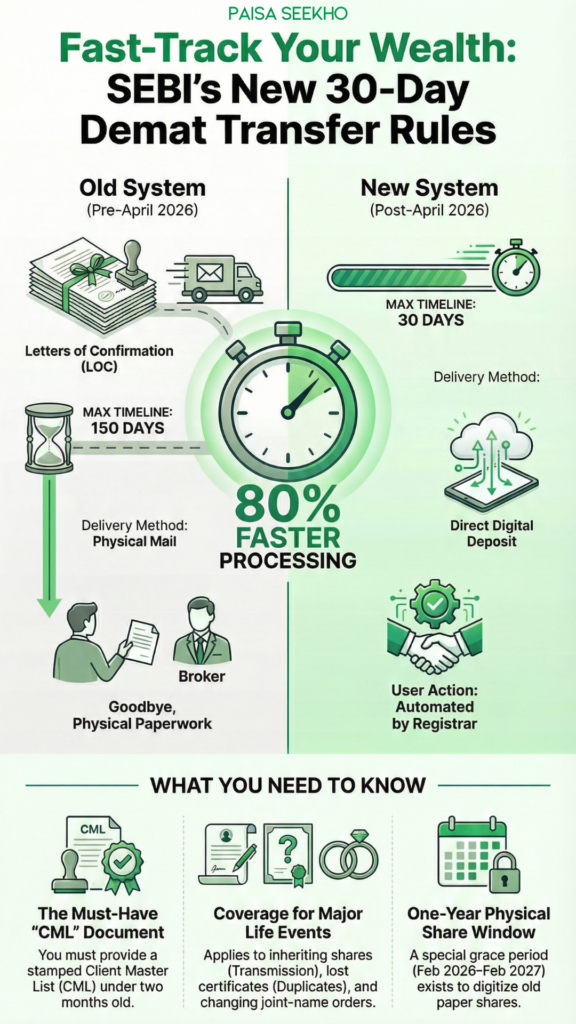
- The Massive Time Cut: The process of getting shares credited to your Demat account for specific service requests has been reduced from roughly 150 days to a strict limit of 30 days.
- Goodbye, Letter of Confirmation (LOC): SEBI has permanently deleted the old rule that required companies to issue a physical “Letter of Confirmation.”
- Direct Digital Transfers: Companies and their Registrars (RTAs) will now directly credit the shares into your digital Demat account without making you act as a middleman.
- What This Applies To: This new fast-track rule applies to getting duplicate shares, “Transmission” (inheriting shares after a death), “Transposition” (changing the order of joint names), and claiming shares from suspense accounts.
- The Magic Document (CML): To use this fast process, you must provide a “Client Master List” (CML) from your broker. The document must be officially stamped and cannot be more than two months old.
- Effective Date: This new framework officially goes live on April 2, 2026.
Introduction
If you have ever tried to inherit shares from a family member who passed away, or if you have ever tried to get a lost physical share certificate replaced, you already know the pain. Dealing with stock market paperwork can sometimes feel like standing in an endless, unmoving line at a government office.
For years, investors have complained about how slow the system was. You would submit your documents to a company, and then you would wait. And wait. And wait some more. In many cases, it would take up to 150 days—nearly five entire months—just to see those shares finally show up in your Demat account.
The Securities and Exchange Board of India (SEBI), which acts as the strict police force and regulator of the Indian stock market, has finally heard these complaints. In a massive move designed to protect retail investors and cut out useless red tape, SEBI has officially rewritten the rulebook.
Starting April 2, 2026, the time it takes to transfer these types of securities into your Demat account has been legally slashed from 150 days down to a maximum of just 30 days.
If you or your family members have old shares, or if you ever need to transfer wealth to the next generation, this new rule is a game-changer. This comprehensive, jargon-free guide will explain exactly what this new SEBI rule means, how the old “Letter of Confirmation” system has been thrown in the trash, and what you need to do to take advantage of this new high-speed process.
1. Why Did Transfers Take 150 Days?
To understand how great this new rule is, we first have to understand why the old system was so painfully slow.
Imagine your grandfather bought shares in a famous Indian company 20 years ago. When he passes away, you are the legal heir, and you want to transfer those shares into your own modern Demat account (an online account that holds shares digitally, like Zerodha or Upstox). This process is called “Transmission.”
In the past, you would gather all the death certificates and legal papers and send them to the company’s Registrar and Transfer Agent (RTA). The RTA is the company hired to keep track of who owns what shares.
Here is what the old process looked like:
- The RTA would take weeks to verify your documents.
- Once verified, the RTA would print out a physical piece of paper called a “Letter of Confirmation” (LOC).
- They would mail this LOC to your house via post.
- You would then have to take this physical LOC paper and submit it to your own stockbroker (your Depository Participant, or DP).
- Your broker would then scan it, verify it, and send a request back to the depository (CDSL or NSDL) to finally credit the shares to your account.
Because the shares were bouncing between the company, the post office, you, the broker, and the depository, the entire cycle could easily drag on for 150 days. If a single piece of paper got lost in the mail, you had to start the whole nightmare all over again.
2. The New SEBI Rule: The Era of Direct Credit
SEBI looked at this 150-day process and realized that in the modern age of digital banking and instant UPI payments, relying on a physical piece of paper in the mail was completely ridiculous.
SEBI has officially eliminated the Letter of Confirmation (LOC).
Starting April 2, 2026, the entire process becomes a direct, digital highway. Here is how the new process works:
- You submit your legal documents to the RTA.
- The RTA verifies your documents.
- The RTA directly credits the shares into your digital Demat account.
That’s it. There is no letter in the mail. There is no running to your broker’s office. Once the RTA confirms you are the rightful owner, they push a button, and the shares appear in your portfolio.
Because they removed the middle steps, SEBI has legally mandated that the RTA must complete this entire process within 30 days of receiving your valid documents.
3. What Situations Does This New 30-Day Rule Apply To?
It is important to understand that this rule does not apply to regular, everyday stock market trading. If you buy shares on the stock market today, they already hit your account the very next day.
This new 30-day rule specifically applies to “Investor Service Requests.” These are administrative tasks, usually involving older shares or major life events. Here is the exact list of situations where the new fast-track rule applies:
1. Transmission (Inheriting Wealth)
This is the most common use case. When a shareholder passes away, their shares must be transferred to the legal heir or the nominee. Grieving families used to have to fight with RTAs for months. Now, once the death certificate and legal heir documents are submitted, the inherited wealth will be safely deposited into the family’s Demat account within 30 days.
2. Issue of Duplicate Share Certificates
If you or your parents accidentally lost, burned, or destroyed old physical paper share certificates, you have to apply for duplicates so they can be converted into digital form. Under the new rules, the RTA will not issue new paper certificates. Instead, they will instantly generate the replacement shares in digital form and credit them directly to your Demat account.
3. Transposition (Changing Name Orders)
Sometimes, shares are held jointly by two people (for example, “Rahul Sharma and Priya Sharma”). If you want to change the order of the names on the official record to “Priya Sharma and Rahul Sharma” for tax or banking reasons, this is called Transposition. This change will now be reflected digitally in 30 days.
4. Unclaimed Suspense Accounts
If a company tried to send shares to an investor, but the investor’s account was frozen or the address was wrong, those shares get locked in an “Unclaimed Suspense Account.” If you discover that your old shares are stuck in one of these accounts, you can claim them and get them directly credited to your active account within the new 30-day window.
5. Corporate Actions
Sometimes, companies go through complex restructuring, like splitting their shares or merging with another company. If there is an issue with crediting the new shares to investors during these corporate events, the new direct-credit rules will apply to resolve the errors quickly.
4. The Document You Need: The Client Master List (CML)
Because SEBI is allowing the RTA to deposit valuable shares directly into your account without asking for a final confirmation letter from you, the RTA needs absolute proof that your Demat account actually exists and truly belongs to you.
To provide this proof, SEBI requires you to submit a very specific document alongside your request. It is called the Client Master List (CML), sometimes called a Client Master Report (CMR).
What is a CML?
Think of a CML as the “Aadhaar Card” or the “Bank Passbook” of your Demat account. It is a highly official, comprehensive document generated by your stockbroker (like Zerodha, Groww, HDFC Securities, or Angel One).
The CML contains all your vital statistics:
- Your 16-digit Demat Account Number (DP ID and Client ID).
- Your exact legal name and date of birth.
- Your linked bank account details.
- Your linked PAN and Aadhaar numbers.
- Your current address and nomination details.
The Two Strict Rules for the CML
If you are submitting a request to an RTA for a 30-day transfer, your CML must meet two very strict conditions:
- It Must Be Fresh: The CML document cannot be more than two months old. If you submit an old CML you downloaded last year, the RTA will reject your application immediately.
- It Must Be Attested: The CML must be officially stamped and signed by your Depository Participant (your broker). Most modern brokers allow you to download a digitally signed CML directly from their mobile app, which is fully accepted by the RTAs.
When the RTA receives your fresh, stamped CML, they know exactly where to send the digital shares, eliminating any chance of the shares accidentally going to the wrong person.
5. Security and Safety: Will Faster Transfers Lead to More Fraud?
Whenever the government speeds up a financial process, a very valid question arises: If they are cutting out steps, is it less safe? Could a scammer use this 30-day rule to steal my grandfather’s shares?
The answer is no. SEBI has designed this new framework to actually eliminate the most common types of fraud.
Under the old system, the RTA mailed a physical Letter of Confirmation (LOC) to your house. Physical mail is highly vulnerable. A thief or a dishonest relative could steal that LOC out of your mailbox, forge your signature, and attempt to divert the shares into their own account.
By destroying the physical LOC, SEBI has closed that security loophole.
Under the new system, the RTA communicates directly with the secure, heavily encrypted depository system (CDSL or NSDL). The RTA takes the exact 16-digit account number from your verified CML and pushes the shares digitally. Furthermore, once the shares are successfully credited, the depository instantly sends an automatic SMS and Email alert directly to your registered mobile phone, notifying you that the transfer is complete.
It is faster, paperless, and significantly safer than relying on the postal service.
6. The Bonus Announcement: The One-Year Special Window for Physical Shares
While SEBI was fixing the digital Demat transfers, they also dropped a massive lifeline for people who are still holding onto ancient, physical paper shares.
Here is the backstory: On April 1, 2019, the government officially made it illegal to transfer or sell physical paper shares. If you wanted to sell a share, you had to convert it into a digital Demat format first. This caused a massive panic. Many older investors had physical shares with minor spelling mistakes on the certificates, or they had bought physical shares decades ago but never officially registered the transfer. Because of the 2019 ban, billions of rupees of wealth became “frozen” in paper form.
The 2026 Special Window
To solve this massive headache, SEBI has opened a “One-Year Special Window” running from February 5, 2026, to February 4, 2027.
If you or your family bought physical shares before the April 2019 ban, but those shares got stuck, rejected, or were never properly processed due to documentation errors, you now have a one-year grace period to fix them.
You can submit your original paper certificates, your old transfer deeds, and your new Client Master List (CML) to the RTA. The RTA is now authorized to forgive the old procedural gaps and directly credit those stuck shares into your modern Demat account.
The Catch: To prevent fraudsters from digging up fake paper shares, SEBI has placed a strict condition on this special window. Any physical shares rescued and converted into digital form during this one-year window will have a mandatory one-year lock-in. This means once the shares hit your Demat account, you cannot sell them, gift them, or pledge them for a loan for exactly 365 days. You just have to let them sit safely in your account.
Conclusion: A Massive Win for the Retail Investor
For decades, the Indian stock market felt like an exclusive club built only for massive corporations and highly aggressive traders. If an average, middle-class family needed help with a basic administrative task, they were buried in paperwork and forced to wait half the year for a resolution.
The new rules effective April 2026 are a clear signal that SEBI is prioritizing the peace of mind of the everyday retail investor.
By slashing the transfer time from 150 days to just 30 days, eliminating the outdated Letter of Confirmation, and forcing companies to use direct digital credits, SEBI has removed a massive wall of anxiety. If you are dealing with the stress of a family member passing away, the last thing you need is a five-month fight with a corporate registrar just to access the wealth that legally belongs to you.
The stock market is finally entering the modern digital age. Make sure your Demat account is active, your mobile numbers are updated for SMS alerts, and your Client Master List is ready. The days of waiting on the postman to deliver your financial future are officially over!
Frequently Asked Questions (FAQs): New SEBI Demat Rules
Q1: What exactly is a Letter of Confirmation (LOC)?
In the old system, an LOC was a physical piece of paper issued by a company’s Registrar. It was essentially a voucher that proved you were entitled to certain shares. You had to physically take this paper to your broker to claim the shares. As of April 2, 2026, SEBI has banned the use of LOCs to make the process completely digital and paperless.
Q2: What happens if I received an LOC paper before April 2, 2026? Is it useless now?
No, do not throw it away! SEBI has provided a grace period. If you were issued a physical LOC before the new rules kicked in on April 2, 2026, that piece of paper remains valid for exactly 120 days from the date it was issued. You can still submit it to your broker to get your shares credited.
Q3: Does the new 30-day limit apply if I buy shares on the regular stock market today?
No. This 30-day rule is specifically for administrative “Investor Service Requests” like inheriting shares (transmission) or getting duplicate certificates for old physical shares. If you just buy shares of Reliance or Tata Motors on your trading app today, they will automatically hit your Demat account by the very next trading day (T+1 settlement).
Q4: How do I get my Client Master List (CML)?
You do not need to call the government to get a CML; you get it from your specific stockbroker (your Depository Participant). If you use a modern app like Zerodha, Groww, or Upstox, you can usually go to your “Profile” or “Account Settings” section and download a digitally signed CML PDF instantly.
Q5: Why does the CML have to be less than two months old?
SEBI instituted this rule as a security measure. People change their bank accounts and addresses frequently. By forcing you to provide a freshly downloaded CML that is less than 60 days old, the RTA is guaranteed to have your most accurate, up-to-date bank and contact information before they transfer massive amounts of wealth to you.
Q6: What does “Transmission” of shares mean?
“Transmission” is the legal financial term for inheriting shares. When the original owner of the shares passes away, the legal process of moving those shares from the deceased person’s Demat account into the Demat account of the legal heir or nominee is called Transmission.
Q7: Who is an RTA in the stock market?
RTA stands for Registrar and Transfer Agent. Massive companies (like Infosys or HDFC) have millions of shareholders. They cannot keep track of them all manually, so they hire an RTA (like KFintech or CAMS) to manage the massive database of who owns exactly how many shares. When you need administrative help, you deal with the RTA, not the company itself.
Q8: Can I convert my grandfather’s old physical paper shares into digital format now?
Yes! SEBI has opened a special one-year window from February 2026 to February 2027. If you have old physical shares and the transfer deeds from before April 2019, you can submit them to the RTA to have them verified and credited as digital shares into your Demat account.
Q9: If I use the special one-year window for physical shares, can I sell them immediately?
No. To prevent fraud and ensure that no one else steps forward to claim the old physical shares, SEBI has placed a mandatory one-year “lock-in” on them. Once the shares are credited to your digital account, you are completely banned from selling or pledging them for exactly 365 days.
Q10: Is there any fee for the RTA to do a direct Demat credit under the new 30-day rule?
Generally, the process of direct credit is free of charge from the RTA’s side, as it is a mandatory regulatory process. However, you may have to pay minor administrative or stamp duty fees depending on the specific legal documentation required for your state (like creating legal heir affidavits or indemnity bonds for inherited shares).