

TL;DR: Key Takeaways on the RBI Margin Rules Delay
If you are short on time, here is the absolute fastest summary of the RBI’s latest announcement:
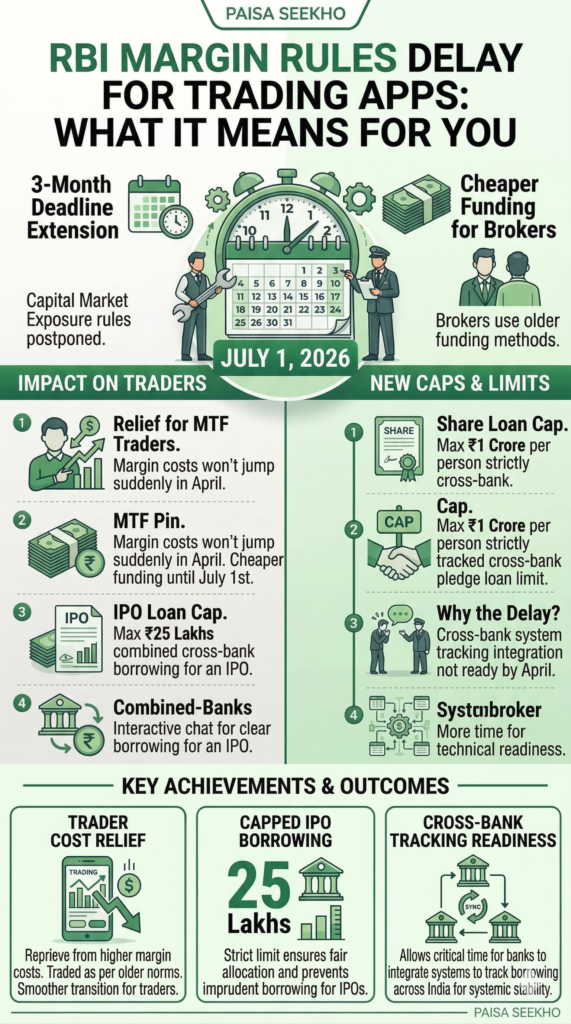
- The Deadline Extension: The RBI has postponed its strict new rules regarding “Capital Market Exposure” by three months. The new deadline is July 1, 2026.
- Relief for MTF Traders: If you trade on margin (borrowing money from your broker to buy shares), your costs will not suddenly jump up in April. Brokers have three more months to use older, cheaper funding methods.
- The IPO Loan Cap: When the rules do kick in, you will only be allowed to borrow a maximum of ₹25 Lakhs across all banks combined to apply for an Initial Public Offering (IPO).
- The Share Loan Cap: If you want to take a loan by pledging your existing shares as security, the maximum limit is capped at ₹1 Crore per person, strictly tracked across the entire banking system.
- Why the Delay? Banks and stockbrokers essentially begged for more time. The new rules require tracking a single customer’s borrowing across every bank in India, and their software systems were simply not ready to do that by April.
Introduction
If you are an active investor who uses trading apps like Zerodha, Groww, Upstox, or Angel One, you might have heard some nervous whispers in the stock market community recently. Everyone was bracing for April 1, 2026. This was the day the Reserve Bank of India (RBI) was supposed to hit the “activate” button on a strict new set of rules that would completely change how borrowed money is used in the stock market.
Many traders who use the “Margin Trading Facility” (MTF) to buy extra shares were terrified that their trading costs were about to skyrocket overnight. Stockbrokers were panicking because they did not have the software ready to follow the new rules.
Then, at the very last minute, the RBI stepped in and hit the pause button.
In a massive sigh of relief for the entire financial sector, the RBI announced a three-month delay. The new rules on “Capital Market Exposure” will now officially take effect on July 1, 2026, instead of April 1.
But what exactly are these rules? Why is the RBI so worried about the stock market, and how will this delay affect the everyday retail trader sitting at home looking at their smartphone portfolio?
In this comprehensive, easy-to-understand guide, we are going to strip away the complex banking jargon. We will explain exactly what margin trading is, why the rules are changing, the new limits on IPO loans, and what you need to do before the new July deadline arrives.
1. Back to Basics: What Exactly is Margin Trading (MTF)?
Before we can understand why the RBI is changing the rules, we have to understand the game that is being played.
Imagine you are looking at your favorite trading app. You see a fantastic company, and you want to buy ₹1,00,000 worth of their shares because you are confident the price will go up. The only problem is, you only have ₹50,000 in your bank account.
Normally, you would just have to buy ₹50,000 worth of shares and go home.
But modern trading apps offer a feature called the Margin Trading Facility (MTF).
Through MTF, the broker basically says: “Give us your ₹50,000, and we will lend you the other ₹50,000 so you can buy the full amount of shares today. You just have to pay us a little bit of interest on the money we lent you.”
It sounds great, right? You get to double your buying power.
However, the broker does not just pull that extra ₹50,000 out of thin air. The broker borrows that massive pile of money from commercial banks. The banks give the brokers huge credit lines, and the brokers pass that money down to retail traders on their apps.
This chain of borrowing money to invest in the stock market is what the RBI calls “Capital Market Exposure.”
2. Why Did the RBI Get Worried? (The Need for New Rules)
The Reserve Bank of India is the supreme guardian of the country’s financial system. Their number one job is to make sure that banks do not do anything foolish that could cause them to go bankrupt and lose the public’s savings.
Over the last few years, the Indian stock market has been booming. Millions of new, young people downloaded trading apps and started buying shares. As excitement grew, more and more people started using MTF to borrow money and place bigger bets.
The RBI looked at this and saw a massive, glowing red warning light.
Here was the danger:
- Banks were lending thousands of crores to stockbrokers.
- Brokers were lending that money to retail traders.
- If the stock market suddenly crashed, the retail traders would lose their money and wouldn’t be able to pay back the brokers.
- The brokers wouldn’t be able to pay back the banks.
- The banks would suffer massive losses.
Furthermore, the RBI realized that the rules were too loose. If an individual wanted a massive loan to apply for a hot new IPO, they could go to Bank A and borrow ₹20 Lakhs, then walk across the street to Bank B and borrow another ₹20 Lakhs. Nobody was talking to each other, and systemic risk was building up rapidly.
To prevent a future disaster, the RBI drafted strict new guidelines in early 2026 to tighten the leash on how much money banks could expose to the unpredictable rollercoaster of the stock market.
3. The Great Escape: Why the Delay to July 1, 2026?
The RBI originally announced these new Capital Market Exposure rules in February 2026 and told everyone they had to be fully compliant by April 1, 2026.
That gave the massive Indian banking and broking industry roughly 45 days to completely rewrite how they do business. Chaos erupted behind the scenes.
The Software Problem
The biggest issue was tracking. Under the new rules, the RBI said that an individual can only borrow a maximum of ₹1 Crore against their shares across the entire banking system.
To enforce this, HDFC Bank, SBI, ICICI Bank, and every other lender needed a centralized software system that talked to each other in real-time to check if “Rahul Sharma” had already borrowed his limit somewhere else. That kind of software integration takes months to build and test safely.
The Broker’s Plea
Secondly, stockbrokers protested the new collateral rules. Under the new guidelines, banks lending money to brokers for proprietary trading required 100% cash or cash-equivalent collateral. Previously, brokers were surviving by providing 50% margin-backed bank guarantees. Changing this funding structure in just a few weeks would have severely choked the daily liquidity of the stock market.
Realizing that forcing the April 1st deadline might accidentally cause the exact financial crash they were trying to prevent, the RBI listened to the feedback. They officially pushed the deadline back by three months, setting the new launch date for July 1, 2026.
4. How the Delay Helps You (The Everyday App Trader)
If you use a trading app, this three-month delay is a massive, direct relief for your wallet.
Let’s talk about the cost of trading. Right now, when you use the Margin Trading Facility (MTF) on apps like Angel One or Motilal Oswal, they charge you an interest rate on the borrowed money, usually around 12% to 18% per year, depending on your broker.
If the RBI had enforced the strict rules on April 1st, banks would have immediately started charging the brokers much higher fees to borrow money, because the collateral rules became stricter.
In the financial world, costs always flow downhill. If the bank charges the broker more, the broker will instantly pass that cost down to you. The interest rate on your MTF trades would have likely spiked, eating heavily into your trading profits.
Because of the delay to July 1st, brokers can continue using their current, cheaper 50% margin-backed bank guarantees. This gives the industry breathing room, preventing sudden fee hikes for retail traders and allowing you to continue your current MTF strategies without interruption for the entire first quarter of the financial year.
5. The ₹1 Crore Cap: Loans Against Shares Explained
When July 1, 2026, finally arrives, the market is going to face some very strict speed limits. One of the biggest changes is regarding “Loans Against Shares” (LAS).
Sometimes, an investor has ₹50 Lakhs worth of great shares (like Tata Motors or Reliance) sitting in their Demat account. They suddenly need ₹20 Lakhs in cash for a medical emergency or a wedding. They do not want to sell their great shares and pay Capital Gains Tax. Instead, they go to a bank, pledge their shares as security, and take a loan.
In the past, wealthy investors abused this system. They would pledge shares at one bank for a massive loan, take that cash, buy more shares, and then pledge those new shares at a different bank for another loan!
The New July Rule:
The RBI has drawn a hard line in the sand. An individual can only borrow a maximum of ₹1 Crore against their shares, InvITs, or REITs.
The crucial clarification the RBI made is that this ₹1 Crore limit is system-wide. You cannot borrow ₹80 Lakhs from SBI and ₹80 Lakhs from HDFC. The moment your combined total across all lenders hits ₹1 Crore, the tap is shut completely.
6. The IPO Bidding Limit: The End of Massive Leverage
If you have been investing in the Indian stock market over the last few years, you know that the Initial Public Offering (IPO) market has been crazy. Whenever a good company launches an IPO, it gets oversubscribed by 100 times, and the stock often doubles on the very first day of listing.
Because it is so hard to get an IPO allotment, wealthy investors started cheating the math. They would go to a Non-Banking Financial Company (NBFC) or a bank, borrow a massive amount of money (like ₹5 Crores), and place a gigantic bid in the High Net-Worth Individual (HNI) category of the IPO to guarantee they got some shares. Once the stock listed and doubled in price, they sold the shares, paid back the loan, and kept a massive profit.
The RBI hates this. It artificially inflates IPO numbers and pushes regular, small retail investors out of the market.
The New July Rule:
When the new rules activate in July 2026, banks and financial institutions will be strictly banned from lending massive amounts for IPOs.
Any loan given to an individual specifically to subscribe to an IPO, an FPO (Follow-on Public Offer), or an ESOP (Employee Stock Ownership Plan) will be hard-capped at exactly ₹25 Lakhs per borrower.
Just like the share loan cap, this ₹25 Lakh limit applies across the entire banking system. You cannot circumvent it by going to multiple banks. This rule will significantly cool down the extreme frenzy in the IPO market and level the playing field for normal retail investors.
7. Fixing the Rules for Company Mergers
While retail traders were focused on MTF and IPOs, the corporate world had its own questions for the RBI regarding “Acquisition Finance.”
Sometimes, a large Indian company wants to buy out a smaller competitor. To do this, they need to borrow hundreds of crores from a bank. The RBI’s original draft rules were highly restrictive about how banks could fund these massive corporate takeovers.
During the delay period, the RBI issued much-needed clarity for the big players:
- The Non-Financial Rule: Banks are now explicitly allowed to lend money to a company to help them acquire another company, but only if the target being acquired is a non-financial business.
- Global Subsidiaries: A major relief was granted to global companies. An Indian parent company can now borrow money from an Indian bank and legally pass those funds down to its subsidiary (whether that subsidiary is in India or abroad) to complete an acquisition.
- Strict Refinancing: However, the RBI added a safety net. If a company takes a loan to buy a business, they cannot “refinance” (replace the loan with a new, cheaper one) until the acquisition is 100% legally completed and they have established total control over the target company.
This clarity ensures that healthy corporate mergers can continue to grow the Indian economy without banks taking on blind, unregulated risks.
8. What Should You Do Before July 2026?
The RBI did not cancel the rules; they just delayed them. July 1, 2026, is coming, and as a smart investor, you need to use this three-month grace period to prepare your portfolio.
1. De-leverage Your Account
If you are currently trading heavily on margin and using MTF to hold massive positions overnight, start winding them down. Do not wait until the last week of June. As the deadline approaches, brokers might proactively start increasing their interest rates or reducing your available margin limits to comply with the new banking realities.
2. Rethink Your IPO Strategy
If you are someone who traditionally relied on heavy borrowing to place massive bids in the HNI category during IPOs, that strategy is officially dead after July. You need to transition your strategy back to standard retail bidding or rely exclusively on your own cash reserves.
3. Check Your Existing Share Loans
If you currently have multiple Loans Against Shares spread across different banks that total more than ₹1 Crore, you need to consolidate or pay down that debt. While existing loans might be grandfathered in until they expire, you will absolutely face rejections if you try to roll them over or apply for new credit lines after the July deadline.
Conclusion: A Safer Highway
Whenever the government introduces strict new rules, the initial reaction of the stock market is always frustration. Nobody likes having their speed limit reduced, especially when the market is making money.
However, the RBI is looking at the bigger picture. A stock market built entirely on heavily borrowed money is like a house built on sand. It looks beautiful when the weather is sunny, but the moment a storm hits, like a global recession or a geopolitical war, the entire house collapses.
The delay to July 1, 2026, is a perfect compromise. It gives the banks and brokers the time they desperately needed to build the proper software and safety nets without causing immediate panic for retail traders. By capping IPO loans, tracking system-wide debt, and demanding better collateral from brokers, the RBI is ensuring that the Indian stock market remains a safe, stable place for everyone to build long-term wealth, rather than a dangerous casino running on borrowed time.
Frequently Asked Questions (FAQs): RBI Margin Rules Delay
Q1: What exactly did the RBI delay regarding the stock market?
The RBI delayed the implementation of its new “Capital Market Exposure” guidelines. These are strict rules dictating how much money commercial banks are allowed to lend to stockbrokers, companies, and individuals for activities connected to the stock market.
Q2: When will the new RBI margin rules actually take effect?
The original deadline was April 1, 2026. The RBI has officially granted a three-month extension, meaning the new rules will now become mandatory on July 1, 2026.
Q3: Why did the RBI decide to push the deadline back?
Banks, stockbrokers, and financial industry groups requested more time. The new rules require tracking a single person’s total borrowing across every bank in India to enforce strict lending caps. The banks simply did not have the software or operational clarity to safely implement this by April 1.
Q4: Will my broker charge me more for Margin Trading (MTF) now?
Not immediately. Because the RBI delayed the rules, brokers are allowed to continue using their current, cheaper funding methods (50% margin-backed bank guarantees) until July. This means your MTF interest rates should remain stable for the next three months.
Q5: What is the new limit for taking a loan against my shares?
When the rules activate in July, the maximum amount any individual can borrow by pledging their shares, REITs, or InvITs will be strictly capped at ₹1 Crore. This limit applies collectively across the entire banking system, not just at one single bank.
Q6: Can I still borrow money from a bank to apply for an IPO?
Yes, but the amount will be heavily restricted. Under the new July 2026 rules, banks can only lend a maximum of ₹25 Lakhs per individual for the purpose of subscribing to an IPO, FPO, or ESOP. This is to prevent wealthy individuals from artificially inflating IPO demand using borrowed money.
Q7: I only buy and hold mutual funds. Does this affect me?
No, absolutely not. These rules are entirely focused on “Capital Market Exposure” and borrowed money (leverage). If you are a standard retail investor who buys stocks or mutual funds using your own saved cash, these rule changes will not affect your investments or your trading app experience at all.
Q8: What changes did the RBI make for companies trying to merge?
The RBI clarified that banks can lend “Acquisition Finance” to an Indian company to buy another company, but only if the target is a non-financial business. They also clarified that companies can use these bank loans to fund their subsidiaries (both in India and abroad) to complete a takeover.
Q9: Why does the RBI care if I borrow money to trade stocks?
The RBI’s job is to protect the banking system. If millions of people borrow money from banks to gamble in the stock market, and the market suddenly crashes, the people cannot pay back the loans. The banks would suffer massive losses, which puts the savings of everyday, non-trading citizens at risk.
Q10: What should a regular trader do before July 1, 2026?
You should use this three-month grace period to review your risk. If you rely heavily on borrowed money (MTF) to hold massive stock positions, you should slowly start reducing that leverage. Prepare for the possibility that your broker might increase interest rates or reduce your available margin limits once the strict rules kick in this July.