
If you are an Indian, you know that “Real Estate” isn’t just an asset class for us. It is an emotion. It is a status symbol and the ultimate proof that you have “settled” in life.
From the moment you get your first job, the pressure starts. Your parents, your relatives, and even your neighbors start asking the same question: “Beta, when are you booking a flat?”
For decades, the path to wealth in India was simple: Save money, take a loan, buy a property, and wait for the price to double. It worked for our parents. It worked for our uncles.
But here is the hard truth that nobody wants to talk about at family dinners: That path is broken for us.
We are living in 2026. The economic landscape has shifted. While India is growing at a robust 7.4%, the cost of buying a physical property has skyrocketed to levels that are frankly depressing for a young earner.
If you are 25 years old, earning ₹35,000 or ₹40,000 a month in a city like Indore, Coimbatore, or Bhubaneswar, buying a house isn’t just difficult, it is mathematically impossible.
But does that mean you can never be a real estate owner? Does that mean you have to miss out on the rent and the appreciation that rich people enjoy?
Absolutely not.
There is a secret door to the real estate market that most people don’t know about. It doesn’t require crores of rupees. It doesn’t require a bank loan, or even require you to visit a registration office.
And it costs less than a large pizza.
In this guide, we are going to talk about REITs (Real Estate Investment Trusts). We will show you how SEBI’s new rules in 2026 have democratized property ownership, allowing you to become a landlord with just ₹300.
If you have been searching for REIT investment India or wondering How to buy REITs in India, you have come to the right place. Let’s unlock the world of “Affordable Real Estate.”
1. The Problem: Why Your “Dream Home” is a Financial Trap
Before we give you the solution, we need to understand the problem. Why are we saying that buying a flat is a bad idea for young earners?
Let’s look at the numbers from the ground level. We are not talking about Mumbai or Delhi (where prices are already insane). We are talking about the “affordable” Tier 2 cities.
The Tier 2 Reality Check
Property prices in growth corridors have surged due to urbanization and infrastructure development.
- Indore: If you want a decent 2BHK in a good area like Nipania or the Super Corridor, you are looking at a price tag ranging from ₹40 lakh to ₹1.35 crore.
- Coimbatore: In Tamil Nadu’s industrial hub, property prices now average ₹5,819 per sq. ft. A standard unit costs between ₹50 lakh and ₹80 lakh.
The Funding Gap (The Math of Misery)
Let’s do the math for a typical young professional, let’s call him Rahul.
- Rahul’s Age: 25
- Monthly Salary: ₹35,000
- Dream House Price: ₹50 Lakh (A modest flat in Coimbatore)
To buy this house, Rahul needs a home loan.
Banks typically give home loans up to 60 times your monthly income.
- 60 x ₹35,000 = ₹21 Lakhs.
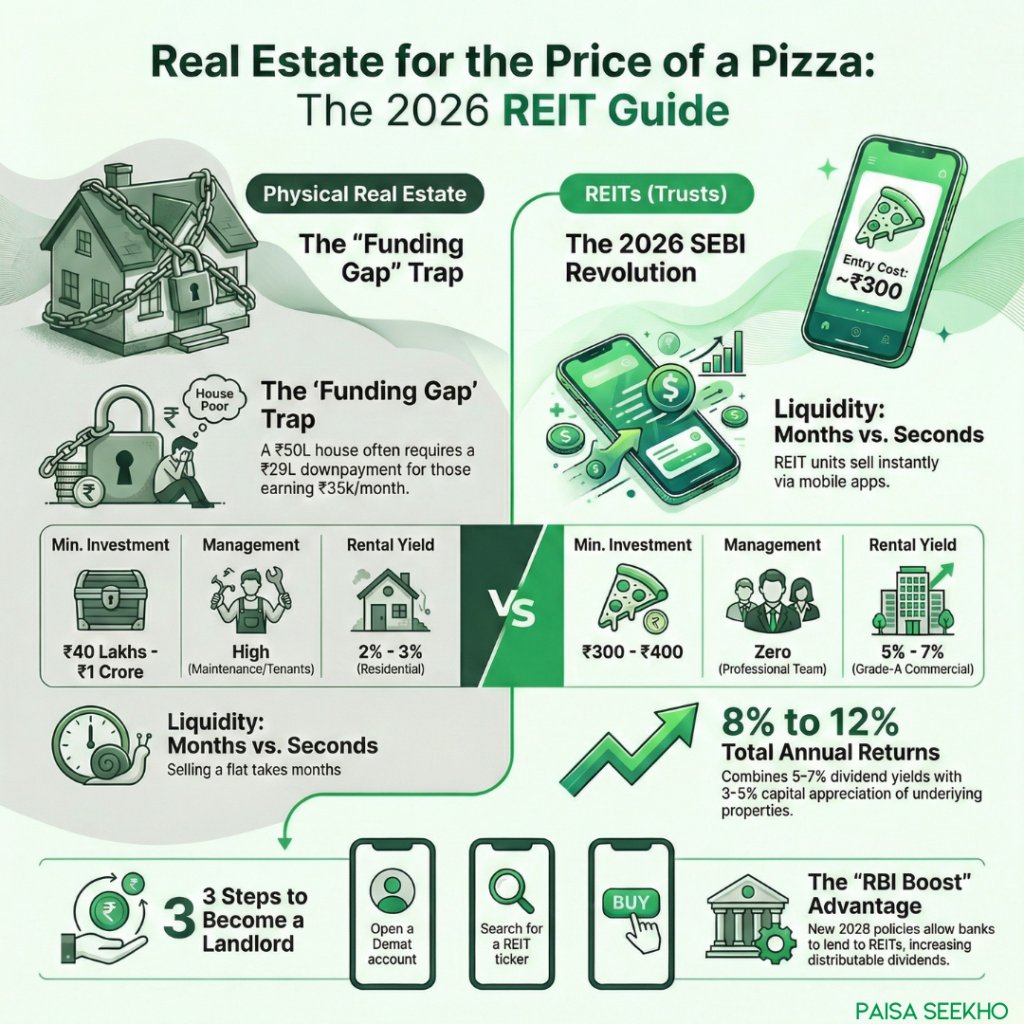
Do you see the problem? Rahul can only get a loan for ₹21 Lakhs. The house costs ₹50 Lakhs. There is a massive funding gap of ₹29 Lakhs.
Even if Rahul somehow borrows money from family to pay the down payment, the EMI on a ₹40 Lakh loan (at 8.5% interest for 20 years) would be roughly ₹35,000 per month.
That is 100% of his salary!
If he takes this loan, he becomes “House Poor.” He will have a house, but he will have zero money for food, travel, emergency funds, or investments. He will be one medical emergency away from bankruptcy.
This is why physical real estate is a trap for young earners in 2026. It destroys your liquidity.
2. The Game Changer: Real Estate for the Price of a Movie Ticket
So, is the dream over? Do you have to wait until you are 45 to invest in property?
No. Because the rules of the game have changed thanks to REIT investment India.
In a pivotal move to help small investors, the Securities and Exchange Board of India (SEBI) has completely revolutionized how we can invest.
The Old Rule:
In the past, if you wanted to invest in a REIT, you had to buy a “lot” of units. Initially, you needed ₹50,000 minimum. Then it came down to ₹10,000-15,000. While better than a flat, it was still a big chunk of money for a college student or a first-jobber.
The New Rule (2026):
SEBI has reduced the trading lot size for REITs and InvITs to just 1 unit.
This is historic. It means that you don’t need to buy a “bundle” of units. You can buy just one single unit. And what is the price of one unit? Depending on the REIT, it usually trades between ₹300 and ₹400.
The Impact:
This implies that an investor can own a piece of a Grade-A office park, where multinational companies like Google, Microsoft, or Accenture have their offices, for the price of a movie ticket.
You are no longer “saving up” to buy property. You are buying property with your pocket money. This is the Real Estate Investment Trust minimum amount revolution we have been waiting for.
3. What is a REIT? (The “Pizza” Analogy)
If you are new to this term, you might be wondering: “What exactly is a REIT?”
Let’s use a simple analogy.
Imagine there is a massive, ultra-luxury office building in Bangalore. It costs ₹1,000 Crores.
Obviously, you cannot buy it. I cannot buy it. Even your rich uncle cannot buy it.
But what if we formed a group?
What if 1 Crore people came together and contributed ₹1,000 each?
Now, the group has ₹1,000 Crores. The group buys the building.
Since you contributed ₹1,000, you own a tiny, fractional share of that building.
Now, imagine IBM rents that building and pays ₹80 Crores in rent every year.
Since you are a partial owner, you get a partial share of that rent.
The group manager takes the rent, deducts a small fee for maintenance, and distributes the rest to all 1 Crore members directly into their bank accounts.
This group is a REIT.
Technical REIT Definition:
A Real Estate Investment Trust (REIT) is a company that owns, operates, or finances income-generating real estate. It is modeled like a Mutual Fund.
- Mutual Funds pool money to buy Stocks.
- REITs pool money to buy Buildings (Offices, Malls, Hotels, Warehouses).
When you buy a unit of a REIT (like Embassy REIT, Mindspace REIT, or Nexus Select Trust), you become a fractional owner of their entire portfolio of assets. You don’t have to worry about finding tenants, fixing leaking taps, or collecting rent. The professional management team does all that. You just sit back and check your bank account.
4. Returns Profile: Why REITs Beat Physical Flats
“Okay,” you say. “It’s cheap to enter. But do I make any money?”
This is where REITs shine. In the current 2026 market, REITs offer a “Total Return” profile that often rivals or beats residential real estate, especially when you factor in the hassle.
REIT returns come from two sources:
Source 1: Dividend Yield (The Rent)
REITs are required by law to distribute 90% of their taxable income to their shareholders. This usually comes in the form of dividends and interest payments.
- Current Yields: Most Indian REITs offer a dividend yield of 5% to 7% per year.
- Payout Frequency: This money is typically distributed to you every quarter (every 3 months) or half-yearly. It acts like a steady passive income stream, similar to rent from a house.
Source 2: Capital Appreciation (The Growth)
Just like the price of a flat goes up over time, the value of the commercial buildings owned by the REIT also goes up.
As the property value increases, the “Unit Price” of the REIT trading on the stock market increases.
- Growth Potential: Historically, commercial real estate appreciates by 5-6% annually.
Total Returns: When you combine the Dividend (5-7%) + Capital Appreciation (3-5%), you are looking at a Total Return of 8-12% annually.
The “RBI Boost” in 2026:
There is another reason why REITs are attractive right now. In a pivotal move, the Reserve Bank of India (RBI) now allows banks to lend directly to REITs.
- Why this matters: Previously, REITs had to borrow at higher interest rates. Now, they can get cheaper loans from banks.
- The Benefit: Lower interest costs for the REIT trust mean they save money. And since they have to distribute 90% of their savings to you, this means higher distributable cash flows (dividends) for the unit-holders.
So, in 2026, you are getting a safer asset, cheaper loans, and better dividends.
5. Comparison: REITs vs. Buying a Flat
Let’s put them head-to-head. If you have some money to invest, should you save for a down payment or buy REITs?
| Feature | Physical Real Estate (Flat/Plot) | REITs (Real Estate Investment Trust) |
| Minimum Investment | ₹40 Lakhs – ₹1 Crore (Huge Loan) | ₹300 – ₹400 (Pocket Change) |
| Liquidity | Very Low. Selling a flat takes months or years. | Very High. Sell in seconds on the app. |
| Asset Quality | Usually Residential (Lower rental yield of 2-3%). | Grade-A Commercial (Higher rental yield). |
| Management | High Headache. Maintenance, tenants, property tax. | Zero Headache. Professionals manage it. |
| Diversification | None. All eggs in one basket (one location). | High. Owns multiple buildings in different cities. |
| Transaction Cost | High (Stamp duty, Registration fees ~5-7%). | Low (Small brokerage fee). |
The Verdict:
For a young earner in a Tier 2 city, Physical Real Estate is a “Concentration Risk.” You are putting all your future earnings into one asset.
REITs offer “Diversification.” With just ₹5,000, you can own a piece of an IT park in Bangalore, a mall in Mumbai, and an office in Noida. It is safer, smarter, and far more flexible.
6. Step-by-Step Guide: How to Buy Your First REIT
Ready to become a landlord? The process is incredibly simple. If you know how to order food on Zomato, you can buy a REIT.
Since REITs trade on the stock exchange (NSE and BSE), buying them is exactly like buying a share of Tata Motors or Reliance.
Step 1: Open a Demat Account
If you don’t have one, open a Demat account with a broker like Zerodha, Groww, Upstox, or Angel One. (It takes 10 minutes and is fully digital).
Step 2: Add Funds
Transfer the amount you want to invest. Remember, the SEBI REIT lot size 2026 is 1 unit. So, even if you transfer ₹500, you are good to go.
Step 3: Search for the Ticker
Go to the search bar of your app and type the name of the listed REITs in India. Currently, some examples of the main ones are the following (this is not investment advice, only a list of REITs as examples for you to understand the concept)
- EMBASSY (Embassy Office Parks REIT)
- MINDSPACE (Mindspace Business Parks REIT)
- BROOKFIELD (Brookfield India Real Estate Trust)
- NEXUS (Nexus Select Trust – Focuses on Malls)
Step 4: Place the Order
- Click on “Buy”.
- Enter Quantity: 1 (or however many you want).
- Select “Market Order” (to buy at current price) or “Limit Order” (to specify your price).
- Click “Confirm”.
Step 5: Check Your Portfolio
Congratulations! Within T days, the REIT units will show up in your Demat holdings. You are now officially a commercial real estate owner. You will start receiving email notifications whenever they announce a dividend distribution.
7. Risks: Is it 100% Safe?
We value honesty at Paisaseekho. No investment is 100% risk-free. While REITs are much safer than buying a random plot of land in an unauthorized colony, they do have risks.
1. Market Volatility:
Since REITs trade on the stock market, their price goes up and down every day. If the market crashes, the REIT price might fall temporarily. However, the underlying asset (the building) is still there, earning rent.
2. Vacancy Risk:
If the IT companies renting the offices leave and the REIT cannot find new tenants, the rental income drops. This means your dividend will drop. However, Indian REITs typically own “Grade A” assets with very high occupancy rates (usually 85-95%).
3. Interest Rate Risk:
Real estate is sensitive to interest rates. If interest rates rise sharply, REIT prices often fall. But with the RBI maintaining a “Neutral” stance and projecting stable inflation, this risk is currently moderate.
Is it Safe for Retail Investors?
Yes. REITs are highly regulated by SEBI. They are required to hold 80% of their assets in completed, rent-generating properties. They are not allowed to take excessive risks with under-construction projects. This makes them a “Defensive” asset class, much safer than buying stocks of small real estate developer companies.
8. The Infrastructure Cousin: InvITs
While we are talking about REITs, we should mention their cousin: InvITs (Infrastructure Investment Trusts).
Just like REITs own buildings, InvITs own infrastructure projects like:
- Highways (collecting tolls)
- Power Transmission Lines (collecting transmission fees)
- Gas Pipelines
With the government allocating a massive ₹12.2 lakh crore to Capex in the 2026 Budget, the infrastructure sector is booming. InvITs (like PowerGrid InvIT or NHAI InvIT) are also available on the stock exchange with small lot sizes. They offer very stable, long-term cash flows backed by sovereign (government) or quasi-sovereign contracts.
If you want to diversify further, you can split your money: 50% in REITs (Offices/Malls) and 50% in InvITs (Highways/Power). This creates a powerful, rent-generating engine for your portfolio.
9. Conclusion: Start Small, Dream Big
The days of waiting for a “jackpot” to invest in real estate are over. The excuse of “I don’t have enough money” is no longer valid.
If you have ₹300 in your pocket, you have enough to start.
The Strategic Wealth Paradigm of 2026 is not about owning a massive house with a massive loan. It is about owning income-generating assets that put money in your pocket, not take it out.
Action Plan:
- Don’t buy a flat just because your relatives say so. Do the math.
- Open your Demat account and look at the REIT options.
- Buy 1 Unit just to test the waters. See how it feels to own a piece of an IT park.
- SIP it: Instead of an EMI, commit to buying 5 or 10 units of REITs every month.
By the time you are ready to settle down, your “Digital Real Estate” portfolio could be paying for your actual house rent!
Welcome to the future of investing. Welcome to democratized wealth.
FAQs
Q: Can I invest in real estate with small money in India?
A: Yes. In 2026, you can invest in real estate with as little as ₹300 to ₹400 through Real Estate Investment Trusts (REITs). SEBI has reduced the minimum trading lot size to 1 unit, making it accessible for small investors to own fractional shares of commercial properties.
Q: What is the minimum lot size for REITs in 2026?
A: The minimum trading lot size for REITs (and InvITs) in India is now 1 unit. This change was introduced by SEBI to democratize access to high-value assets for retail investors.
Q: Are REITs safe for retail investors?
A: REITs are considered a relatively safe investment for retail investors compared to direct property ownership. They are regulated by SEBI and mandated to invest at least 80% of their assets in completed, rent-generating properties. Additionally, they provide diversification across multiple properties and tenants, reducing concentration risk.
Q: How do I buy REITs in India?
A: You can buy REITs through any standard stock trading app (like Zerodha, Groww, or Upstox). They are listed on the NSE and BSE. You simply need a Demat account, search for the REIT ticker (e.g., EMBASSY, NEXUS), and place a buy order for as little as 1 unit.
Q: What returns can I expect from REITs?
A: Investors can typically expect a total return of 8-12% per annum. This consists of a dividend yield of approximately 5-7% (distributed quarterly or semi-annually) and capital appreciation of the underlying property assets of around 3-5%.