

Open your Instagram or YouTube right now. What do you see? You see a 22-year-old “influencer” standing next to a rented luxury car, showing you a screenshot of a ₹50,000 profit made in 10 minutes using “Bank Nifty Options.”
They tell you: “Job kyu karna? Market se kamao!” (Why work? Earn from the market!).
For the last three years, millions of young Indians in Tier 2 and Tier 3 cities, from Surat to Siliguri, have fallen for this trap. You opened Demat accounts, put your hard-earned savings (or your parents’ money) into Futures and Options (F&O), and hoped to become a millionaire overnight.
But Budget 2026 just woke us up from this dream.
With a single announcement, the Finance Minister has made it mathematically almost impossible for small retail traders to win at the “F&O Casino.” The hike in Securities Transaction Tax (STT) is not just a small tweak; it is a loud, clear signal from the government: “Stop Speculating, Start Investing.”
In this blog, we will do the math that the “fin-fluencers” won’t show you. We will calculate exactly how much money you will lose under the new tax rules, and we will show you the real path to wealth that Budget 2026 actually supports.
Part 1: The “F&O Shock” – What Just Happened?
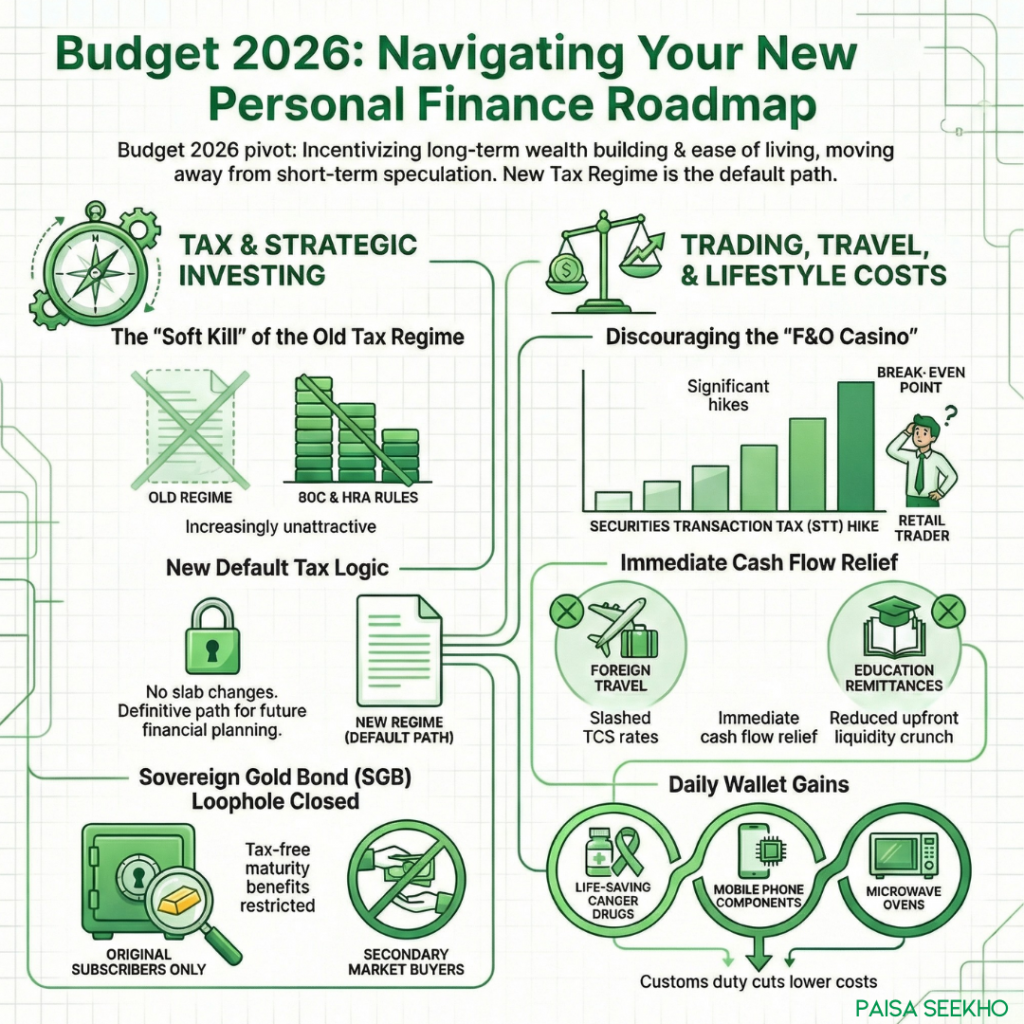
First, let’s look at the cold, hard numbers. The Budget has delivered a significant blow to the rampant speculation in derivatives.
If you trade Futures or Options, your transaction costs just skyrocketed. Here is the breakdown of the new STT rates for the fiscal year 2026-27:
| Derivative Type | Old STT Rate | New STT Rate (Budget 2026) | The Jump |
| Futures | 0.02% | 0.05% | 2.5x (250% Increase) |
| Options (on Premium) | 0.1% | 0.15% | 1.5x (50% Increase) |
| Options Exercise | 0.125% | 0.15% | 1.2x (20% Increase) |
What does this mean in plain English?
Every time you buy or sell, the government takes a cut. Previously, that cut was small enough that you could ignore it. Now, it is a massive chunk of your capital.
The government has seen the data: Young retail traders are losing lakhs of rupees in derivatives. The Economic Survey highlighted the risks of retail capital being wiped out. So, they decided to make the “entry ticket” to this casino much more expensive to discourage you from entering at all.
Part 2: The “Scalper’s Nightmare” – A Real-World Calculation
“But Sir,” you might say, “It’s still just 0.05%. That sounds small!”
Let’s bust this myth with a real-world example. This is for the “Scalpers”, traders who take 10-20 trades a day to capture small price moves.
The Scenario:
Imagine you are a trader in Jaipur. You buy a Nifty Future lot worth ₹10 Lakhs.
You want to make a quick profit of ₹2,000 and exit.
Pre-Budget 2026 Math:
- You buy at ₹10L, sell at ₹10.02L.
- Profit: ₹2,000.
- STT (Old Rate 0.02%): ₹200.
- Net Profit: ₹1,800 (ignoring brokerage/GST for simplicity).
- Verdict: Decent day.
Post-Budget 2026 Math:
- You buy at ₹10L, sell at ₹10.02L.
- Profit: ₹2,000.
- STT (New Rate 0.05%): ₹500.
- Net Profit: ₹1,500.
The “Loss” Scenario (The Real Killer):
Now, imagine you lose money on the trade.
- You buy at ₹10L, sell at ₹9.98L (Loss of ₹2,000).
- Your Trading Loss: -₹2,000.
- STT (You still have to pay it!): -₹500.
- Total Loss: -₹2,500.
The Insight:
The STT hike directly increases your “Break-Even Point”. Previously, if the Nifty moved 5 points in your favor, you made money. Now, Nifty has to move 7-8 points just to cover the taxes. On a high-volume trading day where you take 10 trades, you might pay thousands more in STT regardless of whether you made a profit or a loss.
For a small trader with a capital of ₹50,000, this extra cost will eat your entire capital in a few months. The statistical edge in F&O has just become much harder to maintain.
Part 3: Why Did the Government Do This? (The Nudge)
Many of you are angry. “Why does the government want to stop me from trading?”
The answer lies in the concept of “Behavioral Nudge”. The government wants young Indians to stop treating the stock market as a casino.
The Budget 2026 report argues that the government is actively incentivizing a shift from “speculative” wealth generation to “value-driven” economic participation.
Think about it:
- Trading: You sit in a room, click buttons, and add zero value to the economy. It’s a “Zero-Sum Game” (if you win, someone else loses).
- Investing: You give money to companies (via IPOs or Mutual Funds). Those companies build factories, hire people, and grow the economy. Everyone wins.
The government is telling you: “Pivot from Day-Trading to Skill-Building.”. They want you to use your brain to learn 3D Modeling (Orange Economy) or start a business, not to gamble on Nifty expiry.
Part 4: The “Speculator” vs. The “Smart Saver”
Let’s look at two profiles of young Indians in 2026. Which one are you?
The Budget explicitly favors one and penalizes the other.
| Parameter | The Speculator (Old Habits) | The Smart Saver (Budget 2026 Aligned) |
| Income Source | Salary + F&O Trading | Salary + Freelancing (Orange Economy) |
| Tax Regime | Old Regime (Struggling with proofs) | New Regime (Default, hassle-free) |
| Trading Cost | High (0.15% STT eats profits) | Low (Long-term Equity/SIPs) |
| Mental State | High Stress (Watching charts 24/7) | Peaceful (Automated Wealth Creation) |
| Wealth Trajectory | High risk of capital wipeout. | Compounding Growth. |
Analysis: Budget 2026 penalizes the Speculator significantly through STT hikes. Conversely, it heavily subsidizes the Smart Saver who aligns with government priorities, like long-term investing and upskilling.
If you continue to be the “Speculator” in 2026, you are swimming against the tide.
Part 5: The Alternative – “Swing Trading” & SIPs
Okay, so F&O is dead for small players. Does that mean you should leave the stock market?
Absolutely not.
The Budget is not anti-market. It is anti-gambling. It wants you to stay in the market, but change your strategy.
Strategy 1: Shift to Swing Trading
What is it? instead of buying and selling in 5 minutes (Intraday), you buy a stock and hold it for 5 days, 5 weeks, or 5 months.
- Why it works in 2026: STT on Delivery (buying and holding equity) is much lower than F&O relative to the profit potential.
- The Advantage: You capture bigger moves (e.g., a stock going up 20% in a month) rather than fighting for 10-paise moves in options.
- Tax Benefit: If you hold for more than 1 year, your Long Term Capital Gains (LTCG) tax is favorable compared to the speculative business income tax of F&O.
Strategy 2: The “SIP” Warrior
If you are busy with your job or the new “AVGC Course” you joined (read our previous blog!), you shouldn’t be trading at all.
- The Move: Set up a Systematic Investment Plan (SIP) in a Nifty 50 Index Fund or a Midcap Fund.
- The Math: With the F&O tax hike, the “Probability of Profit” in Mutual Funds is now mathematically superior to trading for 95% of retail participants.
Part 6: Action Plan for Paisaseekho Readers
We know it’s hard to quit. Trading gives an adrenaline rush. But wealth is boring. Here is your detox plan:
1. Stop F&O Trading Immediately.
This is the hardest advice, but the most necessary. The STT hike makes it mathematically very difficult to be profitable. Unless you have a capital of ₹50 Lakhs and advanced hedging strategies, the odds are stacked against you.
2. Redirect Capital to “Real” Assets.
Take the ₹50,000 you kept in your trading account.
- Put 50% into a Mutual Fund SIP.
- Put 25% into Swing Trading (Cash Market).
- Put 25% into Upskilling (Join a course).
3. Use the “Ease of Living” Savings.
The Budget reduced TCS on foreign travel to 2% and made electricity free through Solar Rooftops.
- Don’t spend this saved money. Invest it.
- For a middle-class family, saving ₹2,000/month on electricity and putting it into an SIP can create a corpus of ₹15 Lakhs in 20 years. That is real wealth.
4. Look for the “Budget Themes”.
Instead of trading random stocks, invest in sectors the Budget is pushing:
- Housing Finance Companies: (Benefitting from PMAY Urban 2.0).
- Infrastructure/Railways: (Benefitting from the 7 High-Speed Corridors).
- Renewable Energy: (Benefitting from the Solar push).
Conclusion: Be the Casino Owner, Not the Gambler
The stock market is a wonderful machine for transferring money from the impatient to the patient.
In the last few years, millions of young Indians tried to be the “impatient” ones, hoping F&O would make them rich. Budget 2026 has put up a “Do Not Enter” sign on that door.
It hurts today. But 10 years from now, you might look back and thank this Budget. Why?
Because it forced you to stop gambling away your savings.
It forced you to buy a house (PMAY).
It forced you to learn a skill (AVGC).
And it forced you to become a Long-Term Investor.
The narrative of “Paisaseekho” is empowerment. Real empowerment isn’t guessing where the Nifty will go in the next 5 minutes. Real empowerment is owning a piece of India’s growth story for the next 5 years.
Next Up on Paisaseekho:
We’ve told you how to SAVE money (Housing) and PROTECT money (No F&O). Now, let’s talk about EARNING money. Stay tuned for our next blog on the “Corporate Mitra” scheme!
Frequently Asked Questions (FAQ)
Q1: Does this STT hike apply to Intraday Cash trading too?
Ans: The major hike is specifically for Futures and Options (F&O). Intraday cash equity trading has different STT rates, but the government’s clear intent is to discourage short-term speculation across the board. The safest harbor is “Delivery” based investing.
Q2: I am a full-time trader. Is my career over?
Ans: If you are a profitable full-time trader, you will survive, but your margins will shrink. You will need to adjust your position sizing and stop-losses to account for higher transaction costs. However, if you are a “struggling” trader, this is the sign you needed to quit.
Q3: Can I offset F&O losses against my salary income?
Ans: No. F&O losses are treated as “Business Losses.” They can only be set off against Business Income (speculative or non-speculative), not against Salary. Don’t make the mistake of thinking your trading losses will reduce your tax on your job salary.
Q4: Is Crypto taxed higher too?
Ans: Crypto already faces a stiff 30% tax + 1% TDS. The Budget 2026 focus was tightening the stock market loop. The government effectively wants to treat F&O almost as strictly as Crypto, as a high-risk, “sin” activity that should be taxed heavily.
Disclaimer: This blog is for educational purposes based on the Union Budget 2026-27 analysis. Paisaseekho does not provide investment advice. Please consult a SEBI-registered investment advisor before making financial decisions.