
TL;DR: Key Takeaways on the World Bank GDP Growth Forecast
If you only have two minutes to catch up on the macroeconomic news, here is exactly what you need to know:
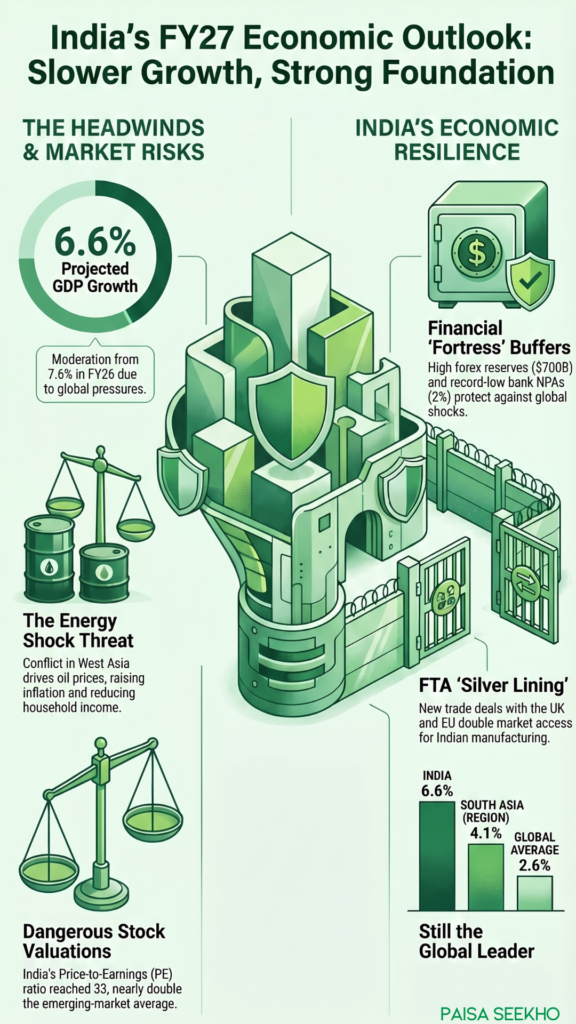
- The New GDP Target: The World Bank projects India’s economy to grow at 6.6% in FY27, moderating from the 7.6% growth in FY26.
- The Energy Threat: The ongoing conflict in West Asia (Iran) is disrupting global energy markets, pushing up crude oil prices. This increases domestic inflation and reduces the disposable income of average households.
- The Equity Warning: The World Bank specifically warned that Indian stock market valuations are dangerously high. The Price-to-Earnings (PE) ratio is at 33, almost twice the emerging-market average, signaling a potential market correction.
- The Silver Lining (FTAs): India recently signed massive Free Trade Agreements (FTAs) with the UK and the European Union, which are expected to double market access and boost manufacturing.
- Still the Global Leader: Despite the slowdown, India’s domestic demand resilience and strong banking buffers ensure it remains the fastest-growing major economy on the planet.
Introduction
Whenever a massive global institution like the World Bank releases an economic report, stock market investors, corporate CEOs, and government officials all hold their breath. This week, the World Bank released its highly anticipated South Asia Economic Update, and the message for India was a fascinating mix of praise and caution.
On one hand, India remains the undisputed crown jewel of the global economy, retaining its title as the fastest-growing major economy in the world. On the other hand, the World Bank officially projected India’s Gross Domestic Product (GDP) growth to decelerate to 6.6% in the upcoming Financial Year 2026-27 (FY27), a step down from the robust 7.6% expansion witnessed in FY26.
Why is the growth engine slowing down? The answer lies outside our borders. A severe energy shock triggered by the escalating conflict in West Asia is combining with dangerously high valuations in the Indian stock market to create a storm of economic headwinds.
If you are an investor, a business owner, or just a citizen trying to understand where the country is headed, this report holds the key. In this simple, jargon-free guide, we will decode the World Bank’s latest findings. We will explain exactly how the West Asia crisis is straining the economy, why your stock portfolio might be at risk of a correction, and the “silver lining” trade deals that are keeping India afloat.
Why Did the World Bank Cut the India Economic Growth 2026 Projections?
To understand the 6.6% growth projection for FY27, we have to look at the massive external forces putting pressure on the Indian economy.
During the last financial year (FY26), India grew at an astonishing 7.6%. This was driven by a post-pandemic consumption boom, massive government spending on infrastructure, and simplified GST structures. However, you cannot drive a car at top speed forever, especially when the road ahead is suddenly covered in debris.
According to the World Bank, the primary roadblock is the “Energy Shock.”
As the geopolitical conflict in the Middle East escalated in early 2026, global crude oil prices became incredibly volatile. Because India imports roughly 85% of its crude oil, this creates a massive, multi-layered problem:
- Rising Production Costs: Factories have to pay more for fuel and transportation, making manufacturing more expensive.
- Eroding Household Incomes: When fuel prices go up, the cost of vegetables, groceries, and daily transport increases (inflation). This leaves the average middle-class family with less money to spend on discretionary items like new cars or smartphones.
- Government Subsidy Burden: To protect citizens from the full impact of expensive oil, the government is forced to absorb the costs by increasing subsidies for cooking fuel and fertilizers. This “ballooning subsidy bill” forces the government to cut back on building new highways or railways to balance the national budget.
Because consumption and government spending are two of the biggest drivers of GDP, this energy shock naturally cools down the overall growth rate to 6.6%.
What Are the Indian Equity Valuation Risks Highlighted by the World Bank?
Perhaps the most alarming part of the World Bank’s update was a very specific, direct warning to Indian retail investors: Be careful with the stock market.
For the last three years, the Indian stock market has been on an unstoppable bull run. Millions of new investors have poured their savings into mutual funds and direct equities, driving the prices of Indian companies to record highs.
The World Bank flagged this as an “area of vigilance.” They noted that Indian equity valuations have become dangerously expensive.
The PE Ratio Warning
To measure how expensive a market is, financial experts use the Cyclically Adjusted Price-to-Earnings (CAPE) ratio.
- The historical, long-run average for the Indian market is a PE of 25.
- According to the World Bank, as of early 2026, the Indian market’s PE ratio had shot up to 33.
To put that into perspective, an average of 33 means Indian stocks are trading at almost twice the valuation of their emerging-market peers (like Brazil or Indonesia). When a market is priced for absolute perfection, any piece of bad news—like prolonged inflation or a delayed interest rate cut by the RBI—can trigger a massive “correction” (a sudden, sharp drop in stock prices). Investors holding highly overpriced stocks need to be incredibly cautious.
How Will the West Asia Conflict Economic Impact Be Buffered by India?
If oil prices are up, inflation is rising, and the stock market is overpriced, why isn’t the World Bank predicting a total recession for India?
Because over the last decade, India has built a financial fortress.
Aurelien Kruse, the Lead Economist for India at the World Bank, pointed out that while the risks are real, India’s macroeconomic buffers are incredibly strong.
- High Foreign Exchange Reserves: India holds massive dollar reserves (nearly $700 billion), allowing the RBI to step in and protect the Rupee from crashing during global panic.
- Domestic Debt: Unlike some developing nations that borrow heavily from foreign countries in US Dollars, India’s public debt is predominantly held domestically in Rupees, keeping us safe from global currency defaults.
- Strong Banks: Indian banks have spent the last few years cleaning up their balance sheets. Gross Non-Performing Assets (NPAs) fell to a multi-year low of 2% in December 2025, meaning banks have the strength to weather an economic storm without collapsing.
Even though we rely on imported oil, our net energy imports account for about 2.8% of our GDP. This is significantly lower than peer nations like South Korea or Thailand, making us slightly more insulated from total disaster.
What is the “Silver Lining” for the Indian Economy in FY27?
Amidst all the gloom of the Middle East conflict, the World Bank highlighted a massive structural positive that will keep India’s growth engine firing: Trade Deals.
In a historic move, India has successfully negotiated and signed comprehensive Free Trade Agreements (FTAs) with major global blocks, most notably the United Kingdom and the European Union.
These agreements are economic game-changers. By cutting tariffs on 95% of goods, these FTAs effectively double India’s market access to a third of the global GDP.
The Manufacturing Boost
This is particularly fantastic news for India’s booming manufacturing sector, which has already expanded by over 10% annually between 2023 and 2025. Boosted by the government’s Production Linked Incentive (PLI) schemes, the electronics segment has seen a massive surge in output. With the new EU and UK trade deals in place, Indian factories can export their goods much more competitively to wealthy Western consumers.
The World Bank noted that rural consumers will benefit the most from this, as manufactured export goods and the subsequent job creation comprise a larger share of the rural economic ecosystem.
Conclusion: Slower, But Still the Fastest
A GDP growth drop from 7.6% to 6.6% sounds like bad news, but context is everything.
In a world crippled by geopolitical wars, high-interest rates, and energy crises, achieving 6.6% growth is an absolute economic miracle. For comparison, the World Bank’s forecast for global economic growth in 2027 is a dismal 2.6%. The rest of South Asia is expected to grow at just 4.1%.
India remains the undisputed primary engine of growth for the entire region. The World Bank report is not a prophecy of doom; it is simply a speed limit sign on a very fast highway. As an individual, this report is a signal to act prudently. Recognize that inflation might remain sticky, ensure your stock portfolio is not dangerously overvalued, and rely on the fact that the underlying foundation of the Indian economy remains the strongest in the world.
Frequently Asked Questions
Q1: What is the World Bank’s GDP growth forecast for India in FY27?
The World Bank projects India’s economy to grow at 6.6% in the financial year 2026-27 (FY27). This is a moderation from the estimated 7.6% expansion achieved in FY26.
Q2: Why did the World Bank lower the growth forecast from the previous year?
The primary reason for the slowdown is the “energy shock” caused by the West Asia conflict. High global crude oil prices are increasing production costs, eroding household disposable incomes through inflation, and forcing the government to spend more money on fuel and fertilizer subsidies.
Q3: Is India losing its position as the fastest-growing economy?
No. Even with the growth rate moderating to 6.6%, India comfortably remains the fastest-growing major economy in the world, far outpacing the global average growth forecast of just 2.6%.
Q4: What warning did the World Bank give regarding the Indian stock market?
The World Bank warned that Indian equity (stock market) valuations are dangerously high. With a Price-to-Earnings (PE) ratio of 33—which is nearly twice the emerging-market average—the market is leaving significant room for a potential downward price correction.
Q5: How does a war in the Middle East impact an Indian household’s income?
When war disrupts global oil supplies, petrol and diesel prices rise. This increases the cost of transporting food, electronics, and daily goods across India. This resulting inflation means your monthly salary buys fewer goods, effectively “eroding” your disposable income.
Q6: What is a Free Trade Agreement (FTA) and how is it helping India?
An FTA is a treaty between countries to reduce or eliminate taxes (tariffs) on imports and exports. The World Bank highlighted that India’s recent FTAs with the UK and the European Union are a massive positive, cutting tariffs on 95% of goods and vastly expanding the market for Indian exporters.
Q7: Will the Reserve Bank of India (RBI) cut interest rates soon to boost growth?
It is unlikely in the immediate short term. Because high energy prices threaten to push domestic inflation up, the RBI will likely keep the Repo Rate unchanged (and borrowing costs high) until the global oil market stabilizes.
Q8: Are Indian banks at risk of collapsing due to the global slowdown?
No. The World Bank specifically noted that India has a “well-capitalized banking system.” The Gross Non-Performing Assets (NPA) ratio of Indian banks fell to a historic low of 2% in December 2025, meaning they have massive financial buffers to survive global economic shocks.
Q9: Does the World Bank report take the new Income Tax Act 2025 into account?
While the report primarily focuses on macro-indicators like energy and trade, it notes that the government’s simplified tax regimes and rationalized structures provide an ongoing buffer for domestic consumption and real household earnings.
Q10: What does the World Bank recommend India should do to sustain long-term growth?
The World Bank recommends that India continues to focus on structural reforms. This includes energy diversification (relying less on imported Middle Eastern oil), prudent fiscal management (controlling the national deficit), and accelerating job creation in the services and manufacturing sectors for its expanding workforce.