
TL;DR: Key Takeaways on the 8th Pay Commission Updates
If you are short on time and just need the latest facts before heading to work, here is the executive summary of the 8th Pay Commission updates:
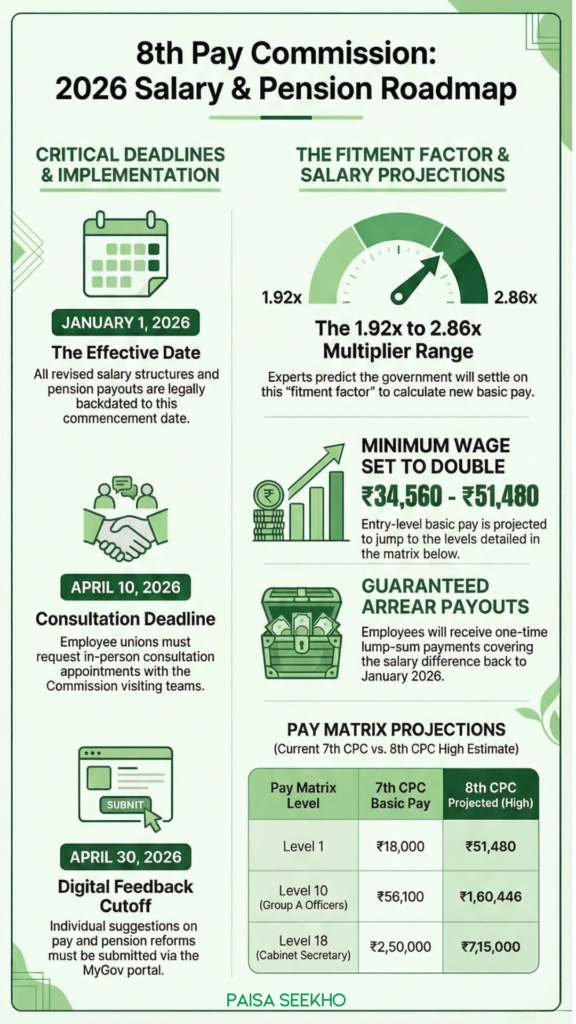
- The Effective Date: The recommendations of the 8th Pay Commission are scheduled to take effect retrospectively from January 1, 2026.
- The April Deadlines: The Commission is actively seeking feedback. Employee unions must request in-person consultation appointments by April 10, 2026, and broad suggestions via the MyGov portal must be submitted by April 30, 2026.
- The Fitment Factor Battle: Unions are aggressively demanding a multiplier of 3.00 to 3.25. However, financial experts predict the government will settle on a realistic fitment factor between 1.92 and 2.86.
- The Minimum Wage Jump: Depending on the final fitment factor, the minimum basic pay for a central government employee is expected to jump from the current ₹18,000 to anywhere between ₹34,560 and ₹51,480.
- The DA Delay Mystery: The routine March 2026 Dearness Allowance hike (expected to push DA to 60%) has been highly delayed, sparking rumors that the government might merge the DA into the basic pay ahead of the 8th CPC rollout.
- Arrears Are Guaranteed: Because the Commission has 18 months to submit its report, actual payouts might not happen until late 2026 or 2027. However, you will receive massive lump-sum arrears backdated to January 1, 2026.
Introduction
If you are one of the 50 lakh serving central government employees or the 65 lakh pensioners in India, the year 2026 is undoubtedly one of the most financially significant years of your life. For the past decade, your salary increments, allowances, and pension payouts have been strictly governed by the rules set forth by the 7th Pay Commission. However, as the cost of living continues to rise and the economic landscape of India evolves, that decade-old framework has officially run its course.
We have officially entered the era of the 8th Central Pay Commission (8th CPC).
With the official constitution of the Commission under the chairmanship of Justice Ranjana Prakash Desai, the wheels of bureaucratic change are finally turning. But as with all massive government initiatives, the transition is sparking thousands of questions. Rumors are swirling on social media about massive salary hikes, delayed Dearness Allowance (DA) announcements, and magical “fitment factors” that could theoretically double your basic pay.
In this comprehensive, deep-dive guide, we are cutting through the noise and the WhatsApp forwards. We will break down the latest, verified updates as of April 2026. We will mathematically explain how the fitment factor works, explore the truth behind the delayed DA merger, and provide a realistic timeline of when you will actually see this extra money hit your bank account.
What is the Exact 8th Pay Commission Implementation Date for Central Government Employees?
Whenever a new Pay Commission is announced, the first question everyone asks is: “When do I actually get paid?” To answer this, we need to understand the difference between the “Effective Date” and the “Payout Date.”
Historically, the Government of India follows a strict ten-year cycle for revising the salaries of its workforce. The 7th Pay Commission was implemented in 2016, and its operational tenure officially concluded on December 31, 2025. Therefore, according to the standard chronological cycle, the 8th Pay Commission’s revised structures must legally take effect from January 1, 2026.
However, government bureaucracy moves slowly. The Union Cabinet formally announced the 8th CPC in early 2025. The Commission has been given a massive, 18-month window to study the Indian economy, consult with stakeholders, and draft a final report that balances employee demands with the government’s fiscal deficit targets.
Because this 18-month window stretches well into the end of 2026 (or possibly early 2027), it is physically impossible for the government to update your April or May 2026 paycheck with the new 8th CPC rates.
The Reality Check:
You will continue to receive your salary based on the old 7th CPC matrix throughout most of 2026. Once the Commission submits its final report and the Finance Ministry officially approves the new pay matrix, the government will implement the new salaries. Because the effective date is locked in as January 1, 2026, the government will calculate the difference between your old salary and your new salary for all the intervening months, and pay you that difference as a massive lump-sum arrear.
How Will the 8th Pay Commission Fitment Factor Impact Your 2026 Salary Hike?
If you want to understand your future salary, you only need to understand one magical phrase: The Fitment Factor.
The fitment factor is simply a mathematical multiplier. It is the core formula used to convert your old basic pay under the 7th CPC into your new, revised basic pay under the 8th CPC. It acts as a bridge, ensuring that the salary hike is uniform and fair across all levels of government service, from a Level 1 peon to a Level 18 Cabinet Secretary.
To see how powerful this number is, let’s look at history:
- The 6th Pay Commission used a fitment factor of 1.86x, resulting in roughly a 54% overall hike.
- The 7th Pay Commission used a fitment factor of 2.57x, resulting in a much lower 14.29% baseline hike.
The Current Tug-of-War
Right now, in April 2026, a massive negotiation is happening behind closed doors.
On one side, the powerful employee unions and the National Council (Joint Consultative Machinery) are demanding a very aggressive fitment factor. They argue that post-pandemic inflation has severely eroded the purchasing power of the middle class. Major unions are demanding a multi-level fitment factor ranging from 3.00 for lower levels up to 3.25 for senior levels.
On the other side, the Finance Ministry has to worry about the national budget. India’s salary and pension bill has already crossed ₹5 lakh crore, eating up roughly 1.2% of the total GDP. Paying a 3.25x multiplier would likely bankrupt the government’s fiscal targets.
Financial experts predict a middle ground. The most realistic projections suggest the 8th CPC will finalize a fitment factor somewhere between 1.92x (Conservative) and 2.86x (Optimistic).
The Mathematical Impact on Minimum Wage
Currently, the lowest basic pay for a central government employee (Level 1) is ₹18,000 per month. Let’s apply the expected fitment factors to see the potential future base salary:
- If the Fitment Factor is 1.92x: ₹18,000 × 1.92 = ₹34,560 minimum basic pay.
- If the Fitment Factor is 2.50x:
₹18,000 × 2.50 = ₹45,000 minimum basic pay. - If the Fitment Factor is 2.86x:
₹18,000 × 2.86 = ₹51,480 minimum basic pay.
Even in the most conservative scenario, employees are looking at a baseline jump that significantly improves their financial stability.
What Are the 9 Key Demands Made by NC-JCM for the 8th Pay Commission?
As the 8th Central Pay Commission actively gathers feedback through its online portal, employee unions are raising serious concerns about the restrictions of the digital submission process. On April 1, 2026, the Staff Side of the National Council (Joint Consultative Machinery – NC-JCM), which is the official umbrella body representing millions of central government workers, wrote a formal letter to the Member Secretary of the 8th CPC.
The NC-JCM highlighted severe flaws in the current memorandum submission format and laid out 9 specific demands to ensure a fair, inclusive, and comprehensive policy review. Here is exactly what the employee unions are fighting for:
- 1. Restoration of the Old Pension Scheme (OPS): The most aggressive demand on the list. The NC-JCM argues that government employees should not be forced into market-linked, contributory schemes like the National Pension System (NPS) or the Unified Pension Scheme (UPS). They are demanding a clear provision in the questionnaire allowing employees to officially request the rollback and restoration of the defined-benefit Old Pension Scheme (OPS).
- 2. A Dedicated Section for Pensioners’ Issues: The current format largely ignores retirees. The union demands a separate, dedicated section specifically for pensioners to address critical post-retirement issues, including pension parity, revisions, restoration of the commuted value of pensions, and general welfare enhancements.
- 3. Welfare Provisions for Women Employees: The NC-JCM strongly proposed that the 8th Pay Commission incorporate a distinct section entirely focused on women-centric workplace issues. This includes demanding better policies for workplace safety, enhanced maternity benefits, menstrual welfare, Child Care Leave (CCL) issues, and broader gender equity policies.
- 4. Space for Department-Specific Issues: A railway worker faces entirely different challenges than a postal worker. The union highlighted that the current generic questionnaire fails to capture unique, cadre-specific operational problems, and demanded separate submission categories for different government departments.
- 5. Extension of the Submission Deadline: Claiming that the current April 30th deadline is far too early to conduct nationwide consultations, the NC-JCM has officially requested that the deadline for submitting department-specific memoranda be extended by a month to May 31, 2026.
- 6. A Massive Increase in the Word Limit: Currently, the 8th CPC portal caps responses at just 3,500 characters (roughly 500 words). The union argues this is far too restrictive to explain complex financial data and policy logic, demanding the limit be increased to at least 1,000 words per theme.
- 7. Clear Provisions for Sub-Questions: The online portal currently forces users to lump all their thoughts into one box. The NC-JCM is demanding a structured, systematic format that allows respondents to clearly answer each specific sub-question and sub-title individually without technical restrictions.
- 8. Enhancement of the Attachment Size Limit: To back up their salary demands, unions need to upload heavy PDF reports and data annexures. The current 2 MB file size limit makes this impossible. The union has requested the upload cap be increased to at least 10 MB.
- 9. Alternative Modes of Submission: To prevent technical barriers from silencing rural or less tech-savvy employees, the NC-JCM has demanded that the 8th Pay Commission accept official memorandums via direct email and physical hard copies, rather than forcing everyone to use the online portal exclusively.
These 9 demands are currently sitting with the Finance Ministry and the 8th CPC panel. If accepted, they will drastically change how employee grievances—especially regarding the highly sensitive Old Pension Scheme—are factored into the final salary matrix.
April 2026 Latest News Update: What Are the Deadlines for the 8th Pay Commission Questionnaire?
The 8th Pay Commission is not making these massive financial decisions in a dark, isolated room. They have been instructed to execute a highly democratic consultation process.
Under the leadership of Chairperson Justice Ranjana Prakash Desai, the Commission has spent the early months of 2026 rolling out extensive feedback mechanisms. They want to hear directly from the people who will be affected by these changes: the unions, the pensioners, and the everyday employees.
As of the first week of April 2026, the Commission has released critical, time-sensitive deadlines:
1. The Appointment Deadline (April 10, 2026)
The 8th CPC has formed specialized visiting teams that are touring major cities across India to hold face-to-face meetings with various government organizations and union representatives. For instance, a team is scheduled to visit Dehradun, Uttarakhand, in late April. The official notice clearly states that any institution or union wishing to book an in-person appointment with the visiting team must submit their formal email request on or before April 10, 2026.
2. The Suggestion Deadline (April 30, 2026)
For individual employees and smaller associations who cannot secure an in-person meeting, the government has digitized the feedback process. An extensive 18-point questionnaire has been hosted on the official MyGov.in portal. This questionnaire asks for direct inputs on the proposed salary hikes, the fitment factor math, and the restructuring of specific allowances. While an initial deadline was set for late March, the portal continues to accept broader suggestions and comprehensive feedback regarding pay and pension reforms until the final cutoff date of April 30, 2026.
It is incredibly important to note that the Commission has stated they will only review digital submissions via the MyGov portal or official email. Traditional paper-based letters and physical PDFs sent through the postal service are largely being ignored to speed up data analysis.
Why is the January 2026 DA Hike Delayed, and Will Dearness Allowance Merge With Basic Pay?
While everyone is looking forward to the long-term benefits of the 8th Pay Commission, there is a very immediate, short-term mystery currently confusing government employees: Where is the January 2026 Dearness Allowance (DA) hike?
Dearness Allowance is a vital component of a government salary. It is designed to offset the impact of inflation. The government revises the DA twice a year: once effective from January 1st, and once effective from July 1st.
Historically, the January DA hike is always announced to the public by the Union Cabinet in the month of March, usually right around the festival of Holi. However, Holi 2026 came and went, and the government remained absolutely silent. As we enter April, the current DA remains frozen at 58%. Based on the All-India Consumer Price Index for Industrial Workers (AICPI-IW) data from late 2025, employees are owed a 2% to 3% hike, which would push the total DA to 60% or 61%.
So, why the unusual, highly uncharacteristic delay?
The “Structural Arithmetic” Theory
Financial experts believe this delay is not a simple administrative error. It points to a massive structural shift happening behind the scenes as the government prepares to transition from the 7th CPC to the 8th CPC.
When a Dearness Allowance crosses the psychological benchmark of 50%, the mathematical pressure on the salary structure becomes immense. There is a historical precedent for this. Back in 2004, when the DA crossed 50%, the government legally “merged” it into the basic pay ahead of the 6th Pay Commission to create a new, much higher base salary.
Many analysts suspect the current delay is because the Finance Ministry is debating doing exactly this.
Instead of simply announcing a routine 2% DA hike, they might be finalizing the complex internal calculations required to merge the massive 60% DA directly into the basic pay.
Why a DA Merger is the Ultimate Win
From an employee’s perspective, a DA merger is a financial jackpot.
If you simply get a DA hike, you get a little bit of extra cash every month. But if the DA is merged into your basic pay, your actual base salary increases massively.
Why does this matter? Because almost every other beneficial component of your salary—such as your House Rent Allowance (HRA), your Provident Fund (PF) contributions, and your retirement Gratuity—are calculated as a strict percentage of your Basic Pay. If your basic pay suddenly jumps because of a merger, all of these other allowances and retirement benefits will experience a compounding, skyrocketing effect.
Regardless of whether it is a simple hike or a structural merger, employees will not lose any money. Whenever the announcement is finally made (expected any day now in April), the payout will be strictly backdated to January 1, 2026, meaning you will receive the pending amounts as arrears in your upcoming salary slip.
How Will 8th Pay Commission Arrears Be Calculated for Pensioners and Employees?
The concept of “Arrears” is often the most exciting part of a new Pay Commission. Because of the inevitable delay between the official effective date (January 1, 2026) and the actual implementation date (sometime in 2027), the government will owe you a massive backlog of money.
The Arrears Calculation Mechanism
Arrears arise when salary revisions are applied retrospectively. Let’s look at a highly simplified example to understand the math.
Assume your current gross salary under the 7th CPC is ₹50,000 per month.
When the 8th CPC is finally implemented in, let’s say, June 2027, your new revised gross salary is calculated to be ₹75,000 per month.
This means that for every single month between January 2026 and June 2027 (18 months), the government essentially underpaid you by ₹25,000 a month.
To fix this, the government will multiply that ₹25,000 difference by the 18 months of delay.
₹25,000 × 18 = ₹4,50,000.
When the new payroll system goes live, you will receive your new ₹75,000 salary for that current month, plus a massive, one-time lump-sum deposit of ₹4.5 Lakhs to clear the arrears debt.
Depending on your pay matrix level, the final fitment factor, and the exact length of the bureaucratic delay, arrears payouts can easily run into several lakhs of rupees. For senior-level officers in Pay Matrix Levels 13 and above, the arrear cheques can be life-changing amounts.
Pensioners Will Not Be Left Behind
This exact same mathematical mechanism applies to the 65 lakh pensioners in India. The 8th CPC is tasked with reviewing and enhancing the pension framework. The fitment factor will be applied to your pre-revised basic pension. If the delay extends into 2027, pensioners will also receive a massive lump-sum arrear payout covering the difference in their monthly stipends, alongside adjustments to their Dearness Relief (DR).
(Note: It is important to remember that massive arrear payouts are fully taxable in the year you receive them. However, you can use the provisions of Section 89 of the Income Tax Act to claim tax relief, preventing the sudden lump sum from unfairly pushing you into the highest 30% tax bracket).
What Does the Projected 8th Pay Commission Pay Matrix Table Look Like?
To give you a clearer picture of the future, financial analysts have used the expected fitment factor ranges to project what the new 8th CPC Pay Matrix will look like. The Pay Matrix is the grid that determines your exact salary based on your seniority level and years of service.
Here is a projected comparison of the baseline salaries for various key levels, comparing the current 7th CPC rates against the conservative (1.83x) and optimistic (2.86x) fitment factor estimates for the 8th CPC:
- Pay Matrix Level 1 (Entry Level Support Staff):
- 7th CPC Basic: ₹18,000
- 8th CPC Expected (Low): ₹32,940
- 8th CPC Expected (High): ₹51,480
- Pay Matrix Level 6 (Sub-Inspectors, Entry Level Assistants):
- 7th CPC Basic: ₹35,400
- 8th CPC Expected (Low): ₹64,872
- 8th CPC Expected (High): ₹1,01,244
- Pay Matrix Level 10 (Entry Level Group A Officers, Assistant Professors):
- 7th CPC Basic: ₹56,100
- 8th CPC Expected (Low): ₹1,02,423
- 8th CPC Expected (High): ₹1,60,446
- Pay Matrix Level 14 (Joint Secretary, Major General equivalent):
- 7th CPC Basic: ₹1,44,200
- 8th CPC Expected (Low): ₹2,63,886
- 8th CPC Expected (High): ₹4,12,412
- Pay Matrix Level 18 (Cabinet Secretary, Highest Rank):
- 7th CPC Basic: ₹2,50,000
- 8th CPC Expected (Low): ₹4,57,500
- 8th CPC Expected (High): ₹7,15,000
Disclaimer: The above numbers are expert projections based on mathematical multipliers. The final, official numbers will only be confirmed once the 8th Pay Commission publishes its official report and receives approval from the Union Cabinet.
Conclusion: Patience is the Ultimate Strategy
The transition from the 7th to the 8th Pay Commission is not just an administrative update; it is a massive macroeconomic event that will reshape the spending power of over a crore Indian households.
As we navigate through 2026, the key for employees and pensioners is absolute patience. The current delay in the DA hike announcement, the ongoing nationwide stakeholder consultations, and the intense negotiations over the fitment factor are all necessary steps in a very complex democratic process. The government must find the perfect balance between giving its workforce the financial dignity they deserve and ensuring the country’s national budget is not pushed into a dangerous deficit.
While the wait might feel long, the structural guarantees of the system remain rock solid. The implementation date of January 1, 2026, ensures that you will not lose a single rupee of the hike you are legally owed. Keep a close eye on the official MyGov portal announcements, manage your current household budget prudently, and prepare for a significant upward reset in your financial trajectory over the next 18 months.
Frequently Asked Questions
Q1: When is the official implementation date for the 8th Pay Commission?
The recommendations of the 8th Pay Commission are legally scheduled to take effect retrospectively from January 1, 2026. Even though the final report and actual salary payouts will likely be delayed until late 2026 or 2027, your new salary will be backdated to this exact January 1st deadline.
Q2: What is the expected fitment factor for the 8th CPC salary hike?
While central government employee unions are aggressively demanding a high fitment factor of 3.00x to 3.25x, financial experts and economists predict the government will finalize a more realistic multiplier. Current estimates place the final fitment factor somewhere between 1.92x and 2.86x to balance employee needs with the national fiscal deficit.
Q3: Will the delayed January 2026 Dearness Allowance (DA) merge with the basic pay?
There is massive speculation that the government is delaying the March DA announcement because they are planning a DA merger. Whenever the Dearness Allowance crosses the 50% mark (it is currently expected to hit 60%), the government historically merges it into the basic pay to create a much higher base salary before calculating the new Pay Commission matrix.
Q4: What will be the new minimum basic pay for central government employees?
Currently, the minimum basic pay at Level 1 is ₹18,000. Depending on the final fitment factor chosen by the 8th Pay Commission, this minimum wage is projected to jump significantly. It could rise to ₹34,560 (under a conservative 1.92x factor) or as high as ₹51,480 (under an optimistic 2.86x factor).
Q5: When will central government pensioners receive their 8th Pay Commission arrears?
Pensioners will receive their arrears at the exact same time as active employees. Once the 8th CPC is officially implemented and the new payroll software is updated (likely in 2027), the government will calculate the difference in your pension from January 1, 2026, to the current month. That entire backlog will be deposited into your bank account as a one-time lump-sum arrear payment.
Q6: How exactly is the new salary calculated using the fitment factor?
The calculation is very simple. The government takes your current Basic Pay under the 7th CPC and multiplies it by the newly approved fitment factor. For example, if your basic pay is ₹50,000 and the fitment factor is 2.50, your new Basic Pay under the 8th CPC becomes ₹1,25,000. Your new allowances (like HRA) will then be calculated as a percentage of this new, much higher basic pay.
Q7: What is the deadline to submit suggestions for the 8th Pay Commission?
The Commission is currently accepting public and union feedback. If a major union wants an in-person meeting with the visiting committee, they must request an appointment by April 10, 2026. For individual employees and smaller associations, digital feedback and suggestions must be submitted via the official MyGov.in portal by April 30, 2026.
Q8: Does the 8th Pay Commission directly apply to state government employees?
No, it does not apply automatically. The 8th Central Pay Commission (CPC) strictly governs central government employees (like Railways, Defense, and Central Ministries). However, almost all state governments in India traditionally adopt the Central Pay Commission’s matrix for their own state employees, usually implementing it a few months or a year after the central rollout.
Q9: Will the 8th CPC change the retirement age or standard pension rules?
While the primary job of the Pay Commission is to revise the pay matrix and allowances, they are also reviewing the pension framework. However, there has been no official confirmation or serious discussion from the Finance Ministry about increasing the retirement age beyond 60 years. The ongoing debates between the Old Pension Scheme (OPS) and the Unified Pension Scheme (UPS) are being handled by separate government committees, though the 8th CPC will factor those decisions into their final report.
Q10: Will I have to pay massive income tax on my 8th Pay Commission arrears?
Yes, arrears are considered part of your taxable salary in the year you receive them. Because an 18-month arrear payout will be a massive lump sum, it could temporarily push you into a much higher 30% tax bracket. However, to protect you from this unfair tax shock, the Income Tax Act allows you to file Form 10E and claim relief under Section 89, which recalculates the tax as if you had received the money normally over the previous months.