

TL;DR: New Rent Rules 2026 Takeaways
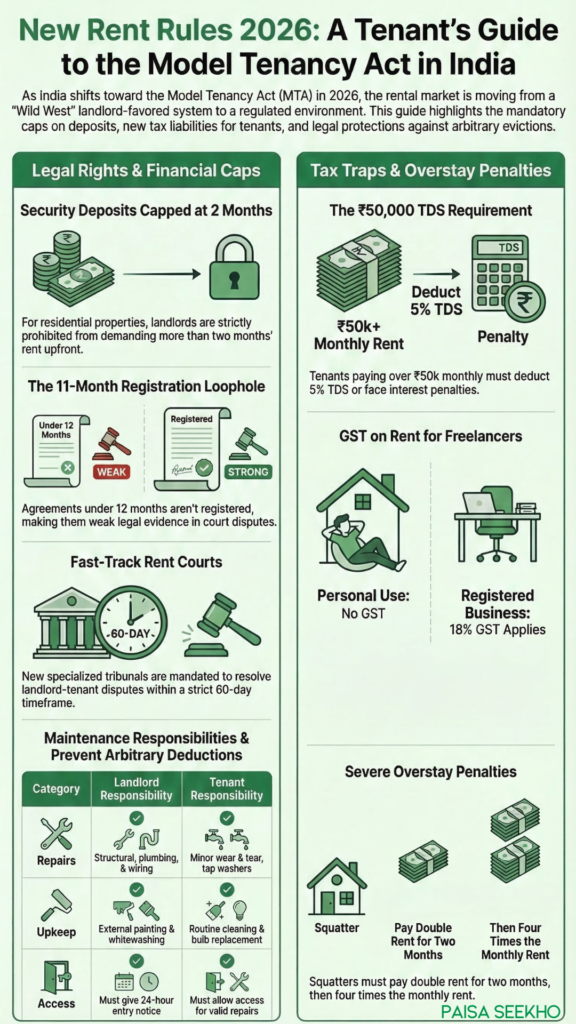
- The Security Deposit Cap: Under the rolling implementation of the Model Tenancy Act (MTA), landlords cannot legally demand 6 or 10 months’ rent upfront. Residential deposits are strictly capped at 2 months’ rent.
- The 11-Month Myth: Why is every lease exactly 11 months? It is a legal loophole. Rent agreements of 12 months or more require mandatory registration at the sub-registrar’s office and heavy stamp duty.
- The GST Trap: If you are a GST-registered freelancer renting a residential flat to live in, you do not pay 18% GST (thanks to recent clarifications). However, if you use it as your registered business office, you must pay it under the Reverse Charge Mechanism (RCM).
- The TDS Rule: If your rent exceeds ₹50,000 per month, you (the tenant) are legally required to deduct 5% TDS before paying your landlord.
1.The Wild West of Indian Real Estate
If you are a young professional moving to a major economic hub like Gurugram, Bengaluru, or Mumbai in 2026, you already know the dread of the house hunt.
Finding the flat is only 10% of the battle. The real anxiety kicks in when the broker slides a highly skewed rent agreement across the table. It demands a non-negotiable 6-month security deposit, a shady “brokerage fee” equivalent to a full month’s rent, and an annual rent escalation clause that completely outpaces inflation.
Historically, the Indian rental market has operated like the Wild West, heavily favoring the landlord. Tenants have routinely been forced to accept illegal lock-in terms, arbitrary deductions from their deposits for “painting,” and the constant threat of overnight eviction.
But the legal landscape is aggressively shifting. With the government pushing states to adopt the Model Tenancy Act (MTA) and the tax department tightening its grip on rental income, 2026 is the year tenants finally get some legal armor. This guide breaks down the exact legal rules, hidden tax traps, and negotiation tactics. Here’s what you need to protect your money and your rights before you sign your next lease.
2. The 11-Month Agreement “Scam” (Decoding the System)
Have you ever wondered why almost every single rent agreement in India is exactly 11 months long? It is not a coincidence, and it is certainly not a legal requirement. It is a highly calculated loophole designed to bypass the government.
To understand why this happens, you have to apply basic systems thinking and look at the underlying law. We’re talking about Section 17 of the Registration Act, 1908.
The Registration Trap
Under Indian law, any lease agreement for a property that exceeds 11 months (i.e., 1 year or more) is legally required to be formally registered at the local sub-registrar’s office.
Registering a document is expensive and tedious. It requires both the landlord and the tenant to physically visit the government office, pay a hefty Stamp Duty (which varies by state but can be 2% to 5% of the annual rent), and pay a registration fee.
The 11-Month Loophole
To avoid paying this tax and skipping the bureaucratic headache, landlords and brokers intentionally draft the agreement for 11 months. Since it falls under the 1-year mark, it does not require mandatory registration. Most people simply print it on a ₹100 or ₹500 stamp paper, get it notarized by a local lawyer, and call it a day.
The Ultimate Risk for the Tenant
While skipping the sub-registrar’s office saves you a few thousand rupees in stamp duty today, it completely destroys your legal leverage tomorrow.
If your landlord illegally kicks you out or refuses to return your ₹1 Lakh security deposit, and you decide to take them to a civil court, the judge will ask for your rent agreement. An unregistered 11-month agreement is not legally admissible as primary evidence in a court of law. It is legally considered a highly weak document.
While it works perfectly fine for 90% of peaceful tenancies, relying on an unregistered 11-month piece of paper means you are operating entirely on blind trust, not legal protection.
3. What is The Model Tenancy Act (MTA)?
For decades, the biggest nightmare for any young professional moving to a city like Bengaluru has been the extortionate security deposit. Landlords routinely demand 10 months’ rent upfront, effectively locking up lakhs of your hard-earned rupees in a dead, zero-interest asset.
To fix this heavily skewed power dynamic, the central government introduced the Model Tenancy Act (MTA). While real estate is a state subject (meaning each state has to individually adopt these rules), by 2026, many major economic hubs are actively transitioning to this framework to formalize the rental market.
If your state has adopted the MTA guidelines, here is the legal armor you now have:
1. The End of the “10-Month Deposit” Extortion
This is the biggest win for tenants. Under the MTA, it is strictly illegal for a landlord to demand arbitrary security deposits.
- For Residential properties, the security deposit is strictly capped at a maximum of 2 months’ rent.
- For Commercial properties, the cap is set at 6 months’ rent.
2. Fast-Track Rent Courts
Historically, if a landlord illegally withheld your deposit when you moved out, your only option was to file a case in a civil court, which could take five to ten years to resolve. The MTA mandates the creation of dedicated Rent Authorities, Rent Courts, and Rent Tribunals. These specialized bodies are designed to resolve disputes within a strict 60-day timeframe, giving you actual legal recourse that doesn’t cost more than the deposit itself!
3. Clear Maintenance Rules (No More Arbitrary Deductions)
Landlords love to deduct ₹20,000 from your deposit for “painting and deep cleaning” when you leave. The MTA finally draws a hard line on who pays for what:
- The Landlord’s Job: Structural repairs, whitewashing, external plumbing, and fixing major wiring issues.
- The Tenant’s Job: Daily wear and tear, replacing fused bulbs, minor plumbing leaks (like a broken tap washer), and routine cleaning. Unless you punched a hole in the drywall, the landlord cannot legally use your security deposit for routine repainting between tenants.
4. What is the GST and TDS on Rent?
As you climb the corporate ladder or scale your freelance business, your rent increases. The moment your rent crosses certain thresholds, you stop being just a tenant—the government actually turns you into a tax collector!
If you don’t know these two specific tax rules, you could be hit with severe financial penalties.
Trap 1: TDS under Section 194-IB (The ₹50,000 Rule)
If you are an individual or HUF paying rent that exceeds ₹50,000 per month, you are legally required to deduct Tax Deducted at Source (TDS).
- The Math: You must deduct 5% of the total rent paid for the year and deposit it directly to the government on behalf of your landlord.
- The Process: You do not need a TAN (Tax Deduction Account Number) to do this. You simply use your landlord’s PAN card and file a simple online form (Form 26QC) once a year (usually in March or when you vacate).
- The Penalty: If your rent is ₹60,000 and you just transfer the full amount to your landlord without deducting the 5% TDS, the income tax department will penalize you, not the landlord! You will have to pay the missing tax out of your own pocket, plus a 1% per month interest penalty.
Trap 2: The Freelancer’s GST Dilemma (The RCM Rule)
If you are a registered GST taxpayer (perhaps you run a digital marketing agency or a tech consultancy) and you rent a property, the rules get tricky.
- Renting for Personal Use: If you are a GST-registered individual but you rent a residential flat purely to live in with your family, you are safe. The government clarified that you do not have to pay 18% GST on this rent.
- Renting for Business (The RCM Catch): However, if you are a GST-registered freelancer and you rent a residential apartment and legally declare it as your “Registered Principal Place of Business,” the government views this as commercial use. Under the Reverse Charge Mechanism (RCM), the landlord won’t charge you GST; you have to calculate 18% on your rent, pay it directly to the government, and then claim it back as an Input Tax Credit (ITC).
5. Evictions & Lock-In Periods (The Legal Ground)
When things go wrong between a landlord and a tenant, they usually go wrong in one of two ways: the tenant wants to leave early, or the landlord wants the tenant out immediately.
Here is exactly where you stand legally in 2026.
The Lock-In Reality: Can You Just Leave?
Brokers love to insert a “6-month” or “1-year” lock-in period into your rent agreement. But are these actually legally binding?
Yes. Under the Indian Contract Act, if you sign an agreement with a lock-in clause, you are legally bound by it.
- The Danger: If you sign a 12-month lock-in, lose your job in month 4, and decide to move back to your hometown, the landlord can legally demand that you pay the rent for the remaining 8 months. They can (and will) entirely swallow your security deposit to recover this.
- The Paisaseekho Fix: Never accept a blind lock-in period. Always negotiate a Diplomatic Clause or a “Buyout Clause.” This states that in case of a job transfer, job loss, or medical emergency, you can break the lock-in by simply paying a pre-agreed penalty (like 1 month’s extra rent) instead of the entire remaining tenure.
Evictions and The Privacy Rule (The 24-Hour Notice)
Historically, aggressive landlords would threaten to change the locks, throw your furniture out, or cut off your electricity if rent was delayed.
- Essential Services: Under no circumstances can a landlord legally cut off your essential services (electricity, water) to force an eviction, even if you are actively disputing the rent.
- Valid Eviction Grounds: Under the MTA, a landlord can only initiate an eviction through a Rent Court for very specific reasons: non-payment of rent for 2 consecutive months, subletting the flat without written permission, or causing structural damage to the property.
- The Privacy Rule: Your landlord cannot simply unlock your door and walk in to “check on the house.” The law mandates that landlords must give a minimum of 24 hours’ advance notice (usually in writing/WhatsApp) before entering the premises, except in absolute emergencies like a fire or flood.
The Overstay Penalty (Do Not Ignore This)
While the new laws protect tenants from harassment, they also severely punish squatters. If your lease expires, you haven’t renewed it, and you simply refuse to vacate the property, the landlord no longer has to fight you in a 10-year civil court case. Under the MTA, if you overstay, you are legally liable to pay double the monthly rent for the first two months, and four times the monthly rent for every month after that!
6. Conclusion: The Paisaseekho Renter’s Checklist
Renting a house in India doesn’t have to feel like a hostage negotiation. By understanding how the 11-month loophole works, leveraging the Model Tenancy Act caps on security deposits, and dodging the massive GST and TDS tax traps, you can protect your peace of mind and your bank balance.
Before you sign your next lease or hand over a single rupee, run this final checklist:
- Never pay in cash. Ensure the security deposit and all monthly rents are transferred via UPI or NEFT so you have a permanent digital paper trail.
- Read the Lock-in Clause. Ensure there is an exit penalty defined, not an open-ended liability.
- Define the Maintenance. Make sure the agreement explicitly states that the landlord covers structural repairs and “normal wear and tear” repainting.
Top 10 Frequently Asked Questions
1. Is an unregistered 11-month rent agreement legally valid in court?
It is valid as a basic contract, but it is considered extremely weak evidence in a civil dispute. Because it bypasses the Registration Act, courts often hesitate to enforce its terms if a massive dispute arises. For complete legal safety, agreements of 12 months or more must be registered.
2. Can my landlord increase my rent whenever they want?
No. Rent hikes must strictly follow the terms written in your agreement (e.g., an automatic 5% increase every 11 months). If no terms are defined, the Model Tenancy Act states that landlords must give you at least 3 months’ written notice before arbitrarily raising the rent.
3. Who is legally responsible for painting the flat when I move out?
Under the new rules, landlords are responsible for structural maintenance, which includes repainting due to normal, everyday wear and tear. You (the tenant) are only financially responsible for painting if you actively damaged the walls (e.g., drawing on them, drilling excessive holes, or causing water damage through negligence).
4. What happens if I leave the flat before the lock-in period ends?
If your agreement does not have an “early exit” or “diplomatic” clause, you are legally in breach of contract. The landlord has the legal right to withhold your security deposit and potentially demand rent for the remaining months of the lock-in period.
5. Can my landlord cut off my electricity or water if I delay my rent?
Absolutely not. Withholding essential services like water or electricity is illegal under Indian law. Even if you haven’t paid rent for months, the landlord must follow the formal eviction process through a Rent Court rather than taking the law into their own hands.
6. Do I have to pay 18% GST on my house rent?
If you are a salaried employee, no. If you are a GST-registered freelancer or business owner renting a house purely for personal residential use, no. However, if you are GST-registered and you list that rented residential flat as your official “Principal Place of Business,” you must pay 18% GST under the Reverse Charge Mechanism (RCM).
7. What is the TDS rule for high house rent?
If your monthly rent exceeds ₹50,000, Section 194-IB of the Income Tax Act requires you (the tenant) to deduct 5% TDS from the rent and deposit it to the government using your landlord’s PAN. If you fail to do this, the tax department will penalize you, not the landlord.
8. Can a landlord keep my entire security deposit for “cleaning”?
No. Deductions from a security deposit must be itemized, reasonable, and strictly for actual damages or unpaid utility bills. They cannot arbitrarily deduct ₹15,000 for “deep cleaning” unless it was explicitly agreed upon in writing in your contract.
9. How much notice does a landlord need to give before visiting my flat?
Under the Model Tenancy Act, landlords must give you a minimum of 24 hours’ written or electronic notice (like a text or email) before entering the rented premises, and they must visit during reasonable daylight hours.
10. What is a “Diplomatic Clause” in a rent agreement?
It is a protective clause for tenants that overrides the lock-in period. It states that if the tenant is transferred to another city by their employer, loses their job, or faces a severe emergency, they can break the lease early by providing a standard notice (usually 1 or 2 months) without paying a massive penalty.