

Let’s talk about the one thing that keeps every 26-year-old Indian awake at night: “Should I pay rent or pay EMI?”
For the longest time, the “financial gurus” on Instagram told you: “Don’t buy a house! It’s a liability! Just rent and invest the difference in the stock market.” And mathematically, they weren’t always wrong. In cities like Mumbai or Gurugram, rental yields were 2%, while home loan interest rates were 8.5%. Buying made no sense.
But Budget 2026 just flipped the script.
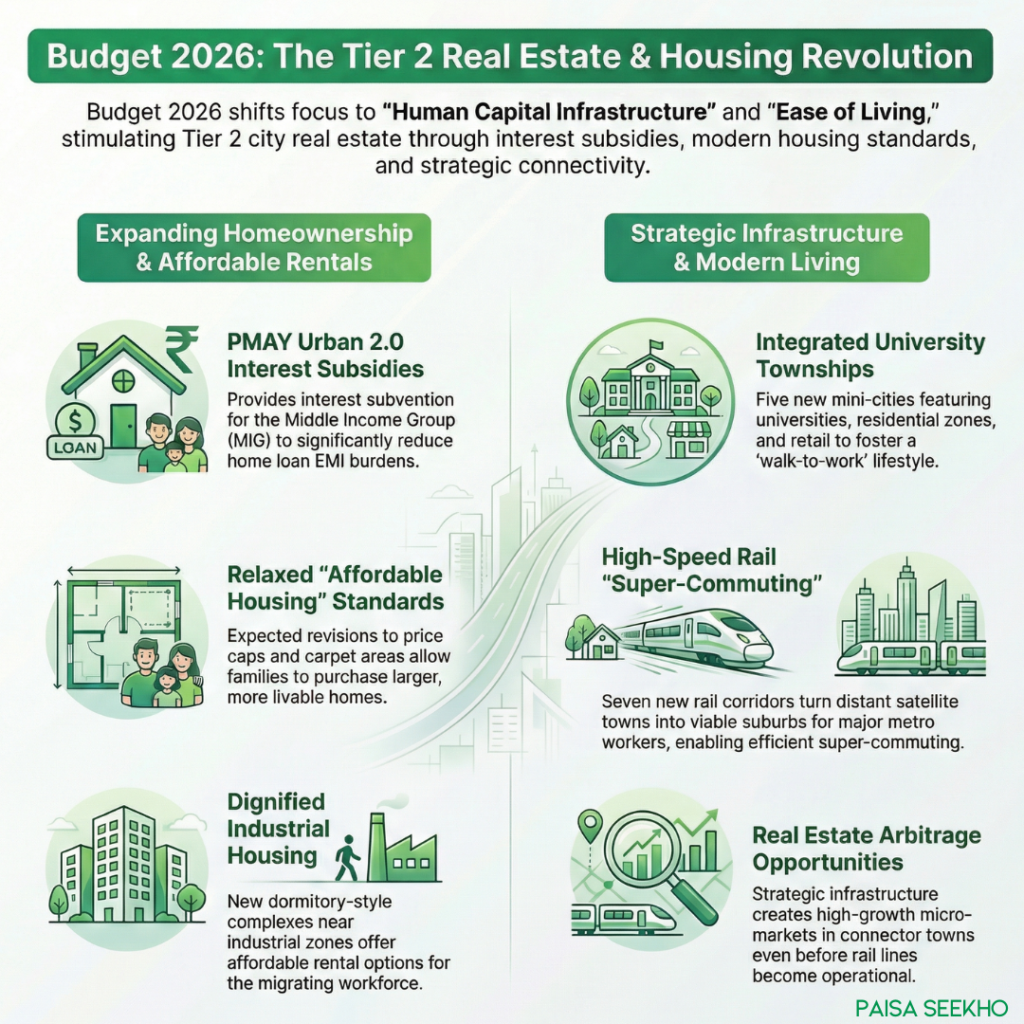
Finance Minister Nirmala Sitharaman has tacitly admitted that for the Indian middle class, “Makaan” (Housing) is not just an asset class; it’s dignity. It’s security. And to ensure you can afford that security, the government has launched PMAY Urban 2.0 (Pradhan Mantri Awas Yojana – Urban 2.0).
This isn’t just a rehash of old schemes. This is a targeted stimulus for the Middle-Income Group (MIG). That’s you, the salaried professional earning ₹6-15 Lakhs a year, living in cities like Lucknow, Coimbatore, Nashik, or Bhubaneswar.
In this deep-dive guide, we will decode how PMAY 2.0, combined with the new “7 Growth Corridors,” creates a once-in-a-decade opportunity for you to stop paying your landlord’s EMI and start building your own asset.
Part 1: PMAY Urban 2.0 – The Comeback of the Middle-Class Subsidy
The headline number is massive: The government plans to support the construction of 1 Crore urban houses. But the devil, and the profit, is in the details.
1. The “MIG” Interest Subsidy is Back
For a few years, the Credit Linked Subsidy Scheme (CLSS) for the Middle-Income Group was paused. Budget 2026 revives it with a vengeance.
How it works: The government provides a subsidy on the interest component of your home loan. Historically, this has been an interest subvention of around 3-4% for a tenure of 20 years.
The Math (The “Wealth Effect”):
Let’s say you take a home loan of ₹50 Lakhs.
- Standard Rate: 8.5%
- Subsidized Rate: Effectively lower due to the upfront subsidy credit.
- The Benefit: If the subsidy amounts to approximately ₹2.3 Lakhs to ₹2.6 Lakhs (based on historical trends), this amount is credited directly to your loan account upfront.
- Result: Your principal outstanding drops immediately. It acts as a direct discount on the home price.
2. The New Definition of “Affordable”
This is the game-changer for Tier 2 cities.
Previously, “Affordable Housing” was capped at ₹45 Lakhs. Let’s be real, you can’t find a decent 2BHK in a good area of Indore or Jaipur for ₹45 Lakhs anymore. The market has moved on.
The Budget signals a revision of this price cap. Industry expectations suggest the cap will rise to ₹65-75 Lakhs.
What does this mean for you?
- Bigger Homes: The definition of “carpet area” is also expected to be relaxed (e.g., from 90 sq m to 120 sq m).
- Better Lifestyle: You don’t have to buy a “matchbox” apartment to save tax. You can buy a spacious 3BHK in a developing suburb of a Tier 2 city and still qualify for government subsidies.
Part 2: The “7 Growth Corridors” – Where Should You Buy?
The oldest rule in real estate is “Location, Location, Location.” But in 2026, the new rule is “Connectivity, Connectivity, Connectivity.”
The Budget announced Seven High-Speed Rail Corridors. These are not just train lines; they are “wealth lines.”
The 7 Corridors:
- Mumbai – Pune
- Pune – Hyderabad
- Hyderabad – Bengaluru
- Hyderabad – Chennai
- Chennai – Bengaluru
- Delhi – Varanasi
- Varanasi – Siliguri
The “Super-Commuter” Phenomenon
Imagine living in a small town like Solapur or Kalaburagi. Currently, working in Hyderabad or Pune is impossible unless you migrate. But with high-speed rail, a 3-hour journey shrinks to 1 hour. This creates the “Super-Commuter.”
The Opportunity:
You can live in a cheaper satellite town (where property is ₹3,000/sq ft) and work in a major metro (where salaries are high).
- Real Estate Arbitrage: Property prices in the “nodes” (stations) along these corridors will appreciate faster than in the metros themselves.
- The Smart Money Move: Don’t try to buy in Hyderabad’s Gachibowli or Bengaluru’s Whitefield, they are already saturated. Buy land or an apartment in the “Connector Towns” halfway between these cities. That is where the 10x growth will happen in the next decade.
Part 3: Industrial Housing – The “Dormitory” Revolution
One of the biggest friction points for young people moving to cities for their first job is finding a decent place to live. You often end up in unauthorized colonies, paying high rent for terrible conditions.
The Budget introduces a new scheme for “Industrial Housing”.
What is it?
Think of these as “Dormitory-Style” living complexes built near major industrial zones and factories.
- Why it matters: It provides a dignified, low-cost rental alternative.
- For the Youth: If you are starting a job in a manufacturing hub (like the new semiconductor plants or EV factories), you won’t have to spend 40% of your salary on rent. These specialized housing zones will lower your “Cost of Migration”, allowing you to save more from Day 1.
Part 4: University Townships – The “Walk-to-Work” Lifestyle
Have you ever seen movies about Oxford, Cambridge, or Palo Alto? Entire cities built around a university? The Budget plans to replicate this by supporting states to develop Five Integrated University Townships.
These are not just campuses. They are mini-cities containing:
- Universities & Research Centers
- Residential Complexes
- Retail & Entertainment Zones
The Investment Angle: These townships create high-quality “Micro-Markets” for real estate.
- Rental Yield King: Investing in a small apartment near these townships is a strategic long-term bet. Why? Because students and professors provide a constant stream of tenants. Unlike IT parks where companies might move out, a university stays for 100 years. Occupancy rates remain high, ensuring your rental income is safe.
Part 5: The Paisaseekho Strategy – Buying vs. Renting in 2026
Okay, we’ve seen the policies. Now let’s look at the numbers for your wallet.
The Scenario:
You are 28 years old. You earn ₹10 Lakhs/year, and live in a Tier 2 city (e.g., Nashik, Mysore, Vizag).
| Parameter | The “Renter” (Old Mindset) | The “Buyer” (Budget 2026 Mindset) |
| Living Situation | Renting a 2BHK in the city center. | Buying a 3BHK in a “PMAY Zone” (suburbs). |
| Monthly Outflow | ₹20,000 Rent (increases 10% yearly). | ₹35,000 EMI (Fixed). |
| Government Help | None. | ~₹2.5 Lakhs Subsidy (PMAY MIG). |
| Tax Benefit | HRA (only if Old Regime). | Interest Deduction (Section 24b). |
| Asset Creation | Zero. | High Appreciation (due to new Infra Corridors). |
| 5-Year Outcome | You paid ₹12 Lakhs in rent. You own nothing. | You paid ₹21 Lakhs in EMI. You own an asset worth ₹85 Lakhs (assuming appreciation). |
The Verdict:
With PMAY 2.0 reducing the cost of borrowing and the 7 Corridors driving appreciation in Tier 2 suburbs, buying is no longer a “liability.” It is a leveraged bet on India’s urbanization.
Part 6: Actionable Advice – How to Start?
If you are convinced, here is your step-by-step “Home Buying Checklist” for 2026:
Step 1: Identify the “PMAY Zones”
Don’t look at the heart of the city where prices are ₹8,000/sq ft. Look at the periphery, the areas that are currently “just outside” the city but will be connected by the new metro lines or ring roads within 3 years. This is where developers will launch projects under the ₹65-75 Lakh cap to qualify for the scheme.
Step 2: Check Your “Credit Score” Today
Banks will only give you the best interest rates (and process the PMAY subsidy faster) if your CIBIL score is above 750.
- Tip: If you have outstanding credit card dues, clear them now before applying for a home loan.
Step 3: Look for the “Connector Towns”
Open Google Maps. Trace the line between Pune and Hyderabad or Delhi and Varanasi.
Identify the towns that lie roughly in the middle or at key junctions.
- Are there new land plots available?
- Are builders announcing projects there?
- Paisaseekho Insight: Buying land in a “Connector Town” is likely to give you better returns than buying a flat in a metro.
Step 4: The “Ready-to-Move” vs. “Under-Construction” Dilemma
Under PMAY, developers are incentivized to finish projects fast. However, for a first-time buyer, “Ready-to-Move” is always safer to avoid construction delays. Look for unsold inventory in projects that are 90% complete, developers are often desperate to clear these and might offer discounts.
Conclusion: Your “Address” is Your New Asset
For years, we were told that living in a Tier 2 city was a “compromise.” We moved to Bengaluru or Mumbai because “that’s where the jobs are.”
Budget 2026 challenges that narrative. With High-Speed Rail connecting cities, BharatNet enabling remote work, and PMAY 2.0 making homes affordable, the “Tier 2 Dream” is now the “Smart Indian Dream.”
You have a choice: You can keep paying high rents in a crowded metro, or you can use government incentives to build a spacious, dignified life in a growing city like Indore, Nagpur, or Coimbatore.
The government has put the money on the table. Will you take it?
Frequently Asked Questions (FAQ)
Q1: I am unmarried. Can I apply for PMAY 2.0?
Ans: Yes! The scheme defines a “beneficiary family” as a husband, wife, and unmarried children. However, as an earning individual, you are treated as a separate household. If you don’t own a pucca house in your name anywhere in India, you are eligible.
Q2: Does this apply to resale flats?
Ans: Usually, PMAY schemes are targeted at increasing the housing stock (new construction). However, banks often extend CLSS benefits to resale properties if it is the beneficiary’s first home. Wait for the detailed notification from the Ministry of Housing to confirm the specific rules for 2026.
Q3: What if I earn more than the limit?
Ans: Even if you don’t qualify for the direct subsidy, the “7 Corridors” strategy still applies to you. The infrastructure boom benefits everyone who owns property in those regions, regardless of income. The appreciation potential in Tier 2 cities is currently higher than in saturated Tier 1 markets.
Q4: Should I buy a flat or a plot of land?
Ans: If you want to live in it immediately, buy a flat. If you are looking purely for investment/wealth creation over 10 years, buy a plot in the “Connector Towns” or near the “University Townships.” Land has zero maintenance cost and historically appreciates faster than apartments in developing areas.
Disclaimer: This blog provides financial education based on Budget 2026 announcements. Real estate investments carry risks. Please consult a financial advisor and check official PMAY guidelines before booking a property.