TL;DR: Key Takeaways on SFBs and Collateral-Free Loans
If you are a busy entrepreneur and need the facts quickly, here is a summary of how Small Finance Banks are changing the game.
- The Problem with Old Banks: Traditional banks historically demanded heavy collateral (like houses or land) to approve business loans, locking out millions of property-less entrepreneurs.
- The Rise of SFBs: The Reserve Bank of India (RBI) created Small Finance Banks specifically to serve small businesses, unorganized sectors, and local shopkeepers who were ignored by massive banks.
- No Property Needed: SFBs offer “collateral-free” or unsecured loans. You do not need to pledge your personal home or shop to get the money to grow your business.
- Cash-Flow Over Assets: Instead of looking at what you own, SFBs look at what you earn. They use modern technology to analyze your daily UPI receipts and GST returns to approve your loan.
- Government Backing: SFBs can confidently give out these risky loans because they are heavily backed by government safety nets like the CGTMSE (Credit Guarantee Fund Trust for Micro and Small Enterprises).
- Breaking the Debt Trap: By offering fair interest rates, SFBs have successfully rescued local business owners from the clutches of informal, local moneylenders who charge predatory interest rates.
Introduction
Imagine you run a small, thriving bakery in your neighborhood. Everyone loves your cakes, and you have a massive line out the door every single evening. You want to expand. You want to buy a larger commercial oven, hire two more bakers, and open a second branch.
You have a great business plan and a proven track record of making a profit. But when you walk into a traditional, massive commercial bank and ask for a loan, the manager asks you a terrifying question. “What property can you pledge as collateral?”
If you are a first-generation entrepreneur renting your house and your bakery shop, you do not have any property to pledge. In the past, that is where your dream would die. Traditional banks would reject your application, leaving millions of smart, hardworking business owners stuck in the mud, unable to grow.
But over the last decade, the Indian financial system underwent a massive revolution. A new breed of financial institutions emerged to solve this exact problem: Small Finance Banks (SFBs).
By offering collateral-free (unsecured) business loans, these new banks have become the ultimate fuel for India’s Micro, Small, and Medium Enterprises (MSMEs). In this comprehensive guide, we are going to explore exactly how Small Finance Banks flipped the traditional banking model upside down. Find out how collateral-free loans actually work, and how they are transforming local businesses across the country.
What Exactly Are Small Finance Banks (SFBs) and Why Were They Created?
To understand the magic of collateral-free loans, we first need to understand what a Small Finance Bank actually is.
If you look at the banking sector, you have massive commercial giants like SBI, HDFC, and ICICI. These banks are incredible at handling massive corporate loans, funding international trade, and managing the wealth of the middle and upper classes. However, because they are so big, they struggle to understand the very small, local businessman.
For a giant commercial bank, spending weeks doing the paperwork to approve a small ₹5 Lakh loan for a local grocery store simply is not profitable enough.
The Reserve Bank of India (RBI) realized this was a massive problem. India runs on small businesses. If the local tailor, the grocery store owner, and the hardware shop cannot get funding, the economy cannot grow. So, the RBI created a special license for a new type of bank: the Small Finance Bank.
Institutions like AU Small Finance Bank, Equitas, Ujjivan, and ESAF were born with a very specific, legally mandated mission: Financial Inclusion.
By law, SFBs are required to lend a massive portion of their total money to “priority sectors,” which primarily means micro and small businesses. They were explicitly designed to go into the narrow streets and small towns of India, find the shopkeepers who were previously invisible to the banking system, and give them the capital they desperately needed.
How Do Collateral-Free Loans for Small Businesses Actually Work?
The term “collateral-free” sounds almost too good to be true. How can a bank just hand over ₹10 Lakhs or ₹20 Lakhs without asking for a safety net?
To understand this, let’s break down the two main types of lending in the financial world:
1. Secured Lending (The Old Way)
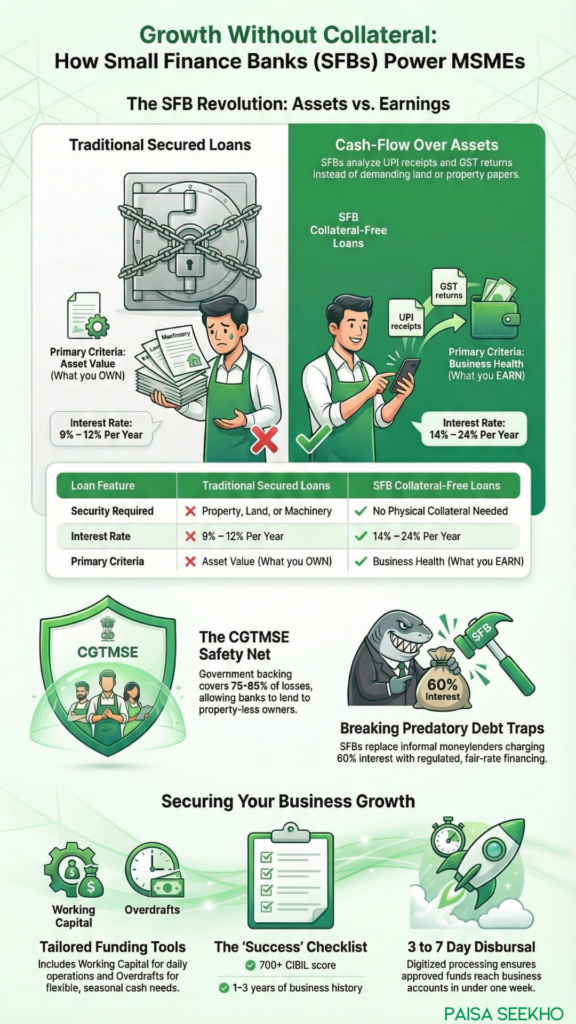
This is how traditional banks operate. If you want a loan, you have to provide collateral—an asset the bank can legally seize and sell if you run away or go bankrupt. This usually means pledging the original registry papers of your house, a plot of land, or heavy factory machinery. If you don’t have property, you don’t get the money.
2. Unsecured or Collateral-Free Lending (The SFB Way)
In a collateral-free loan, you do not pledge a single piece of physical property. The bank gives you the money based entirely on trust, your business history, and your ability to repay.
But SFBs are not doing charity. They are smart businesses. So how do they protect themselves from losing money?
They replaced “Asset-Based Underwriting” with “Cash-Flow Based Underwriting.”
Instead of looking at the value of your house, the SFB manager looks at the health of your business. They ask questions like:
- How much inventory do you sell every month?
- Are your daily UPI transactions increasing?
- Have you been paying your GST bills on time?
- Do you have a history of paying your credit card bills without defaulting?
If your cash flow is strong and steady, the SFB realizes that you are a highly capable business owner who can easily afford to pay a monthly EMI out of your daily profits. They trust your future income, rather than relying on your past assets.
Why Are Small Finance Banks Better at Offering Unsecured Business Loans?
You might wonder, why don’t the massive, traditional banks just copy this model and offer millions of collateral-free loans themselves? While massive banks are slowly entering this space, SFBs have a distinct, structural advantage that makes them the absolute kings of unsecured lending.
1. The Local Connect and Doorstep Banking
Massive banks rely on rigid, computerized rules. If your paperwork does not perfectly match their strict algorithms, the computer rejects your application instantly.
Small Finance Banks operate more like a local partner. Their loan officers are trained to walk out of the air-conditioned branch and visit your actual shop. They will sit with you, look at your foot traffic, look at your inventory registers, and understand the pulse of your specific business. This local, human touch allows them to comfortably approve a loan that a distant computer algorithm would have rejected.
2. The Power of the CGTMSE Shield
This is the secret weapon of the Indian MSME sector. The Credit Guarantee Fund Trust for Micro and Small Enterprises (CGTMSE) is a brilliant government scheme.
Here is how it works: When an SFB gives you a collateral-free loan, the government steps in behind the scenes and tells the bank, “If this business owner fails and cannot repay the loan, the government will cover up to 75% or 85% of your losses.”
Because the government is acting as the ultimate guarantor, SFBs can confidently lend millions of rupees without fear. The risk is minimized, allowing them to lend freely to first-time entrepreneurs.
3. Embracing Digital Footprints
Small Finance Banks are incredibly tech-savvy. Many local business owners in India do not have perfectly maintained, audited accounting books. In the past, this was a guaranteed loan rejection. Today, SFBs use advanced software to scan your digital footprint. They look at your digital payment history (PhonePe, Google Pay merchant accounts) and your bank statements to mathematically prove that your business makes enough money to survive, completely bypassing the need for traditional, complex accounting books.
What Types of MSME Business Growth Loans Do Small Finance Banks Provide?
Small businesses do not all have the same problems. A farmer needs a different type of loan than a tech startup, and a retail shop needs a different loan than a manufacturing unit. Small Finance Banks understand this perfectly, which is why they offer highly customized, collateral-free loan products.
Here are the most common ways SFBs fund business growth:
1. Working Capital Loans
This is the oxygen of any small business. Sometimes, your money gets blocked. You sold goods to a massive client, but they take 60 days to pay your invoice. In the meantime, you have to pay your factory rent, your employee salaries, and your electricity bills. An unsecured working capital loan from an SFB gives you a short-term cash injection to cover these daily operations until your clients pay you. It keeps your business running smoothly without interruptions.
2. Business Expansion Loans
If your business is stable and you are ready to take the next big step, this is the loan you need. Whether you are a successful restaurant owner wanting to open a second location across town, or a boutique clothing store wanting to launch an e-commerce website, SFBs provide lump-sum, collateral-free term loans to fund these massive growth projects.
3. Machinery and Equipment Finance
If you run a manufacturing or service business, upgrading your technology is the only way to beat the competition. A doctor might need a new, advanced ultrasound machine for their clinic. A printing press owner might need a faster, high-capacity printer. SFBs offer specific loans to buy this equipment. Interestingly, in these specific loans, the machinery itself often acts as the collateral, meaning you still do not have to pledge your house or external property!
4. Overdraft (OD) Facilities
An Overdraft is like a magical, flexible credit card for your business bank account. The SFB approves a limit—let’s say ₹5 Lakhs. You do not have to take all ₹5 Lakhs at once. You can just withdraw ₹50,000 to buy some emergency inventory, and you only pay interest on the exact ₹50,000 you used, for the exact number of days you used it. It is the ultimate tool for managing unpredictable, seasonal businesses.
How Have Collateral-Free Loans Fueled Business Growth Across India?
The impact of Small Finance Banks on the Indian economy cannot be overstated. By removing the barrier of collateral, they have unleashed a tidal wave of entrepreneurship.
Breaking the Cycle of the Local Moneylender
Before SFBs existed, if a poor vegetable vendor or a small carpenter needed emergency money to buy raw materials, they had only one option: the local, informal moneylender.
These unregulated moneylenders are notorious for charging predatory, crushing interest rates. They often charge 3% to 5% interest per month. That equals a terrifying 36% to 60% per year! Business owners became trapped in an endless cycle of debt, working 14-hour days just to pay interest, never able to actually keep any profits for their families.
Small Finance Banks broke this deadly cycle. By offering formal, regulated, collateral-free loans at fair interest rates (usually between 14% and 22% per year), SFBs allowed these business owners to finally escape the clutches of the moneylenders. For the first time, small entrepreneurs were able to keep their profits, reinvest in their shops, and actually build generational wealth.
Formalizing the Economy
When a business owner takes a loan from an SFB, they are forced to enter the formal economy. To get the best interest rates, the bank encourages them to get a proper GST registration, maintain clean bank accounts, and use digital payments. This massive shift from a cash-based, “hidden” economy into a formal, digital economy benefits the entire country by increasing transparency and efficiency.
Massive Job Creation
When you give a small business owner capital, they do not just lock it in a vault; they spend it. A collateral-free loan allows a local manufacturer to buy a new machine, which requires them to hire three new machine operators. It allows a delivery company to buy five new trucks, creating five new jobs for drivers. By directly funding MSMEs, Small Finance Banks are indirectly acting as the biggest engines of job creation in India.
What Are the Typical Interest Rates for Small Finance Bank Collateral-Free Loans?
Transparency is key when taking any kind of debt. While collateral-free loans are incredible tools for growth, you must understand the pricing structure before you sign the paperwork.
Because the bank is not taking any physical property as security, an unsecured loan is mathematically riskier for the bank than a secured home loan. To compensate for this extra risk, the interest rates on collateral-free business loans are naturally higher.
- Secured Business Loans: Usually range from 9% to 12% per year.
- Collateral-Free (Unsecured) SFB Loans: Usually range from 14% to 24% per year, depending on the health of your business.
What Determines Your Specific Interest Rate?
The bank will not just randomly assign you a rate. They use a strict grading system. If you want to secure the lowest possible interest rate (closer to 14%), you need to have an excellent profile:
- A Fantastic CIBIL Score: Your personal and commercial credit score is the most important factor. A CIBIL score above 750 proves to the bank that you have a history of paying your debts perfectly on time.
- Business Vintage: SFBs prefer businesses that have survived the initial startup phase. If your business has been actively running for more than 3 years (called “vintage”), you will get a much better interest rate than a business that just opened last month.
- Clean Bank Statements: If your bank account shows constant cash coming in, no bounced cheques, and healthy end-of-day balances, the bank views you as a low-risk borrower and will reward you with a lower rate.
Step-by-Step Guide: How to Apply for a Collateral-Free Business Loan from an SFB
If you are ready to expand your business and want to tap into the power of a Small Finance Bank, the process today is faster and easier than ever before. Here is a simple checklist to get you started:
Step 1: Get Your Documentation in Perfect Order
Do not walk into a bank empty-handed. Prepare a professional file containing:
- Your KYC documents (Aadhaar and PAN card for both you and your business).
- Proof of Business (GST Registration Certificate, Udyam Registration, or Shop and Establishment Act license).
- Bank statements for the last 6 to 12 months (in PDF format).
- Income Tax Returns (ITR) for the last 2 years, if applicable.
Step 2: Check Your CIBIL Score
Before applying, go online and check your credit score for free. If your score is below 700 due to a missed credit card payment or an old, forgotten loan, fix those errors and clear the dues first. Applying with a bad CIBIL score will result in an instant rejection and hurt your score even further.
Step 3: Choose the Right SFB and Apply Digitally
You do not need to physically visit 10 different branches. Go to the official websites of major Small Finance Banks (like AU, Ujjivan, Equitas, or Jana). They all have dedicated “MSME Unsecured Loans” sections. You can upload your documents directly through their secure portals.
Step 4: The Verification Process
Once you apply, the SFB’s digital systems will analyze your bank statements instantly. Shortly after, a loan officer will likely visit your physical business premises. Be honest, show them your operations, and explain exactly how you plan to use the loan money to generate more profit.
Step 5: Disbursal
If approved, modern SFBs move incredibly fast. Once you digitally sign the loan agreement, the collateral-free funds are often disbursed directly into your business bank account within 3 to 7 working days, giving you the immediate cash power to execute your growth strategy!
Conclusion
For too long, the brilliant ideas of Indian entrepreneurs were locked behind a wall of physical collateral. Countless businesses failed to reach their true potential simply because the owner did not have an ancestral home or a plot of land to pledge to a massive corporate bank.
Small Finance Banks completely shattered that wall.
By looking past the lack of physical assets and focusing on the actual cash-generating potential of a hardworking business, SFBs have leveled the playing field. Collateral-free loans have transformed from a risky financial experiment into the most powerful weapon for MSME growth in the country.
If you have a solid business plan, a growing customer base, and the drive to succeed, the lack of property should no longer stop you. Get your digital accounting in order, approach a Small Finance Bank, and secure the collateral-free fuel you need to turn your local small business into the next massive success story.
Frequently Asked Questions (FAQs): SFB Collateral-Free Loans
Q1: What exactly is a collateral-free business loan?
A collateral-free loan (also known as an unsecured loan) is a loan where the bank provides you with money based entirely on your business’s financial health and credit score. You do not have to pledge any personal or business property, such as your house, land, or gold, to secure the funds.
Q2: Why do Small Finance Banks offer unsecured business loans when traditional banks refuse?
The Reserve Bank of India created Small Finance Banks specifically to serve the “priority sector,” which includes micro and small enterprises. Because their entire business model is built around local, grassroots businesses, SFBs use advanced cash-flow analysis and government safety nets (like CGTMSE) to safely approve unsecured loans that large commercial banks avoid.
Q3: What is the maximum loan amount I can get without collateral from an SFB?
The amount varies wildly depending on the specific bank and your business health. While micro-businesses can easily get ₹50,000 to ₹5 Lakhs, highly profitable, established small businesses can often secure collateral-free loans ranging from ₹10 Lakhs up to ₹50 Lakhs from major Small Finance Banks.
Q4: Will I have to pay higher Small Finance Bank interest rates for an unsecured loan?
Yes. Because the bank is taking on more risk by not holding any of your property, unsecured loans are always more expensive than secured loans (like a home loan). You can generally expect interest rates for collateral-free business loans from SFBs to fall between 14% and 24% per year, depending on your CIBIL score.
Q5: My business is only 6 months old. Can I get a collateral-free loan?
It is very difficult. Most Small Finance Banks require “business vintage” to prove that your concept actually makes money. Typically, banks want to see that your business has been actively operating and generating revenue for a minimum of 1 to 3 years before they will approve a completely unsecured loan.
Q6: Is a bad CIBIL score going to stop me from getting an MSME business growth loan?
In most cases, yes. When a bank lends money without collateral, your CIBIL score is their primary indicator of trust. A low CIBIL score (usually below 700) warns the bank that you have a history of missing payments, which will almost always result in a rejected application for an unsecured loan.
Q7: Do I need to provide audited financial statements and massive tax books to apply?
While having audited financials is fantastic, modern SFBs are very flexible. If you run a micro-business, many SFBs will approve your collateral-free loan based purely on your last 12 months of bank account statements, your GST returns, and your digital UPI transaction history, completely bypassing the need for complex CA-audited books.
Q8: What is a Working Capital Loan and how does it help MSMEs?
A working capital loan is a short-term, collateral-free loan designed strictly to cover your day-to-day operational expenses. It is not for buying massive new factories; it is used to buy seasonal inventory, pay your staff, or pay your rent while you wait for your clients to clear your pending invoices.
Q9: How long does it take for an SFB to approve and disburse the money?
Because Small Finance Banks use highly digitized processing systems, the turnaround time is usually very fast. If your KYC, bank statements, and CIBIL score are perfect, you can often get an approval and have the money disbursed directly into your bank account within 3 to 7 working days.
Q10: Can I use an unsecured business loan from an SFB for personal expenses?
No. When you sign the loan agreement, you are legally binding yourself to use the funds strictly for business purposes, such as buying inventory, marketing, or expanding operations. Diverting business loan funds to pay for a personal vacation or a family wedding is a violation of the loan terms and can cause the bank to instantly recall the entire loan amount.