

Let’s set the scene: A year ago, you started taking freelance graphic design projects on the weekends, or maybe you launched a small Instagram thrift store right out of your bedroom in Jaipur. Fast forward to today, your notifications are buzzing, clients are paying you consistently, and you have finally crossed that magical Rs. 5 Lakh or Rs. 10 Lakh revenue milestone.
First of all, congratulations! You are officially building something of your own.
But right after the excitement fades, the panic usually sets in. You look at your bank account and think, “Oh no. Does the Income Tax Department know about this? Am I going to get a tax notice? How much of this money is actually mine?”
At Paisaseekho, we see so many brilliant young creators and founders stall their growth simply because they are terrified of business taxation. But here is the ultimate mindset shift you need to make: The government actually wants small businesses to thrive. Unlike salaried employees who get taxed on their entire income before they even see it, business owners get incredible, legal “cheat codes” to reduce their tax burden. Through smart deductions and special presumptive taxation schemes, you can legally wipe out a massive chunk of your tax liability. By the end of this 2026 guide, you will know exactly how your business structure impacts your wallet, what expenses you can legally write off, and how to keep more of your hard-earned profits.
Sole Proprietor, LLP, or Pvt Ltd: How Does Your Structure Change Your Tax?
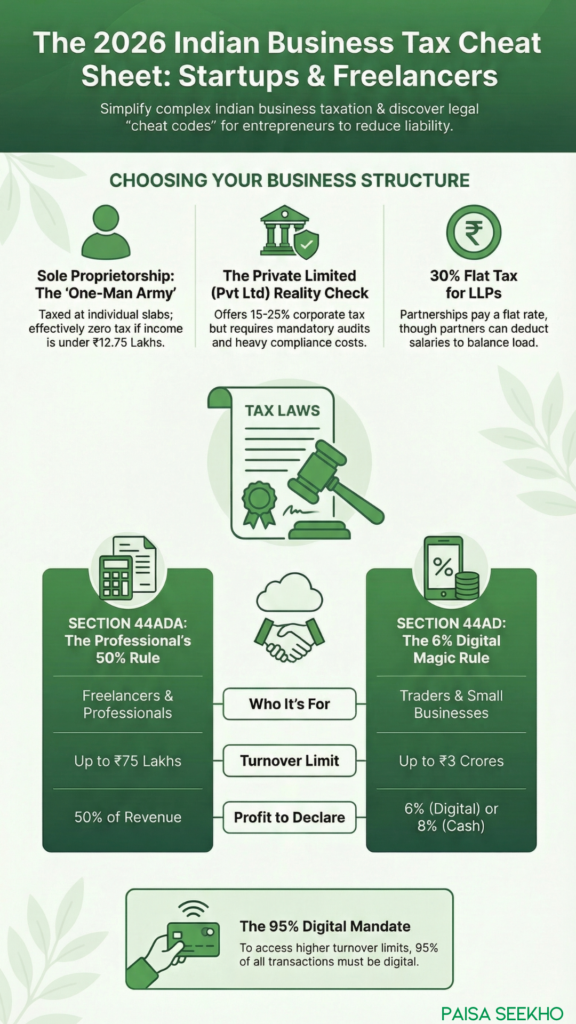
Before we can calculate how much tax you owe, the government needs to know what you are. In India, the way your business is legally registered dictates exactly how it will be taxed.
If you are just starting out, you will generally fall into one of these three buckets:
1. The Sole Proprietorship (The “One-Man Army”)
If you are a freelance writer, an independent tech consultant, or a solo shop owner who hasn’t registered a formal company, you are automatically a Sole Proprietor by default.
- How you are taxed: In the eyes of the law, you and your business are the exact same person. Your business profits are simply added to your personal income and taxed according to your individual tax slab (whether you choose the Old Tax Regime or the default New Tax Regime in 2026).
- The Benefit: It is incredibly easy. There is zero registration cost, zero complex compliance, and if your total income is under the basic exemption limit (up to Rs. 12.75 Lakhs under the new regime), your tax is effectively zero!
2. The LLP & Partnership Firm (The “Tag Team”)
If you team up with a college friend to start a marketing agency or a cloud kitchen, you might register a Partnership Firm or a Limited Liability Partnership (LLP).
- How you are taxed: The government treats the partnership as a separate entity from you. Partnerships and LLPs are currently taxed at a flat rate of 30% on their profits (plus applicable surcharge and health/education cess).
- The Catch: A 30% flat tax is quite high for beginners. However, the partners can draw a salary from the LLP (which is a deductible expense for the business), helping balance the overall tax load.
3. The Private Limited Company (The “Corporate Big League”)
This is the structure most startups dream of. If you plan to raise funding from venture capitalists or offer employee stock options (ESOPs), you must register as a Private Limited Company (Pvt Ltd).
- How you are taxed: Companies pay Corporate Tax. Depending on your turnover and whether you claim certain exemptions, domestic corporate tax rates for small businesses generally range between 15% to 25%.
- The Catch: While the tax percentage might look lower than an LLP, the compliance cost is brutal. You have to hire a Chartered Accountant, conduct mandatory annual audits, hold formal board meetings, and file heavy paperwork with the Ministry of Corporate Affairs (MCA).
Paisaseekho Pro-Tip: We see a lot of young entrepreneurs rush to register a “Pvt Ltd” company just to put the “Founder & CEO” tag in their Instagram bio. Do not do this! If your revenue is still in its early stages, the massive CA fees and compliance costs will eat you alive. Start as a simple Sole Proprietor, test your business model, and upgrade your legal structure only when your revenue (or your investors) demand it.
The Freelancer & Creator Cheat Code: Section 44ADA (Presumptive Taxation)
If you take away just one thing from this entire guide, let it be this section. If you are a freelancer, consultant, or creator, the Income Tax Department has gifted you a massive legal loophole called Presumptive Taxation under Section 44ADA.
To understand why this is a lifesaver, imagine trying to prove to the tax department exactly how much of your home internet bill, electricity, and laptop depreciation was used for “business purposes” versus “watching Netflix.” It is an accounting nightmare. Section 44ADA completely eliminates this headache.
Who Can Use Section 44ADA?
This scheme is specifically designed for “specified professionals.” If you are a freelance graphic designer, software developer, writer, architect, doctor, lawyer, or technical consultant, this is for you.
The 2026 Turnover Limits
Following recent budget updates, the government massively increased the safety net for digital creators. You can opt for this scheme if your total annual gross receipts (your total revenue) are up to Rs. 75 Lakhs. (The only catch: To use this expanded 75 Lakh limit, at least 95% of your payments must be received digitally via UPI, bank transfers, or cheques. If you deal heavily in cash, your limit is restricted to Rs. 50 Lakhs).
The 50% Magic Rule
Here is how the cheat code works: Instead of maintaining complex books of accounts and tracking every single expense receipt, the government allows you to simply declare 50% of your total revenue as your actual profit. You only pay tax on that half!
Let’s look at the math: Imagine you are a freelance UI/UX designer who made Rs. 16 Lakhs this year.
- Without 44ADA: You would have to hire a CA, calculate every single expense (software subscriptions, rent, internet), prove your profit is, say, Rs. 12 Lakhs, and pay tax on that amount.
- With 44ADA: You simply check a box on your tax return declaring that 50% of your revenue (Rs. 8 Lakhs) is your profit. The government presumes the other Rs. 8 Lakhs was spent on business expenses.
- The Result: Because Rs. 8 Lakhs falls under the tax-free limit of the New Tax Regime, your tax liability becomes ZERO, and you didn’t have to save a single expense bill!
The Small Business & Trader Cheat Code: Section 44AD
What if you don’t sell services, but you sell physical goods? Maybe you run a popular cloud kitchen, a local boutique, a digital marketing agency, or an online D2C (Direct-to-Consumer) brand.
For you, the government created a sibling scheme: Section 44AD.
Running a business involving inventory, raw materials, and staff salaries means your profit margins are naturally much lower than a freelancer’s. The government knows this, which is why the tax math here is incredibly generous.
Who Can Use Section 44AD?
This section is for resident individuals, HUFs, and Partnership Firms (but not LLPs or Pvt Ltd companies) engaged in almost any retail, trading, or manufacturing business.
The 2026 Turnover Limits
Just like with freelancers, the government recently boosted the limits to encourage digital businesses. You can use Section 44AD if your total annual turnover (sales) is up to Rs. 3 Crores. (Again, the condition remains: 95% of your sales must be digital. If you run a heavily cash-based shop, your limit is capped at Rs. 2 Crores).
The 6% / 8% Magic Rule
If you opt for Section 44AD, you do not need to maintain complex balance sheets or get your accounts audited. You simply declare a tiny, fixed percentage of your total sales as your taxable profit:
- For Digital Sales (UPI, NEFT, Cards): You only declare 6% of your turnover as profit.
- For Cash Sales: You declare 8% of your turnover as profit.
Let’s look at the math: Imagine you run a successful Instagram sneaker store. You sold Rs. 50 Lakhs worth of shoes this year, and every single customer paid via UPI or online transfer.
- Under Section 44AD, you declare your profit as just 6% of Rs. 50 Lakhs.
- Your total taxable income is considered to be just Rs. 3 Lakhs.
- Since Rs. 3 Lakhs is well below the basic tax exemption limit, you pay absolutely zero income tax on a business that moved 50 Lakhs in inventory, and you never had to hire an accountant to tally your shipping bills!
What Business Expenses Can You Actually Deduct? (If Not Using Presumptive Tax)
The presumptive taxation schemes (44AD and 44ADA) are amazing, but they aren’t perfect for everyone. What if you run a high-end video production agency where you spend 70% of your revenue on expensive camera gear, studio rent, and editing crew salaries? Declaring a 50% profit under 44ADA would actually force you to pay more tax than you should!
If your profit margins are naturally low, or if your business expenses are massive, you should skip the presumptive schemes, maintain proper accounting books, and claim your actual business expenses.
The Golden Rule of Business Deductions
Under Section 37 of the Income Tax Act, you can deduct almost any expense from your revenue before paying tax, as long as it passes one simple test: The expense must be incurred wholly and exclusively for the purpose of your business.
Here are the everyday expenses you can (and should) legally deduct:
- Rent & Utilities: If you rent a co-working space, a dedicated office, or a warehouse for your inventory, the rent and electricity bills are fully deductible. (Note: If you work from home, you can only deduct a proportionate percentage of your rent/electricity based on the area used for work).
- Software & Subscriptions: Your Adobe Creative Cloud, Notion, web hosting, domain renewals, and any SaaS tools necessary to run your business.
- Depreciation on Assets: This is a big one. If you buy a Rs. 1 Lakh MacBook for freelance coding, you cannot deduct the entire 1 Lakh in year one. The government requires you to claim “depreciation”—meaning you deduct a specific percentage of the laptop’s value every year as it undergoes wear and tear.
- Salaries & Freelance Payouts: The money you pay to your virtual assistant, your interns, or the freelance copywriter you hired for a project.
- Marketing & Advertising: Every rupee you spend on Facebook Ads, Instagram boosts, or Google AdWords to get clients is a 100% deductible business expense.
The Big Red Flags
The Income Tax Department is smart. Do not try to claim your family vacation to Goa as a “business networking trip,” or your weekly Zomato grocery orders as “office supplies.” Mixing personal expenses with business expenses is the fastest way to get a tax notice. Keep a separate bank account for your business to make this tracking easy!
Startup India: How Does the Section 80-IAC Tax Holiday Work?
If you are building something bigger than a solo freelance gig—like the next big AI SaaS platform or a massive D2C brand—and you have registered as a Private Limited Company or an LLP, the government has a special red carpet rolled out for you.
Under the Startup India initiative, the government introduced Section 80-IAC to give ambitious young founders a massive financial runway.
The 100% Tax Exemption Benefit
If your startup qualifies under this section, you get a 100% tax exemption on your profits for any 3 consecutive years out of your first 10 years of incorporation.
Imagine your tech startup makes no profit for the first three years while you build the app. In year four, it explodes and you make Rs. 2 Crores in pure profit. Under Section 80-IAC, you can choose years 4, 5, and 6 as your “tax holiday” block and pay absolutely zero corporate tax on those massive profits!
The 2026 Eligibility Update
To claim this incredible benefit, your startup must jump through a few hoops:
- The Timeline: Following the recent 2026 Budget updates, the government extended the eligibility window. Your startup must be incorporated on or before April 1, 2030.
- DPIIT Recognition: You first need to register your company on the Startup India portal and get recognized by the Department for Promotion of Industry and Internal Trade (DPIIT).
- The IMB Hurdle: Simply being a startup isn’t enough. You must apply to the Inter-Ministerial Board (IMB) and prove that your business is highly innovative, improves existing products/services, or has the potential for massive wealth and job creation.
Paisaseekho Pro-Tip: The IMB certification is strictly guarded. You cannot get a 3-year tax holiday just for opening a standard digital marketing agency. You need to prove you are building proprietary technology or a highly innovative, scalable business model.
Do I Need to Worry About GST? (The Indirect Tax Check)
We cannot talk about business taxation without doing a quick check on the “invisible tax.” While Income Tax is paid on your profits, GST (Goods and Services Tax) is charged on your sales.
As your side hustle grows, you need to know exactly when the government expects you to start charging GST to your clients or customers.
- The Service Provider Rule (Freelancers/Consultants): If you provide services, you must register for GST when your total annual revenue crosses Rs. 20 Lakhs (Rs. 10 Lakhs in Special Category States).
- The Goods Seller Rule (Shop Owners/D2C Brands): If you sell physical goods, the limit is much higher. You only need to register for GST when your total annual sales cross Rs. 40 Lakhs (Rs. 20 Lakhs in Special Category States).
- The E-commerce Catch: If you plan to sell your physical products across state borders using platforms like Amazon or Flipkart, you generally need a mandatory GST registration from Day 1, regardless of your turnover.
Paisaseekho Pro-Tip: If you want a deep dive into how GST slabs work and how to legally invoice your freelance clients, check out our comprehensive GST & Indirect Tax Basics Guide.
ITR-3 vs. ITR-4: Which Form Should You File?
Okay, you have structured your business, calculated your revenue, and applied your deductions. Now, it is July, and it is time to actually file your taxes on the government portal.
As a business owner or freelancer, the standard ITR-1 or ITR-2 forms that salaried employees use will not work for you. You have to choose between two specific forms:
1. ITR-4 (Sugam): The “Easy” Form
If you decided to use the cheat codes we talked about earlier—Section 44ADA (for professionals) or Section 44AD (for small businesses)—you will file ITR-4.
- Why it’s great: “Sugam” literally translates to “easy” or “simple.” Because you are simply declaring 50% (or 6%/8%) of your revenue as profit, this form does not ask you for complex balance sheets, profit & loss statements, or a giant list of your internet and electricity bills. It takes barely 15 minutes to fill out!
2. ITR-3: The “Detailed” Form
If you decided not to use the presumptive taxation schemes because your actual business expenses were very high, or if your turnover crossed the Rs. 75 Lakh / Rs. 3 Crore limits, you must file ITR-3.
- Why it’s complex: This form requires proper accounting. You have to declare your exact revenue, list out all your deductible business expenses (rent, salaries, depreciation), and provide a proper balance sheet.
- Rule of thumb: If you are filing ITR-3, do not try to DIY it on the portal. Hire a Chartered Accountant to ensure you don’t make a costly mistake.
Conclusion: Don’t Let Tax Fear Kill Your Hustle
Transitioning from a salaried employee to a business owner or a full-time freelancer is one of the most exciting leaps you can make. Do not let the fear of the Income Tax Department hold you back from scaling your hustle into an empire.
The tax system in India might seem intimidating at first glance, but it is actually packed with legal provisions designed specifically to help you survive your early years. By understanding your business structure, keeping your personal and business bank accounts separate, and utilizing powerful tools like Section 44ADA, you can legally wipe out a massive chunk of your tax liability.
Your Next Step: If you are a freelancer or a creator, open your bank statement right now. Calculate your total receipts for the year. If you are under Rs. 75 Lakhs, start planning to file ITR-4 using the 50% presumptive scheme this July, and watch your tax bill magically shrink!
FAQs
1. Do freelancers need to maintain proper accounting books and bills?
If you opt for the Presumptive Taxation Scheme under Section 44ADA, the answer is a relieving no! Because you are simply declaring 50% of your total income as profit, the Income Tax Department does not require you to maintain complex ledgers, balance sheets, or keep a shoebox full of internet and electricity bills.
2. Can I claim my internet, rent, and laptop as business expenses under Section 44ADA?
No. The 50% profit rule under Section 44ADA assumes that the other 50% of your income was spent on running your business. You cannot claim the 50% exemption and then try to deduct your laptop or Wi-Fi bill on top of it. If your actual expenses are much higher than 50%, you should skip 44ADA, maintain proper books, and file ITR-3 to claim those specific deductions.
3. Which ITR form should a freelancer or independent creator file?
If your gross total income is under Rs. 75 Lakhs and you are using the Section 44ADA presumptive scheme, you should file the simple ITR-4 (Sugam). If your income crosses that limit, or if you want to claim actual business expenses instead of the 50% rule, you must file the much more detailed ITR-3.
4. How much tax does a Sole Proprietorship actually pay?
A Sole Proprietorship does not have a separate corporate tax rate. Because you and the business are considered the same entity, your business profits are simply added to any other income you have, and you are taxed according to the standard individual income tax slabs (Old or New Regime).
5. What happens if my freelance income crosses Rs. 75 Lakhs?
Once you cross the Rs. 75 Lakh threshold (or Rs. 50 Lakhs if you deal heavily in cash), you are no longer eligible for the Section 44ADA cheat code. You will be legally required to maintain proper books of accounts, get your accounts audited by a Chartered Accountant (under Section 44AB), and file your taxes using ITR-3.
6. Is it better to register a Private Limited Company to save tax?
Not if you are just starting out! While the corporate tax rate (15% to 25%) might look lower than the highest individual tax slab (30%), running a Pvt Ltd company involves heavy compliance costs. You have to pay for mandatory annual audits, MCA filings, and CA fees. Stick to a Sole Proprietorship until your revenue is high enough to justify those expenses, or until you need to raise funding from investors.
7. Do I have to pay Advance Tax if I am using Section 44ADA or 44AD?
Yes, but the government gives you a slight concession. Normally, business owners have to pay Advance Tax in four installments throughout the year. But if you opt for the presumptive taxation schemes (44AD or 44ADA), you are allowed to pay your entire Advance Tax in a single installment on or before March 15th of that financial year.
8. Can I show my personal travel or meals as a business expense?
Strictly no. The Income Tax Act clearly states that any expense you deduct must be wholly and exclusively for the purpose of your business. Trying to pass off a family vacation as a “business networking trip” or your daily personal groceries as “office supplies” is a major red flag that can trigger a tax notice and heavy penalties.
9. What is the turnover limit for small businesses under Section 44AD in 2026?
If you run a small business (like a retail shop, cloud kitchen, or trading business), you can opt for Section 44AD if your total annual turnover is up to Rs. 3 Crores. However, to unlock this higher 3 Crore limit, 95% of all your business transactions must be digital (UPI, NEFT, cards). If you run a cash-heavy business, your limit remains at Rs. 2 Crores.
10. Do I need a separate bank account for my freelance business?
While it is not legally mandatory for a Sole Proprietor to have a “Current Account,” it is highly recommended. Mixing your personal grocery shopping with your client payouts in a single savings account makes calculating your revenue and expenses an absolute nightmare at the end of the year. Open a separate bank account just for your hustle!