
TL;DR: Documents Required for ITR Filing Key Takeaways
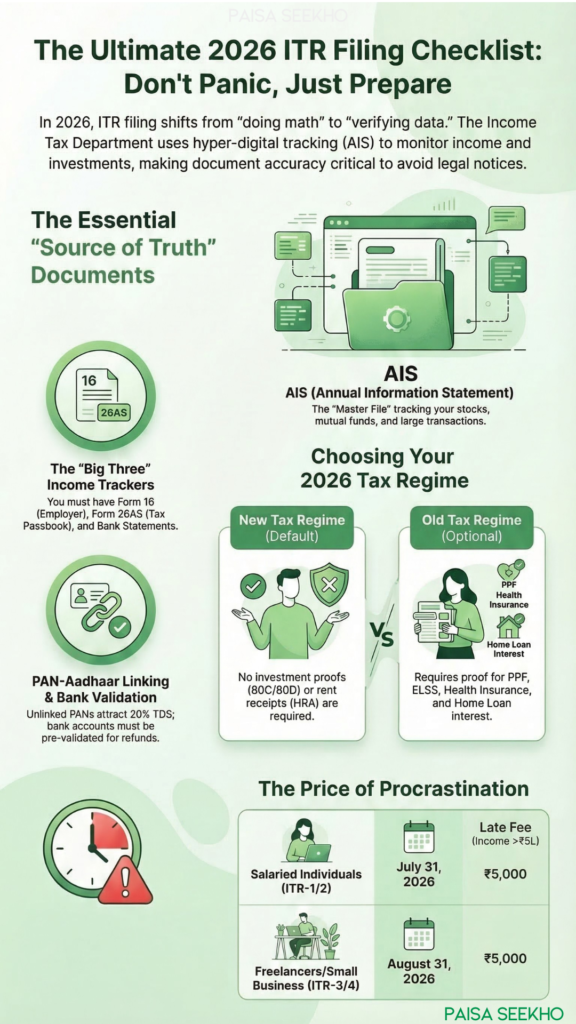
- The “Master File”: Your AIS (Annual Information Statement) is the most critical document in 2026. The Income Tax Department already tracks your salary, mutual fund sales, FDs, and large financial transactions. If your ITR does not match your AIS, you will almost certainly get a defect notice.
- The Regime Trap: The New Tax Regime is the default for FY 2025-26 (AY 2026-27). If you stick with it, you do not need to frantically hunt for 80C (PPF/ELSS) or 80D (Health Insurance) investment proofs. You only need those documents if you are actively opting for the Old Tax Regime!
- The Big Three for Salaried Employees: If you have a standard 9-to-5 job, you absolutely must have Form 16 (from your employer), Form 26AS (your tax passbook), and your Bank Statements.
- The New 2026 Deadlines: Deadlines are strictly enforced. For salaried individuals (ITR-1/ITR-2), the deadline remains July 31, 2026. For non-audit business owners and freelancers (ITR-3/ITR-4), you have until August 31, 2026.
1. Escaping the Last-Minute Tax Panic
We all know the chaotic scene that plays out in every Indian household during the last week of July.
You are desperately digging through your inbox trying to find rent receipts from eight months ago. You are calling your HR department asking for your Form 16. But, you are locked out of the income tax portal because you forgot your password, and your CA is refusing to pick up your calls because they haven’t slept in three days.
Filing your Income Tax Return (ITR) used to be a massive, anxiety-inducing math project. But in 2026, the reality is very different.
The Income Tax Department has gone hyper-digital. Thanks to linked PANs and Aadhaars, they already know exactly how much salary you earned, which mutual funds you sold on your brokerage app, and how much interest your bank paid you. Today, filing your return is no longer about “doing the math”—it is simply about verifying the data the government already has.
Gathering the right paperwork is 90% of the battle. If you have the correct documents sitting in a folder on your desktop, actually filing your return takes less than 15 minutes. To save you from the July panic, here is the ultimate, foolproof checklist of every single document you need before you sit down to file your Assessment Year 2026-27 return.
2. The Absolute Basics: Identity & Banking
Before we get into the complex financial trackers, you need your core identity and banking documents. You literally cannot log into the portal or receive a tax refund without these.
PAN Card & Aadhaar Card
Your Permanent Account Number (PAN) is your primary identity for the tax department. Your Aadhaar must be officially linked to your PAN. If they are not linked, your PAN becomes inoperative, meaning you cannot file your return, and worse, a flat 20% TDS will be deducted from your income!
Pre-Validated Bank Account Details
You need the account number and IFSC code of your primary bank account.
- Why it matters: If you overpaid your taxes and the government owes you a refund, they will not send you a physical cheque. They will transfer the money directly to your bank account via an ECS transfer.
- The Rule: Your bank account must be pre-validated on the Income Tax e-filing portal. If it is not pre-validated, your tax refund will get stuck in digital limbo, even if you file your return perfectly on time.
3. The Income Trackers (The “Big Three”)
If you are a salaried employee or a freelancer, these three documents form the absolute backbone of your tax return. Do not start filing until you have downloaded all three.
1. Form 16 (Part A & Part B)
This is the holy grail for salaried employees. It is a certificate issued by your employer proving that they have deducted tax at source (TDS) from your salary and deposited it with the government.
- Part A: Shows the total amount of TDS deducted by your employer.
- Part B: Shows the complete, granular breakdown of your salary (basic pay, HRA, allowances) and any deductions you claimed through your employer.
2. Form 26AS (The Tax Passbook)
Think of Form 26AS as your official tax bank statement. It is a consolidated record of every single rupee of TDS deducted against your PAN across the entire country.
- If your employer deducted TDS, it shows up here.
- If a freelance client deducted 10% TDS before paying your invoice, it shows up here.
- If the bank deducted TDS on your Fixed Deposit interest, it shows up here.
- Always cross-check Form 16 against Form 26AS to ensure your employer actually deposited your tax with the government!
3. AIS & TIS (The Government’s Master Watchers)
This is the most crucial update for 2026. The Annual Information Statement (AIS) and Taxpayer Information Summary (TIS) have essentially replaced Form 26AS as the ultimate source of truth. The AIS tracks everything. It monitors your stock market trades, mutual fund redemptions, foreign travel, property purchases, and even heavy credit card bills.
The Rule:
You must download your AIS from the tax portal before filing. If your ITR says you made zero profit from stocks, but your AIS shows you sold Rs. 5 Lakhs worth of mutual funds on Groww, the system will automatically flag the mismatch and send you a legal tax notice.
4. The Investment Proofs (The Regime Reality Check)
Every July, millions of young earners turn their houses upside down looking for faded LIC premium receipts, PPF passbooks, and rent agreements.
Before you join the panic, you need to answer one critical question: Which tax regime are you choosing for FY 2025-26? Because the New Tax Regime is now the default setting on the income tax portal, the list of investment documents you actually need has drastically changed.
The New Tax Regime (The “No Paperwork” Route)
If you run the math and decide to stick with the default New Tax Regime, congratulations! Your paperwork is basically done.
- What you DO NOT need: You do not need rent receipts for HRA, you do not need your PPF or ELSS mutual fund statements for Section 80C, and you do not need health insurance premium receipts for Section 80D. The government gives you a flat Standard Deduction and lower tax slab rates in exchange for giving up all these exemptions.
The Old Tax Regime (The “Heavy Paperwork” Route)
If you are actively opting back into the Old Tax Regime because you have massive home loan interest and heavy 80C investments, you must have the documentary proof ready before you file. (Even if you don’t upload them all, you must keep them safe in case of an audit).
Gather these specific documents:
- Section 80C (The Rs. 1.5 Lakh Limit): Statements for ELSS Mutual Funds, PPF passbooks, EPF contribution statements (usually on your Form 16), Life Insurance (LIC) premium receipts, and the principal repayment certificate for your Home Loan.
- Section 80D (Health Insurance): The premium payment receipts for your medical insurance (both for yourself and your parents). Remember, cash payments are not allowed for this deduction!
- Section 24(b) (Home Loan Interest): You need the official “Home Loan Interest Certificate” from your bank showing exactly how much interest you paid during the financial year.
- HRA Proofs: Rent receipts for the entire year, a copy of the rent agreement, and crucially, your landlord’s PAN card if your annual rent exceeds Rs. 1,00,000.
5. The “Wealth & Side Hustle” Documents
If you only have a salary and a savings account, Form 16 is enough. But you are a Paisaseekho reader, which means you probably have investments, side hustles, or freelance gigs. The government wants to know about those, too.
Capital Gains Statements (Stocks & Mutual Funds)
If you sold any shares on Zerodha, redeemed mutual funds on Groww, or sold digital gold this year, you triggered “Capital Gains.” You cannot just guess your profit or loss.
- The Document: You must download the official Tax P&L (Profit & Loss) Statement or Capital Gains Statement from your broker for the financial year.
- Why it matters: It gives you the exact breakdown of Short-Term Capital Gains (STCG) and Long-Term Capital Gains (LTCG), which are taxed at completely different rates. You can also download a consolidated statement from registrars like CAMS or KFintech for all your mutual funds.
Interest Certificates (The Silent Income)
The interest you earn on your bank accounts is fully taxable!
- The Document: Log into your net banking portal and download the Interest Certificate for the financial year.
- This includes interest from your regular Savings Accounts, Fixed Deposits (FDs), and Recurring Deposits (RDs). Note: Even if the bank already deducted TDS on your FD, you still have to declare the gross interest income in your ITR!
Freelance & Business Income Records
If you do graphic design on the side, run a YouTube channel, or consult as a freelancer, you cannot use the standard ITR-1 form. You will likely need to file ITR-3 or ITR-4.
- The Documents: Keep a digital folder of all your raised client invoices and your bank account statements showing the incoming payments.
- Expense Receipts: If you are claiming business expenses (like buying a new laptop for your freelance work, or paying for internet), you must have the GST bills and receipts saved to prove these were legitimate business costs.
6. Conclusion: The “Do Not Wait” Warning
Gathering your documents is 90% of the work. Once you have your digital folder ready with your Form 16, AIS, and capital gains statements, the actual filing process on the income tax portal takes less than 15 minutes.
However, waiting until the final week of July is a dangerous game. In 2026, the tax department’s systems are faster than ever, but so are the penalties for missing the deadline.
The Price of Procrastination:
- The Late Fee: If you miss the July 31st deadline, you will be hit with a late fee under Section 234F. If your income is above Rs. 5 Lakh, you pay a flat Rs. 5,000. If it is below Rs. 5 Lakh, the penalty is Rs. 1,000.
- The Interest Hit: For every month you are late, you pay 1% interest on any unpaid tax liability under Section 234A.
- The Loss Trap: If you miss the original deadline, you cannot carry forward losses from the stock market or business to future years. This means you lose the chance to reduce your tax bill for 2027 and 2028!
Call to Action: Don’t let the “tax season” stress win. Log into the income tax portal today, download your AIS, and check if it matches your bank statements. Finding a mismatch in March is an easy fix; finding it on July 30th is a disaster.
Top 10 Frequently Asked Questions
1. What is the deadline for ITR filing in 2026?
For salaried individuals and taxpayers not requiring a tax audit (ITR-1 and ITR-2), the deadline is July 31, 2026. For non-audit business owners and freelancers (ITR-3 and ITR-4), the deadline has been extended to August 31, 2026.
2. Is Form 16 mandatory for filing ITR?
While Form 16 is the most convenient document for salaried employees, it is not strictly mandatory if you have your monthly salary slips and Form 26AS. However, it is highly recommended as it contains the exact breakdown of your taxable income and TDS.
3. What is the difference between AIS and Form 26AS?
Form 26AS is primarily a “tax passbook” that shows TDS/TCS deducted against your PAN. The AIS (Annual Information Statement) is a much more detailed report that tracks all financial transactions, including savings interest, stock market trades, and high-value credit card spending.
4. Do I need to submit physical copies of my documents to the IT department?
No. India’s ITR filing is completely paperless. You do not need to upload or send physical copies of your documents. However, you must keep them safely in your records for at least 6 years in case the department sends you a scrutiny notice.
5. Can I file ITR without my landlord’s PAN for HRA?
If your annual rent exceeds Rs. 1,00,000, providing your landlord’s PAN is mandatory to claim the HRA (House Rent Allowance) exemption under the Old Tax Regime. Under the New Tax Regime, you cannot claim HRA anyway, so the landlord’s PAN is not needed.
6. Where can I get my Capital Gains statement for ITR?
You can download your Tax P&L or Capital Gains statement directly from your stockbroker’s app (like Zerodha, Groww, or Upstox). Alternatively, you can get a consolidated statement for all mutual funds from the CAMS or KFintech websites.
7. What is the penalty for filing ITR after July 31, 2026?
Under Section 234F, the late fee is Rs. 5,000 if your total income exceeds Rs. 5 Lakh. If your income is below Rs. 5 Lakh, the late fee is reduced to Rs. 1,000.
8. Is Aadhaar-PAN linking mandatory for ITR filing in 2026?
Yes. If your Aadhaar is not linked to your PAN, your PAN will be considered “inoperative.” You will not be able to file your return, and any tax refund due to you will be blocked.
9. Do I need documents for the New Tax Regime?
If you choose the New Tax Regime, you don’t need proofs for 80C, 80D, or HRA. However, you still need your Form 16, AIS, and Bank Statements to report your total income accurately.
10. Can I file ITR if I don’t have a Form 16?
Yes. If your employer didn’t issue a Form 16 (often in cases where your income was below the taxable limit), you can still file your return using your bank statements and salary slips to calculate your total income.