
TL;DR: Key Takeaways on EV Tax Exemptions
If you are planning to book an EV this weekend, here is the urgent summary:
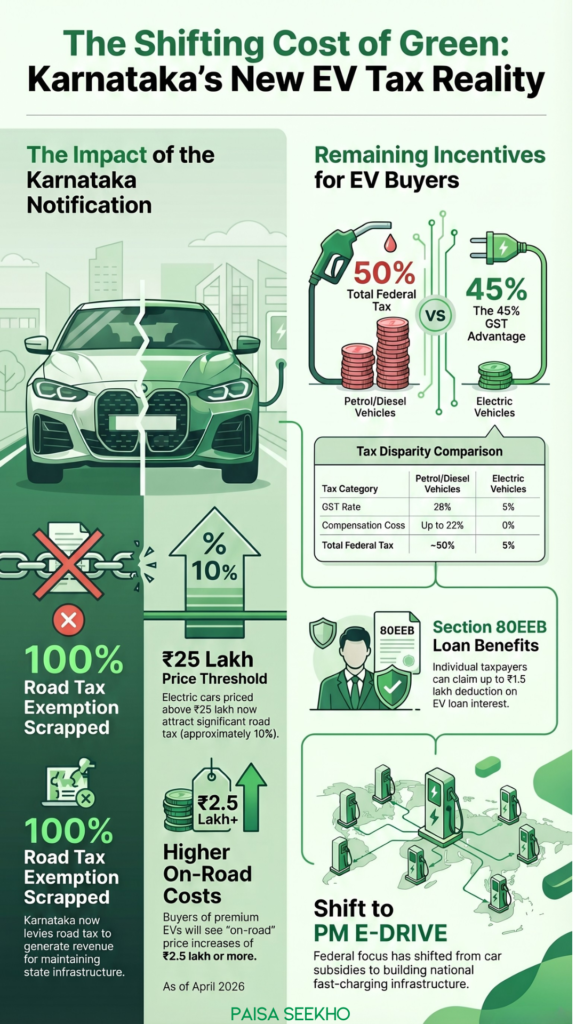
- The Karnataka Shock: Karnataka has scrapped its 100% road tax exemption. Electric cars costing above ₹25 lakh will now attract a significant road tax (likely around 10%), adding ₹2.5 lakh or more to the “on-road” price.
- The GST Advantage: The only “permanent” tax break left is the 5% GST on EVs (compared to 28% + Cess on petrol cars). This remains the biggest driver of EV affordability.
- Subsidy Shift: The old FAME-II subsidy has been replaced by the PM E-DRIVE scheme, which focuses more on two-wheelers and public transport, leaving luxury electric cars with fewer direct cash incentives.
- State-wise Variance: While Karnataka has pulled back, states like Uttar Pradesh and Tamil Nadu still offer various levels of exemptions, making the “location” of your purchase more critical than ever.
- The Middle-Class Impact: With road tax returning, the “Price Parity” between petrol cars and EVs has been pushed further away, potentially slowing down the transition to green energy.
Introduction
For the last few years, the dream of owning an electric vehicle (EV) in India was fueled by a very simple equation: the cars were expensive to buy, but the government made them “affordable” through massive tax breaks. If you lived in a city like Bangalore, you could buy a premium electric SUV and pay zero road tax, saving you lakhs of rupees compared to a petrol or diesel equivalent.
But as we move into April 2026, the “honeymoon phase” for EV buyers is officially coming to an end.
In a move that has sent shockwaves through the automotive industry, the Karnataka government has officially notified the end of road tax exemptions for electric vehicles. What was once a 100% discount has now been replaced by a significant tax levy, making EVs suddenly much more expensive in India’s “EV Capital.”
In this comprehensive guide, we will break down the latest Karnataka news, explain the shifting landscape of EV tax exemptions across India, and provide a tool to help you calculate exactly how much more you will now pay for your dream electric car.
1. The Karnataka Notification: Why Bangalore’s EV Advantage is Gone
Karnataka was one of the first states in India to implement a comprehensive EV policy. To encourage people to ditch diesel, the state offered a 100% waiver on road tax for all electric vehicles. This made Bangalore the top market for brands like Tesla (imported), Tata Motors, and Mahindra.
The 2026 Update:
The state government has now notified that this exemption is no longer sustainable. Citing the need for revenue to maintain road infrastructure, the government has introduced a slab-based road tax for EVs.
- Budget EVs (Below ₹25 Lakh): May still enjoy partial exemptions or lower tax rates to protect mass-market buyers.
- Premium EVs (Above ₹25 Lakh): Will now attract standard road tax, which in Karnataka is among the highest in India.
For a buyer looking at a premium electric car priced at ₹30 lakh, this single notification adds roughly ₹3 lakh to ₹4 lakh to the final bill overnight.
2. Understanding the General EV Tax Landscape in India
While the Karnataka news is a local setback, the national tax structure for EVs is still designed to be “friendlier” than internal combustion engine (ICE) vehicles. If you are looking at EV tax exemptions in general, you need to look at three main pillars:
Pillar 1: The GST Gap (The Biggest Saver)
The Central Government maintains a massive tax gap between “clean” and “dirty” cars.
- Petrol/Diesel Cars: Attract 28% GST plus a “Compensation Cess” that can go up to 22%. Total tax can hit 50%.
- Electric Vehicles: Attract a flat 5% GST with zero cess.
This 45% tax difference is the only reason EVs can even compete on price with petrol cars today.
Pillar 2: Section 80EEB (The Hidden Benefit)
Many taxpayers forget that the government provides an incentive for those taking loans to buy EVs. Under Section 80EEB, individual taxpayers can claim a deduction of up to ₹1.5 lakh on the interest paid on an EV loan. This can result in a direct tax saving of up to ₹45,000 for those in the highest tax bracket.
Pillar 3: State Road Tax & Registration
This is where the Karnataka news fits in. Road tax is a state subject. States like Tamil Nadu, Telangana, and Uttar Pradesh have used 100% road tax exemptions to attract EV manufacturing and buyers. However, as the number of EVs on the road increases, more states are expected to follow Karnataka’s lead and start charging road tax to recover lost revenue.
3. From FAME-II to PM E-DRIVE: The Subsidy Evolution
For years, the “FAME” (Faster Adoption and Manufacturing of Hybrid and Electric Vehicles) scheme provided direct cash discounts to buyers.
In late 2024 and 2025, the transition moved toward the PM E-DRIVE (Powered Mobility Electric Democratic Vehicle) scheme.
- The Focus: The new scheme heavily prioritizes electric two-wheelers, three-wheelers, and e-buses.
- The Car Catch: Direct cash subsidies for private electric cars have been significantly reduced or eliminated in the latest federal budget. The government believes that the “5% GST” is a large enough subsidy for car buyers, and the remaining funds should be used to improve Charging Infrastructure.
4. How Much Will Your EV Cost Now?
With road tax coming back in major states, calculating the “On-Road” price of an EV has become a headache. To help you understand the impact of these tax shifts, use the calculator below. You can compare the cost of an EV with and without the road tax exemption to see exactly how much the Karnataka notification (or potential moves by other states) will hit your pocket.
5. Conclusion: Is Buying an EV Still Worth It?
The end of tax exemptions in Karnataka is a sign of things to come. As electric vehicles move from being a “niche luxury” to a “mass-market reality,” governments can no longer afford to give away thousands of crores in road tax revenue.
Is the EV dream dead? Not at all.
Even with a 10% road tax, an electric car still carries a 5% GST compared to the massive 43-50% tax on a petrol car. Furthermore, the running cost (petrol vs. electricity) still favors EVs by a massive margin.
However, the “break-even” point (the time it takes for your fuel savings to cover the higher purchase price of an EV) has just gotten longer. If you are an urban commuter driving more than 40km a day, the EV still makes perfect sense. But if you were buying an EV solely for the “tax savings,” the new rules in Karnataka are a clear signal to re-evaluate your math.
Frequently Asked Questions (FAQs): EV Tax Exemptions 2026
Q1: Is road tax still zero for EVs in India?
It depends on the state. While it was zero in many states previously, Karnataka has officially ended the 100% exemption in April 2026. Other states like Delhi and Maharashtra have also been reviewing these exemptions periodically.
Q2: What is the GST rate on electric vehicles?
The GST on all electric vehicles in India is currently fixed at a very low rate of 5%. This is significantly lower than the 28% to 50% total tax levied on petrol and diesel vehicles.
Q3: Can I still claim the ₹1.5 lakh income tax deduction on an EV loan?
The deduction under Section 80EEB was originally for loans sanctioned until March 31, 2023. Unless the government explicitly extends this in the latest 2026 budget circulars, new loans may not be eligible. Always check the latest Finance Act updates for the current assessment year.
Q4: Does the Karnataka road tax apply to electric two-wheelers (scooters)?
The recent notification primarily targets four-wheelers and premium vehicles. Many states continue to offer exemptions for electric two-wheelers to support affordable transport for the masses.
Q5: What is the PM E-DRIVE scheme?
PM E-DRIVE is the successor to the FAME-II scheme. It provides subsidies for the purchase of electric two-wheelers, three-wheelers, and e-buses, and focuses heavily on setting up a nationwide network of fast-charging stations.
Q6: Why are states like Karnataka removing EV exemptions?
As EV adoption grows, states are losing a massive chunk of their revenue which comes from “Motor Vehicle Tax” (Road Tax). To maintain roads and fund public infrastructure, states are now slowly re-introducing taxes on EVs.
Q7: Is it cheaper to register my EV in another state?
While it might seem cheaper, you are legally required to register your vehicle in the state where you primarily reside. Registering in a low-tax state while living in Bangalore can lead to heavy penalties and seizure of the vehicle by local RTO authorities.
Q8: Are hybrid cars also eligible for these EV tax exemptions?
No. In India, “Strong Hybrids” (like the Toyota Hyryder or Maruti Grand Vitara) are still taxed similarly to petrol cars, with GST rates often hitting 43%. Tax exemptions are strictly reserved for Battery Electric Vehicles (BEVs).
Q9: Does the 5% GST apply to EV chargers and batteries?
If you buy the charger along with the car, it is taxed at 5%. However, if you buy a charger or a spare battery separately later, it may attract a higher GST rate of 18%.
Q10: Should I wait for FAME-III before buying an electric car?
The government has shifted focus toward the PM E-DRIVE scheme. It is unlikely that massive direct cash subsidies for private electric cars will return in the near future. If you need a car now, waiting for a “new” subsidy might result in you paying higher prices due to inflation and the removal of road tax exemptions.