

TL;DR: Key Takeaways on March vs. April Salary Tax Rules
If you are just about to check your bank account and need the quick facts, here is the summary of the new payroll rules:
- The Payment Date Rule: The tax law applied to your salary depends entirely on when it is paid to you, not when you earned it.
- March Salary (Paid by March 31): If your company credited your March salary on or before March 31, 2026, it is governed by the old Income-tax Act, 1961 (under Section 192).
- April Salary (Paid from April 1 onwards): Any salary paid on or after April 1, 2026, is legally governed by the new Income Tax Act, 2025 (under the new Section 392).
- The Big Reset: Your employer is required to completely “reset” your TDS calculation starting April 1, using the new rules, projected income, and the new “Tax Year 2026-27” framework.
- Investment Proofs: Old section names (like Section 80C) are gone. Your HR department will require you to submit your new investment declarations referencing the updated schedules of the 2025 Act.
Introduction
April is usually a month of celebration for salaried employees. It marks the beginning of the new financial year, appraisals are finalized, and annual bonuses start rolling in. But in April 2026, the mood in HR and payroll departments across India is a mix of confusion and panic.
Why? Because the entire legal foundation of how your salary is taxed has just changed overnight.
On April 1, 2026, the government officially retired the 65-year-old Income-tax Act of 1961 and replaced it with the brand-new Income Tax Act, 2025. This massive legal shift has left millions of salaried employees asking a very practical question: “If I am receiving my March salary today, which tax law applies? The old one or the new one?”
The answer directly impacts your take-home pay, your Tax Deducted at Source (TDS), and your investment declarations. The Income Tax Department recently released a detailed set of FAQs to clear up this exact overlap. In this comprehensive guide, we are going to break down the “March vs. April” payroll confusion so you know exactly what is happening to your hard-earned money this month.
Why is There Confusion Between March and April 2026 Salary Tax Calculations?
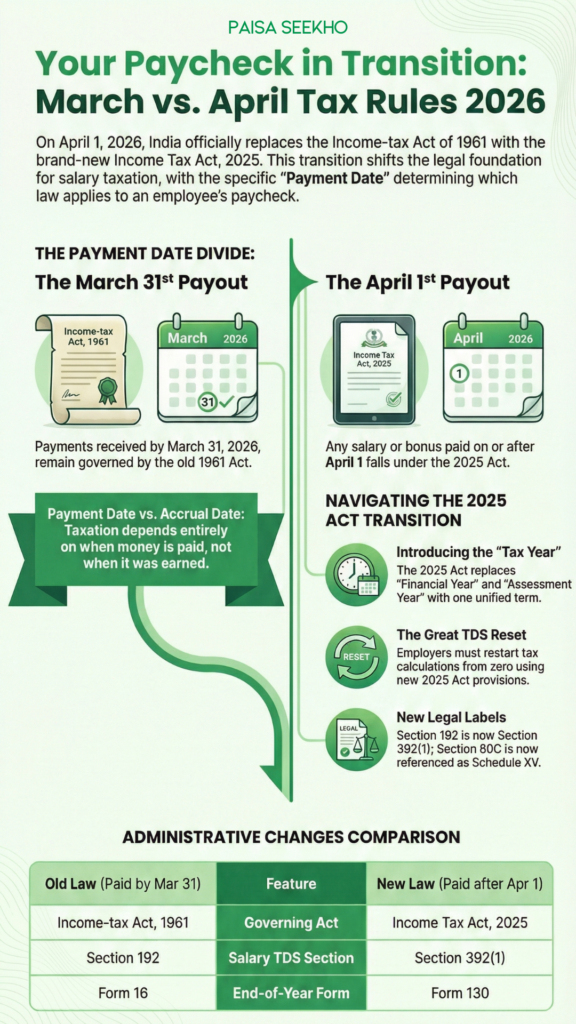
To understand the chaos, you have to understand the timeline of the new law.
For the entirety of Financial Year (FY) 2025-26, your employer deducted your taxes based on the old Income-tax Act of 1961. You submitted your rent receipts for HRA, your life insurance proofs for 80C, and your home loan interest certificates. Based on that old math, the HR department calculated a fixed monthly TDS amount and deducted it from your paycheck from April 2025 all the way to March 2026.
However, on April 1, 2026, the Income Tax Act 2025 came into power. The old concepts of “Financial Year” and “Assessment Year” were thrown in the trash, replaced by a single, simplified term called the “Tax Year.” The confusion arises because work performed in March is often paid in the first week of April. Employees want to know if their March hard work gets dragged into the new April tax rules.
How Does the Payment Date Decide Between the 1961 Act and 2025 Act?
The Income Tax Department recognized this massive overlap and issued a crystal-clear directive to all employers: Taxation depends on the date of payment, not the date of accrual.
Under Indian tax law, Tax Deducted at Source (TDS) on salary must be deducted at the time of payment. This creates a very strict dividing line:
Scenario A: The March 31st Payout
If your employer has a policy of crediting the monthly salary on the very last day of the month, your March 2026 salary hit your bank account on March 31.
- Because the payment happened before the new law activated, this paycheck is strictly governed by the old Income-tax Act, 1961.
- The TDS was deducted under the classic Section 192.
- This income officially belongs to the final FY 2025-26, and you will receive the classic Form 16 for it.
Scenario B: The April Payout
If your company credits your monthly salary on the 1st, 5th, or 7th of the following month, things change dramatically. Any salary, advance payment, or bonus paid to you on or after April 1, 2026, falls under the new legal regime.
- Your April salary (paid in late April or early May) will be governed entirely by the Income Tax Act, 2025.
- It belongs to the brand-new Tax Year 2026-27.
This means that within a span of just a few days, your payroll department has to switch from an old 65-year-old law to a completely new legal framework.
What Are the New TDS Rules Under Section 392(1) from April 2026?
For decades, every accountant and HR professional in India had “Section 192” memorized. It was the legal code that forced employers to deduct TDS from your salary.
Under the new Income Tax Act 2025, that section has been retired.
Starting from your April 2026 salary, your TDS is legally governed by Section 392(1).
While the section number has changed, the core “pay-as-you-earn” philosophy remains the same. The government still wants their tax money every single month rather than waiting for a lump sum at the end of the year.
The Great TDS Reset
The tax department’s FAQs explicitly state that employers must initiate a “TDS Reset” starting April 1, 2026.
This means your HR department cannot just copy-paste the TDS amount they deducted from you in March and apply it to April. They must start with a blank slate. They will:
- Re-estimate your total annual income for the new Tax Year 2026-27.
- Apply the revised provisions, slab rates, and exemptions available under the 2025 Act.
- Calculate a brand-new monthly TDS deduction amount.
Because of this reset, you might notice a slight change in your in-hand “take-home” pay this month, depending on how your deductions are recalibrated under the new mathematical framework.
How Will Your Investment Declarations Change Under the New Tax Law?
Every April, HR sends out that dreaded email asking you to declare your planned investments for the year so they can calculate your tax. Usually, you just tick the box for “Section 80C” (PPF, LIC) and “Section 80D” (Health Insurance).
If you are sticking to the Old Tax Regime, you can still claim these deductions, but the names of the laws have changed.
You can no longer officially declare investments under “Section 80C.” The Income Tax Act 2025 has consolidated and rewritten these sections. As the tax department clarified, deductions that used to fall under Section 80C are now officially referenced as “Schedule XV read with section 123” of the Income Tax Act, 2025.
Your employer’s payroll software (like SAP, Zoho, or Keka) is currently being aggressively updated to reflect this new section numbering. When you log into your employee portal to declare your rent or investments this month, do not panic if the old familiar section names are gone. The financial benefits (the ₹1.5 Lakh limits) are mostly the same; they just have a shiny new legal label.
Conclusion
The transition to the Income Tax Act 2025 is a monumental event in India’s financial history. While the government has done an excellent job of simplifying the actual tax code, the mechanical process of switching over is bound to cause some minor friction in corporate payroll departments.
The most important takeaway for you as an employee is to understand the timeline. Your March salary belongs to the past, and your April salary belongs to the future.
When your April 2026 payslip arrives, take five minutes to review it carefully. Check the TDS amount to see how the “reset” affected your take-home pay, and ensure your HR department has successfully migrated your profile to the new Tax Year 2026-27 calculations. By staying informed, you can avoid year-end tax shocks and ensure a smooth financial journey through this historic transition year.
Frequently Asked Questions (FAQs): March vs. April Salary Tax Rules
Q1: Will my March 2026 salary be taxed under the new Income Tax Act 2025?
If your employer paid your March salary on or before March 31, 2026, it is governed by the old Income-tax Act, 1961. The tax rules depend entirely on the date the money is paid to you, not the month you performed the work.
Q2: What tax law applies to my April 2026 salary?
Any salary, bonus, or advance paid to you on or after April 1, 2026, is legally governed by the new Income Tax Act, 2025.
Q3: What happened to Section 192 for salary TDS?
Section 192 of the old 1961 Act has been officially replaced. Under the new 2025 Act, the legal mandate for your employer to deduct TDS from your monthly salary falls under Section 392(1).
Q4: Will my take-home pay change in April 2026?
It is highly possible. The Income Tax Department has instructed all employers to “reset” TDS computations starting April 1. Based on your new projected income and the provisions of the new 2025 Act, your monthly TDS deduction might slightly increase or decrease, altering your final in-hand salary.
Q5: Are the tax slab rates different in April compared to March?
The core tax slab rates (especially under the New Tax Regime) were largely retained during the transition to the 2025 Act to prevent financial shock. However, the exact calculation of your TDS will now follow the streamlined provisions of the new Act.
Q6: What happened to “Assessment Year” and “Financial Year”?
The new Income Tax Act 2025 completely deletes the confusing concepts of a previous Financial Year and a future Assessment Year. Starting from your April salary, everything falls under a single, unified term called the “Tax Year” (e.g., Tax Year 2026-27).
Q7: Can I still claim Section 80C deductions for my PPF investments in April?
Yes, the financial benefit remains if you opt for the Old Tax Regime, but the legal name has changed. What used to be known as Section 80C is now referenced as “Schedule XV read with section 123” under the new 2025 Act.
Q8: Will I get Form 16 for my March 2026 salary?
Yes. For all salary earned and paid up to March 31, 2026, your employer will issue the traditional Form 16 (covering FY 2025-26). However, for the salary you earn from April 2026 onwards, you will eventually receive the newly introduced Form 130 next year.
Q9: What if my company made a mistake and deducted TDS under the old rules in April?
The tax department has clarified that citing the old section number (like Section 192 instead of Section 392) for payments made after April 1 may lead to processing errors. Your HR or payroll department will have to submit a “correction statement” to the government to fix the section reference.
Q10: What should I do if my HR asks for my investment declaration for the new year?
You should submit your planned investments (like life insurance, rent, or mutual funds) immediately. Ensure that your employer’s portal has been updated to reflect the new 2025 Act terminology so that your TDS for Tax Year 2026-27 is calculated accurately from your very first April paycheck.