

TL;DR: Key Takeaways on the Income Tax Act 2025
If you are short on time, here is the absolute quickest summary of what changes today:
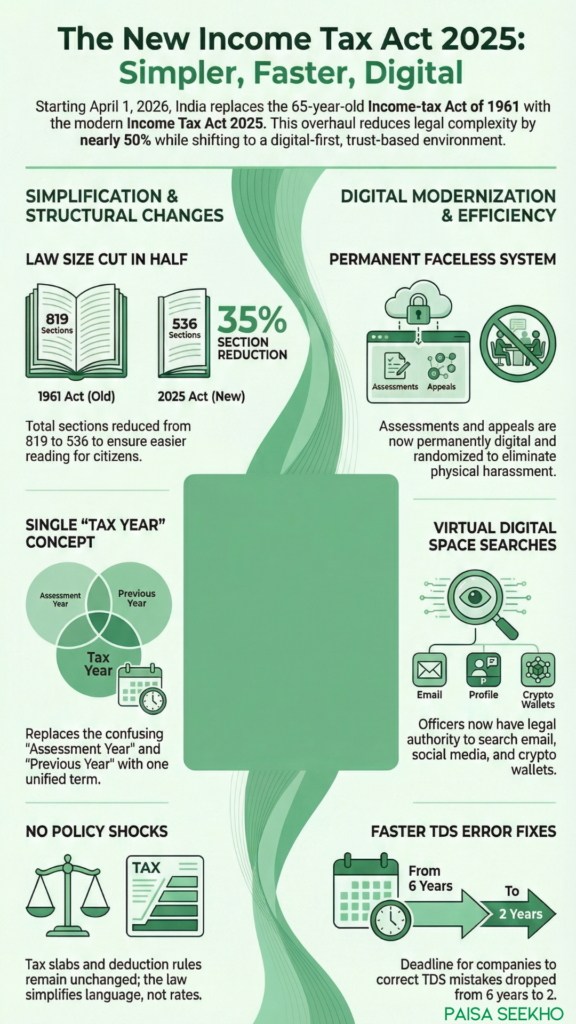
- The Law is Much Shorter: The government cut the word count of the tax law in half! They deleted hundreds of outdated sections, making the law much easier for a normal person to read.
- Goodbye Form 16: The most famous tax document in India is officially retired. Starting this year, your employer will issue you Form 130 instead of Form 16. It serves the exact same purpose but is much more detailed and entirely digital.
- Your Tax Rates Stay the Same: The new Act does not increase your taxes. The tax slabs and the choice between the Old and New Tax Regimes remain exactly the same as before.
- Goodbye “Assessment Year”: The confusing old system of having a “Previous Year” and an “Assessment Year” is dead. The new law introduces a single, simple term: the “Tax Year.”
- Digital Searches are Legal: If you are investigated for tax fraud, the new law legally allows officers to break digital locks and search your “Virtual Digital Spaces,” like your emails, social media, and crypto wallets.
- Faster Fixes for Mistakes: If a company makes a mistake on your TDS (Tax Deducted at Source), they now only have 2 years to fix it, down from 6 years. This means less waiting for you to get your tax refunds.
Introduction
Imagine living in a massive, beautiful house, but the instruction manual on how to run the electricity and plumbing was written 65 years ago. Over the decades, people kept adding sticky notes, crossing out sentences, and gluing new pages into the manual. Eventually, the manual became so heavy and confusing that you had to hire a highly paid expert just to figure out how to turn on the lights.
For the last several decades, that is exactly how the Indian tax system felt. We were using the Income-tax Act of 1961—a massive, incredibly complicated law that had been stitched together and rewritten hundreds of times. It was so full of legal jargon and confusing exceptions that even professional Chartered Accountants sometimes struggled to understand it.
But today, April 1, 2026, marks a historic milestone in India’s financial history. The government has officially retired that old 1961 rulebook and replaced it with the brand-new Income Tax Act, 2025.
If you are worried that the government just invented a completely new law to secretly raise your taxes, take a deep breath and relax. The goal of this new law is not to take more of your money. The goal is to make taxes simple, transparent, and digital.
In this comprehensive, easy-to-understand guide, we are going to break down exactly what the new Income Tax Act 2025 is, why the government created it, and the biggest changes that will directly affect your wallet, your business, and your peace of mind.
1. Why Did We Need a New Income Tax Act 2025 in the First Place?
To understand how great the new law is, you have to understand how terrible the old law had become.
The Income-tax Act of 1961 was over 5.12 lakh words long. It had 819 different sections. When the government wanted to change a rule, they didn’t just rewrite the sentence. Instead, they added confusing legal phrases called “provisos” and “explanations” to the bottom of the page. It became a maze.
Because the language was so difficult to understand, it caused massive fights. The Income Tax Department would read a sentence one way, and the taxpayer would read it another way. This resulted in thousands of court cases dragging on for years, wasting the government’s time and the citizen’s money.
The Income Tax Act, 2025 is the ultimate cleanup project.
The government set up a special committee to rewrite the entire law in plain, simple English. They deleted obsolete rules that nobody has used since the 1990s. They reduced the number of sections from 819 down to just 536, and they cut the word count by nearly 50%.
Instead of writing massive paragraphs of text, the new Act uses simple mathematical formulas and clear tables. It is designed so that a regular small business owner can actually read the law and understand what they owe without needing a law degree.
2. Form 16 Is Replaced by Form 130
For decades, millions of salaried employees in India eagerly waited for their HR departments to hand them “Form 16” every June. Form 16 was synonymous with filing taxes. It was the ultimate cheat sheet that showed your salary and how much TDS the company had cut.
Under the new Income Tax Act 2025, Form 16 is officially dead. As part of the massive legal cleanup, the government is completely renumbering all tax forms so they logically match the new sections of the 2025 Act. Here is exactly what is changing in your paperwork:
Form 130 Replaces Form 16
Starting this financial year, your employer will issue you Form 130. Functionally, it does the exact same job as Form 16, but it is far more detailed, transparent, and comprehensive. It is cleanly divided into three distinct parts:
- Part A: Contains the basic details of your employer and your own personal details.
- Part B: A high-level summary of the income paid to you and the tax deducted.
- Part C: This is the deep dive. It features Annexure I, which gives a crystal clear, step-by-step breakdown of your gross salary, your claimed exemptions, your deductions, your total taxable income, and your final tax payable. (There is also an Annexure II specifically designed for senior citizens to detail pension and interest income).
The End of Manual Forms
The biggest upgrade with Form 130 is that employers cannot just type it out on a manual Excel sheet anymore. By law, employers must officially file their quarterly statements with the government, and then download Form 130 directly from the government’s TRACES portal. This guarantees that the tax numbers on your paper perfectly match the numbers in the government’s computer, dramatically reducing the chance of you getting an error notice.
Other Famous Forms Renamed
Form 16 is not the only document getting a new name. You need to memorize these new numbers:
- Form 131 (Replaces Form 16A): If you earn non-salary income, like rent from a property, freelance professional fees, or bank interest, you will now receive Form 131 as your TDS certificate.
- Form 168 (Replaces Form 26AS): Your beloved annual tax passbook, which shows every single rupee of tax paid against your PAN card across the whole country, is now officially called Form 168.
- Form 138 (Replaces Form 24Q): This is the form your employer uses to file their quarterly TDS returns to the government.
3. Your Tax Rates Are NOT Going Up
Whenever a government announces a “new tax law,” people instantly panic. The biggest misconception spreading on social media right now is that the Income Tax Act 2025 is a sneaky way to increase taxes on the middle class.
This is completely false. When drafting the new Act, the Ministry of Finance had a strict golden rule: Textual simplification, no policy shocks. This means the actual math behind your taxes has not changed. The familiar structure you know—like the “5 Heads of Income” (Salary, House Property, Capital Gains, Business, and Other Sources)—remains perfectly intact.
- The low tax slabs of the New Tax Regime? They are still there.
- The ₹1.5 Lakh Section 80C deduction in the Old Regime? It is still there.
- The corporate tax rates for companies? Completely unchanged.
The government wanted to ensure absolute continuity and predictability. They changed the language to make it easier to read, but they did not change the price tag of your taxes.
3. New Income Tax Act 2025 Will Have a Single “Tax Year”
If you have ever filed an Income Tax Return (ITR), you have probably been confused by the calendar.
Under the old 1961 law, we had two different terms:
- The Previous Year (PY): This was the year you actually worked and earned the money (e.g., April 2024 to March 2025).
- The Assessment Year (AY): This was the year you actually filed the paperwork and paid the tax (e.g., April 2025 to March 2026).
This confused everyone. People would log into the portal to file taxes for 2024, click “2024”, and suddenly get an error because they were supposed to click Assessment Year 2025.
The Income Tax Act 2025 completely destroys this confusing double-calendar system.
Starting today, the law introduces a single, brilliant, and easy-to-understand concept: The Tax Year.
If you earn a salary between April 1, 2026, and March 31, 2027, all of your income, investments, and tax filings will simply be referred to as “Tax Year 2026-27.” No more mental gymnastics. You earn the money in that year, and you file for that year. Simple!
4. Digital Upgrade of the Tax System
The world has changed since 1961. Back then, accounting was done in physical leather-bound books, and tax officers worked entirely on paper. Today, our money moves at the speed of light through UPI, and our investments are digital. The new Act aggressively modernizes the powers of the tax department to match the 21st century.
The Faceless Revolution is Permanent
In the past, if there was a problem with your taxes, you had to physically go to the Income Tax Office, sit across from an officer, and argue your case. This human interaction often led to delays, bias, and sadly, corruption.
A few years ago, the government started experimenting with “Faceless Assessments,” where everything is done online, and you never even know the name of the officer checking your file. The Income Tax Act 2025 makes this general power permanent. The central government now has sweeping powers to design technology-driven schemes to handle tax collections, inquiries, and appeals completely digitally, ensuring massive transparency and zero physical harassment.
Searching “Virtual Digital Spaces”
This is a massive new power for the tax authorities.
Under the old law, if someone was suspected of massive tax evasion, officers would raid their physical house and break open physical metal safes to find hidden account books. But today, criminals hide their money on the internet.
The new Act explicitly gives income tax authorities the legal power to search a “Virtual Digital Space.” The law defines this as any environment experienced through computer technology. This means that during a legal search and seizure, officers can now legally break open or override passwords to your:
- Email servers
- Social media accounts
- Online stock trading accounts
- Cryptocurrency wallets
- Cloud storage drives
If you are hiding digital assets, the taxman now officially has the digital keys to find them.
5. Faster Fixes and Shorter Deadlines
Nobody likes waiting for the government to fix a mistake. The new Act recognizes that in a digital world, corrections should happen much faster.
A great example of this is the new rule for TDS (Tax Deducted at Source).
Let’s say you do freelance work for a big company. The company pays you, deducts 10% TDS, and is supposed to deposit that money with the government under your PAN card.
Under the old 1961 Act, if the company made a typo and messed up your TDS statement, the law gave them a massive six years to file a correction. That meant you might have to fight with a company for years just to get the tax credit you legally deserved.
The Income Tax Act 2025 has drastically reduced this timeline. Companies now only have a maximum of two years to file a correction statement for TDS. This forces corporations to be much more accurate and efficient, ensuring that regular taxpayers get their tax credits and refunds much faster.
Furthermore, all the scattered rules about TDS have been consolidated into one easy-to-read chapter, making it much easier for businesses to understand exactly when and how they need to deduct tax.
6. What Happens to Old Tax Disputes?
You might be wondering: “If the old 1961 law is dead, what happens to someone who is currently fighting a tax case in court from the year 2023?”
The government thought of this. You cannot just delete a law overnight without causing chaos. To prevent the system from crashing, the government introduced “transitional provisions.”
Think of this as a grandfather clause. If you received a tax notice, filed an appeal, or claimed a refund under the old 1961 Act before April 1, 2026, that specific case will continue to be processed and judged using the old 1961 rules until the case is closed.
However, any new money you earn, any new tax returns you file, and any new notices issued after April 1, 2026, will strictly follow the rules of the new Income Tax Act 2025.
7. A Trust-Based Tax Environment
Ultimately, the most important shift in the Income Tax Act 2025 is not just about word counts or digital searches; it is a shift in philosophy.
For a long time, the tax system in India was built on suspicion. The laws were incredibly strict and complicated because the government assumed people would try to cheat. The problem is that complicated laws don’t stop criminals; they only end up confusing and punishing honest, hardworking citizens.
By simplifying the legal structures, providing crystal clear definitions, and embracing digital-first processes, the government is trying to build a “trust-based” tax environment. They want to make it so incredibly easy to comply with the law that the average person no longer feels the need to hide their income or hire expensive consultants just to file a basic return.
Conclusion: A Modern Law for a Modern India
April 1, 2026, will be remembered as the day India’s tax system finally caught up with its rapidly growing economy.
The Income Tax Act 2025 is a massive victory for clarity, simplicity, and common sense. By throwing away the obsolete rules of the 1960s, eliminating the confusing Assessment Year calendar, and integrating modern technology directly into the legal code, the government has created a framework that works for the taxpayer, not against them.
While the core math of your paycheck remains the same, the experience of managing your taxes is about to become significantly smoother, faster, and infinitely less stressful. Welcome to the future of Indian taxation!
Frequently Asked Questions (FAQs): The Income Tax Act 2025
Q1: When exactly does the new Income Tax Act 2025 take effect?
The new Act comes into force today, April 1, 2026. This means that all the income you start earning from this day forward (for the financial year 2026-27) will be governed, calculated, and assessed under this brand-new law.
Q2: Did my tax slab rates increase under the new Act?
No, absolutely not! The government’s main goal was to simplify the language of the law, not to change the math. Your income tax slabs, the rates you pay, and the basic exemption limits remain exactly the same as they were before the transition.
Q3: What is the difference between “Assessment Year” and the new “Tax Year”?
In the old system, if you earned money in 2024, you filed your taxes in the “Assessment Year” of 2025. It was very confusing. The new law deletes “Assessment Year” entirely. Now, there is only the “Tax Year.” If you earn money between April 2026 and March 2027, you file your return for the “Tax Year 2026-27.” It matches perfectly.
Q4: Do I need to learn a completely new way to file my ITR online?
No. While the backend legal framework has been completely rewritten, the Income Tax Department’s e-filing website will look very similar to you. You will still log in with your PAN, check your pre-filled data, and submit. In fact, because the new law is simpler, the online forms will likely become even shorter and easier to fill out.
Q5: What are “Virtual Digital Spaces” in the new tax law?
Because modern wealth is often stored digitally, the new Act gives tax officers the legal power to search “Virtual Digital Spaces” during an official fraud investigation. This includes accessing a suspect’s email servers, social media accounts, cloud storage drives, online investment accounts, and cryptocurrency wallets.
Q6: Why did the government throw away the old 1961 Act instead of just updating it?
The 1961 Act had been updated so many times over 65 years that it became a massive, unreadable mess of over 5.12 lakh words. The constant patches made the language confusing and led to endless court battles. The government realized it was easier to throw it out and write a clean, 2.6-lakh-word modern law from scratch.
Q7: Will this new law stop tax officers from harassing citizens?
Yes, that is a major goal. The new Act permanently bakes “Faceless Assessment” and “Faceless Appeals” into the core powers of the government. This means your tax returns are processed and audited by computers and randomized officers online, eliminating the need for you to ever physically meet a tax officer, which drastically reduces the chance of corruption.
Q8: What happens if I have a pending tax dispute or notice from 2024?
Do not worry; the system will not crash. The government has created “transitional provisions.” This means that any tax disputes, legal appeals, or notices related to the years before April 1, 2026, will continue to be handled using the old 1961 rules until they are completely resolved.
Q9: Is the Old Tax Regime completely cancelled in the 2025 Act?
No. The Income Tax Act 2025 retains the core policy framework, which means the choice between the New Tax Regime (low rates, no deductions) and the Old Tax Regime (higher rates, lots of deductions) is still available. You can still claim your 80C and HRA if you choose the Old Regime.
Q10: Did the rules for TDS (Tax Deducted at Source) change?
The tax rates for TDS are mostly the same, but the deadlines are much stricter now. In the past, companies had 6 years to fix a mistake on a TDS statement. Under the new Act, they only have 2 years to file a correction. This ensures your tax records are updated quickly and your refunds are not delayed by corporate laziness.
Q11: What is the difference between Form 16 and the new Form 130?
Functionally, they do the same job. However, Form 130 is more comprehensive and standardized. It features three distinct parts (A, B, and C) that provide a clearer breakdown of your salary, deductions, and tax calculations. Most importantly, Form 130 must be generated directly from the government’s TRACES portal, ensuring it is 100% accurate
⚠️ Disclaimer:
At Paisaseekho, our mission is to make you financially literate. The information provided in this article is for educational and informational purposes only and should not be construed as professional tax, investment, or legal advice.