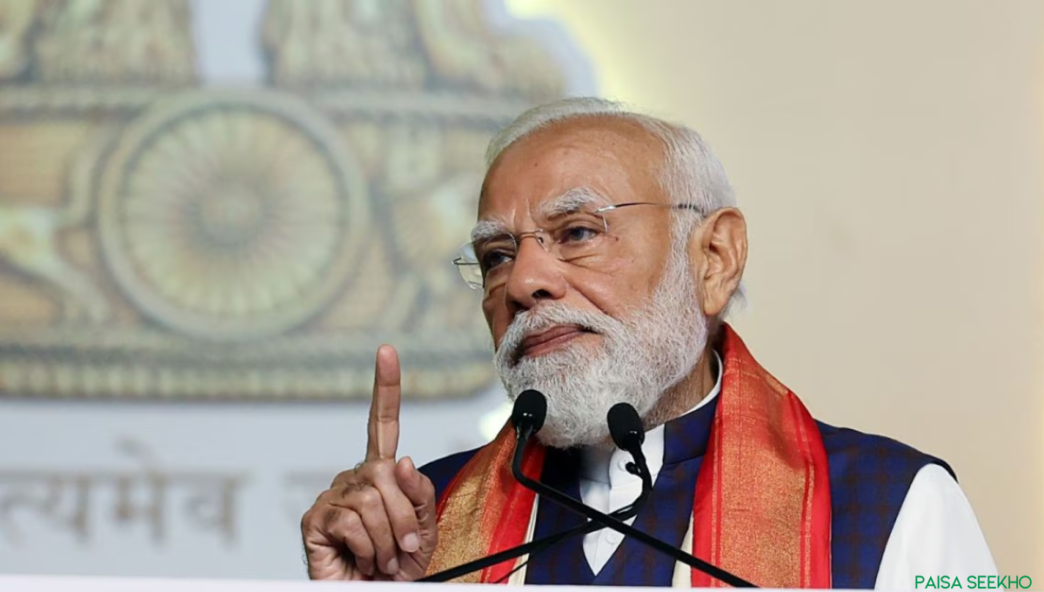
TL;DR: Key Takeaways from the PM Modi Announcements
If you are rushing to work right now and need the fast facts, here is the summary of what is happening:
- The Root Cause: The massive war in West Asia has severely disrupted global crude oil supplies, sending petrol and diesel prices skyrocketing globally.
- The WFH Appeal: PM Modi urged corporate India to reinstate Work From Home. This is not for health reasons; it is to keep millions of cars off the road to save millions of liters of fuel every day.
- The Gold Ban Appeal: India imports almost all its gold using US Dollars. Buying gold right now drains India’s precious Dollar reserves, which the government desperately needs to buy expensive crude oil.
- The Travel Appeal: Going on foreign holidays also drains US Dollars from the Indian economy. The PM urged citizens to practice “Dekho Apna Desh” and travel domestically to keep money inside the country.
- The Goal: Prevent a massive drop in India’s Foreign Exchange (Forex) reserves and stop the Indian Rupee from crashing against the US Dollar.
Introduction
If you were watching television or scrolling through your phone on the evening of May 10, 2026, you probably felt a sudden sense of déjà vu. The Prime Minister of India, Narendra Modi, appeared on our screens for an unscheduled national address.
For a brief, terrifying moment, many Indians wondered: “Is it another pandemic? Are we going back into a lockdown?”
Thankfully, it is not a medical emergency. However, it is a severe economic and geopolitical emergency.
Addressing the nation amid the rapidly escalating conflict in West Asia (the Middle East), PM Modi made three highly unusual, direct appeals to the middle class and corporate India:
- Implement “Work From Home” (WFH) wherever possible.
- Avoid buying physical gold.
- Postpone non-essential foreign trips and vacations.
Why is the Prime Minister asking us to stop buying gold for upcoming weddings? Why is he asking IT companies to send their employees back home? What does an international war have to do with your family vacation to Thailand or Dubai?
Let’s connect the dots between global wars, crude oil, and your daily life. We will explain exactly why the government is pushing the panic button on foreign exchange, how these “PM Modi announcements” affect your wallet, and give you a free interactive calculator to see how much money you can personally save by following the WFH mandate.
How is the West Asia Crisis Impacting India?

To understand the Prime Minister’s requests, you first have to understand India’s biggest economic weakness: We do not produce our own oil.
India imports roughly 85% of its crude oil requirements. The vast majority of this oil comes from the Middle East (West Asia).
In May 2026, the geopolitical conflict in West Asia reached a boiling point, severely disrupting shipping routes through the Red Sea and the Strait of Hormuz. When the supply of oil stops, the price of oil explodes.
Global crude oil prices have shot past dangerous levels, meaning the Indian government has to pay significantly more money just to bring the same amount of petrol and diesel into the country.
The Dollar Drain:
When India buys oil from Saudi Arabia, Iraq, or the UAE, we do not pay in Indian Rupees; we pay in US Dollars.
Because oil is suddenly so expensive, India’s reserve of US Dollars (our Forex Reserves) is draining at an alarming rate. If our dollar reserves drop too low, the value of the Indian Rupee will crash, causing massive hyperinflation across the country. Everything from your groceries to your electronics will become unaffordable.
The PM’s announcements are a strategic masterplan to save US Dollars and reduce oil consumption immediately. Let us break them down one by one.
Announcement 1: Work From Home to Save Fuel
When PM Modi requested companies to adopt Work From Home (WFH) or hybrid models, he wasn’t doing it to give employees a better work-life balance. It is pure mathematics.
Every single day, millions of IT professionals, bankers, and corporate employees drive their cars and ride their bikes through heavy traffic in cities like Bengaluru, Gurugram, Mumbai, and Hyderabad.
- Cars stuck in traffic burn massive amounts of petrol.
- The government has to import more oil to meet this demand.
- More imports mean more US Dollars leaving the country.
By simply telling 30% of the corporate workforce to log in from their laptops at home, the government can instantly wipe out the demand for millions of liters of fuel every single day.
The Double Benefit:
- Macro Level: The country saves billions of dollars on its national import bill, protecting the economy from inflation.
- Micro Level: You, the employee, save thousands of rupees every month on expensive petrol, helping your household budget survive the inflation wave.
(If your company implements a 3-day WFH policy this week, scroll down to use our custom Paisaseekho calculator to see exactly how much money you will save!)
Announcement 2: Avoid Buying Gold (The Forex Defender)
This was perhaps the most shocking part of the address. Asking Indians not to buy gold, especially during the wedding season, is culturally massive.
But why did the PM specifically target gold?
Just like oil, India produces almost zero gold. We are the second-largest consumer of gold in the world, and we import almost 100% of it. And just like oil, we pay for imported gold using US Dollars.
In a normal year, buying gold is fine. But during an international crisis, every single US Dollar the RBI holds is precious. The government needs those dollars to buy life-saving oil, defense equipment, and essential medicines.
When you buy a ₹5 Lakh heavy gold necklace for a wedding, the local jeweler eventually has to replace that gold by importing more from Switzerland or Dubai, forcing the country to spend more US Dollars.
The PM’s Message: For a few months, treat national economic security as more important than personal jewelry.
If you genuinely want to invest in gold during this period, financial experts strongly recommend buying Sovereign Gold Bonds (SGBs) or Digital Gold ETFs instead. These are paper investments that do not require the physical import of foreign metal, keeping our dollar reserves safe.
Announcement 3: Postpone Foreign Trips (The Domestic Push)
The third pillar of the PM Modi announcements was a strong appeal to the wealthy and upper-middle class: Cancel your summer trips to Europe, Dubai, and Southeast Asia.
In 2025 and early 2026, “Revenge Tourism” was at an all-time high. Millions of Indians were traveling abroad.
When you travel to Paris or Bali, you take your Indian Rupees, convert them into Euros or US Dollars, and spend them in foreign hotels, restaurants, and shopping malls.
This is known as Capital Flight. You are taking wealth generated in India and injecting it into a foreign economy, draining India’s forex reserves in the process.
The “Dekho Apna Desh” Solution:
The Prime Minister urged citizens to redirect their travel budgets inward.
If you cancel your trip to Switzerland and go to Kashmir or Himachal Pradesh instead:
- You spend in Indian Rupees (no foreign exchange lost).
- You support local Indian hotels, taxi drivers, and restaurants.
- The money circulates within the Indian economy, helping it stay strong during a global crisis.
Here are the new sections covering the Prime Minister’s appeals regarding public transport and edible oil. You can easily insert these right after the “Foreign Trips” section in the main article:
Announcement 4: Shift to Public Transport & EVs
While Work From Home is a massive relief for corporate employees, not everyone can log in from a laptop. Essential workers, factory staff, business owners, and shopkeepers still have to travel every single day.
For them, the Prime Minister made a very specific, practical appeal: Ditch the single-passenger car. In his address, PM Modi explicitly urged citizens to prioritize public transport, such as metro rail networks and city buses, wherever available. If using a private car is absolutely unavoidable, he requested an immediate shift to carpooling.
But why is the government focusing on our daily commute so heavily?
- The Scale of Waste: A standard petrol car carrying just one person burns roughly 1 liter of imported fuel every 10 to 15 kilometers. A metro train carrying 1,000 people runs on domestic electricity. The per-person fuel consumption drops to a fraction of a fraction.
- The Freight & EV Push: The PM also reiterated the urgent need to switch to Electric Vehicles (EVs) for personal travel and requested large businesses to transport their freight using the Indian Railways rather than diesel-guzzling transport trucks.
This is not an environmental pitch about saving trees; it is pure national economic defense. Every time you choose the metro or carpool with a colleague, you are directly preventing expensive foreign oil from being imported.
Announcement 5: Cut Edible Oil Consumption
This was perhaps the most unique and unexpected request in the entire national address. PM Modi stepped away from corporate policies and spoke directly to Indian households, asking families to drastically reduce their consumption of cooking oil.
What does the frying pan in your kitchen have to do with a global economic crisis?
Most people do not realize that India is the world’s largest importer of edible oils. We buy massive quantities of palm oil, sunflower oil, and soybean oil from international markets. Just like crude oil and gold, we pay for this edible oil using US Dollars. With global supply chains already in a severe crisis and major shipping routes experiencing terrifying bottlenecks, the cost of importing cooking oil is skyrocketing, quietly draining our foreign exchange reserves.
The Dual Benefit:
The Prime Minister framed this reduction as a brilliant “win-win” scenario:
- National Economic Health: By cutting down on deep-fried foods and heavily reducing daily oil usage, Indian families will cause a massive drop in national import demand. This keeps billions of US Dollars safely inside the RBI’s vaults.
- Personal Physical Health: Using less oil naturally leads to better heart health, lower cholesterol, and improved fitness for the average Indian citizen.
It is a rare moment in history where adopting a healthier personal diet directly acts as a powerful act of economic patriotism.
Interactive Tool: The WFH Fuel Savings Calculator
While the geopolitical situation is stressful, the Work From Home mandate actually puts money directly back into your pocket.
Because petrol prices are volatile right now, commuting is more expensive than ever. Use our custom Paisaseekho WFH Calculator below to see exactly how much money, and how many liters of imported oil, you are personally saving by staying off the roads!
WFH Commute Savings Calculator
See how your WFH schedule helps your wallet and the nation.
*You are directly helping reduce India’s import bill!
Money Saved Per Month
₹2,520
Yearly Savings: ₹30,240
What Happens if India Ignores the PM’s Appeal?
You might be thinking, “I have the money, why should I care? I want to buy gold and take my Dubai trip anyway.”
While India is a free democracy and these are appeals, not legal bans, ignoring them has severe consequences for the entire middle class.
If millions of Indians continue to buy gold, travel abroad, and drive gas-guzzling cars to the office, the RBI’s foreign exchange reserves will deplete drastically.
When the RBI runs out of dollars:
- The Rupee becomes incredibly weak (e.g., ₹95 or ₹100 for 1 USD).
- Because the Rupee is weak, importing electronics (smartphones, laptops) becomes massively expensive.
- Fuel prices at the local petrol pump could cross ₹120 or ₹130 per liter.
- Transportation of basic vegetables and groceries becomes expensive, causing extreme food inflation.
By making small, temporary sacrifices today, like enjoying a staycation, logging into Zoom from your living room, and postponing jewelry purchases, you are actively participating in national economic defense.
7. How Long Will These “Restrictions” Last?
The good news is that the global oil market is cyclical.
Geopolitical wars eventually reach resolutions or stalemates. Once the shipping lanes in the Red Sea open up again and global crude oil production stabilizes, the prices will drop back to normal levels.
Financial experts predict that this intense “conservation mode” will likely be necessary for the next 3 to 6 months. Once the RBI’s forex reserves stabilize and the global panic subsides, the government will likely encourage normal spending behavior to boost the domestic retail market again.
Until then, treat this period as an opportunity to build your emergency savings. Take the thousands of rupees you are saving on petrol (using the WFH calculator above) and invest it into high-yielding Fixed Deposits, Mutual Funds, or Sovereign Gold Bonds.
Conclusion
The recent PM Modi announcements are a stark reminder that the modern global economy is deeply interconnected. A missile fired in the Middle East directly impacts the price of the vegetables in your kitchen and the gold in your local market.
We are not facing a medical lockdown; we are facing an economic stress test.
By adopting Work From Home, pausing our international holidays, and holding off on physical gold purchases, the Indian middle class has the power to act as an economic shield for the nation. It is a temporary pause on luxury to ensure long-term stability.
Stay home, stay productive, and keep your finances strong. India has weathered worse storms, and with smart financial discipline, we will navigate the 2026 West Asia oil crisis safely.
Frequently Asked Questions (FAQs) About the PM’s Announcements
Q1: Did PM Modi announce a strict lockdown?
No. This is not a lockdown or a medical emergency. The Prime Minister simply appealed to corporate India to voluntarily implement “Work From Home” to reduce traffic and save fuel due to the global oil crisis.
Q2: Why are fuel prices and the West Asia crisis connected?
India imports roughly 85% of its crude oil, mostly from the Middle East (West Asia). The ongoing war has disrupted supply lines, making crude oil incredibly expensive and forcing India to spend billions of extra dollars to import it.
Q3: Is it illegal to buy gold right now?
No, it is not illegal. The PM made a patriotic appeal to avoid buying physical gold temporarily. Since India imports almost all its gold using US Dollars, reducing gold purchases helps save the country’s dollar reserves.
Q4: If I shouldn’t buy physical gold, how can I invest in gold?
Financial experts recommend buying Sovereign Gold Bonds (SGBs) or Gold ETFs. These are digital/paper forms of gold that give you the financial returns of the metal without forcing the country to physically import it.
Q5: Can I still travel abroad for work or emergencies?
Yes. The appeal is specifically aimed at “non-essential” travel, like luxury vacations and tourism. Business trips, medical travel, and student travel are unaffected.
Q6: How does staying in India for a holiday help the economy?
When you travel domestically (“Dekho Apna Desh”), you spend Indian Rupees. This money goes to local businesses, hotels, and airlines, creating jobs in India. When you travel abroad, you spend US Dollars or Euros, draining India’s foreign exchange.
Q7: Will my company force me to Work From Home?
It depends entirely on your employer. Following the PM’s address, the Ministry of Corporate Affairs issued advisories encouraging IT, banking, and service-sector companies to allow employees to work from home 3 to 4 days a week to save national fuel.
Q8: Will petrol and diesel prices increase?
If the West Asia crisis continues and global crude prices remain high, Oil Marketing Companies (like Indian Oil and Bharat Petroleum) may eventually have to increase retail pump prices. Reducing consumption through WFH is the government’s attempt to delay this price hike.
Q9: How long will these measures be in place?
These are voluntary economic defense measures. They will likely be encouraged for the next 3 to 6 months, or until the geopolitical situation in West Asia stabilizes and crude oil prices drop back to normal levels.
Q10: What does “Forex Reserves” mean?
Forex (Foreign Exchange) Reserves are the emergency funds of foreign currencies (mostly US Dollars) held by the Reserve Bank of India (RBI). India needs these dollars to buy essential imports like oil, defense equipment, and medicines from other countries.