TL;DR: Quick Facts on the Gold Bull Market
If you are currently standing outside a jewelry shop wondering if you should buy right now, here is the fast-track summary:
- The Definition: A “Bull Market” is officially declared when the price of an asset surges by 20% or more from its recent low and shows a sustained upward trend.
- The Psychology: A bull market is driven by optimism, greed, and the fear of missing out. People buy gold simply because the price is going up, which pushes the price up even further.
- The 3 Mega-Forces: Gold skyrockets when Bank Interest Rates fall, the US Dollar weakens, or Global Inflation/War creates worldwide panic.
- The “Whale” Buyers: In 2026, global Central Banks (like the RBI and China’s PBOC) are hoarding thousands of tonnes of gold to protect themselves from US sanctions. This massive buying creates a floor for the price.
- The Strategy: Do not buy physical jewelry if you want pure investment returns (making charges will eat your profits). During a bull run, invest in Gold ETFs or Sovereign Gold Bonds (SGBs) to maximize your gains.
Introduction
In India, we do not just invest in gold; we celebrate it. From the tiny gold chain gifted to a newborn baby, to the heavy jewelry bought during Dhanteras, to the safe-deposit boxes filled with gold biscuits, the “yellow metal” is the ultimate symbol of wealth, security, and prestige for the Indian middle class.
For the most part, gold is a slow, steady, and boring investment. It quietly protects your wealth against inflation while sitting inside a dark bank locker.
But every once in a while, gold wakes up.
Suddenly, you look at the news, and the price of gold is breaking records every single day. Within a few months, the price jumps from ₹60,000 to ₹75,000, and then effortlessly crosses ₹80,000. Your local jeweler is overwhelmed with customers, financial news channels cannot stop talking about it, and everyone experiences massive FOMO (Fear Of Missing Out).
In the global financial world, this thrilling, high-speed price explosion is officially called a Gold Bull Market.
If you want to build generational wealth, you must understand exactly how and why these magical periods happen. Why does the world suddenly go crazy for gold? What are the hidden global forces pushing the price up? And most importantly, how can an everyday retail investor maximize their profits before the wave crashes?
Welcome to another comprehensive Paisaseekho guide. Today, we are getting the “Gold Bull Market explained” in simple, 10th-grade English. We will decode the global economy, explore the secret moves of Central Banks, and give you a master plan to profit safely during a massive gold rush.
1. What Exactly is a “Bull Market”?
To understand the financial world, you need to learn its unique animal slang. If you watch business news, you will constantly hear two animals mentioned: the Bear and the Bull.
- The Bear Market: When a bear attacks, it stands on its hind legs and swipes its heavy paws downwards. Therefore, a “Bear Market” means prices are crashing, investors are panicking, and the market is going down.
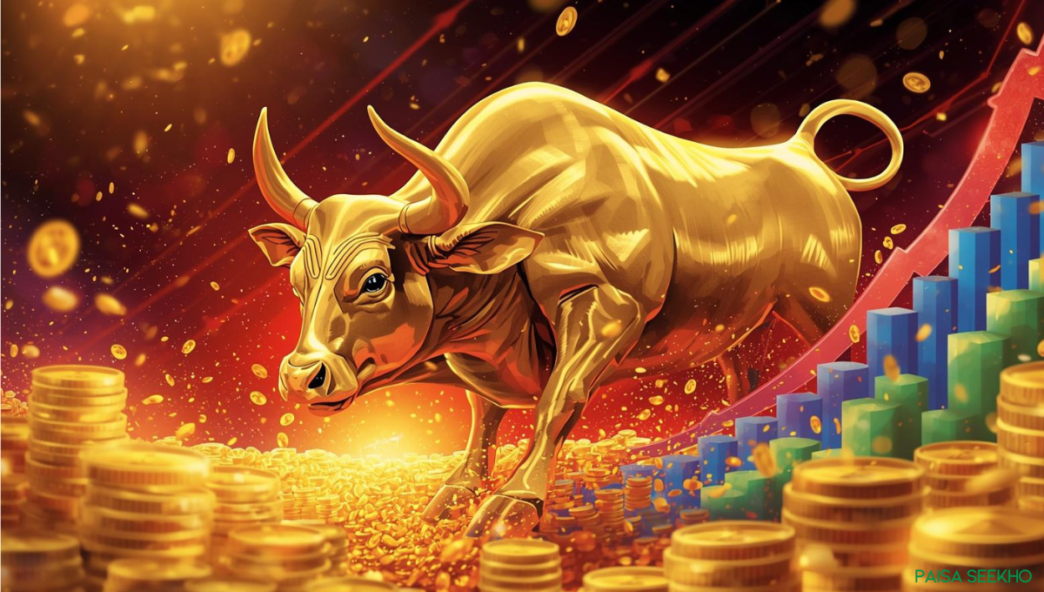
- The Bull Market: When a bull attacks, it lowers its head and thrusts its horns fiercely upwards into the air. Therefore, a “Bull Market” means prices are aggressively surging upwards. Everyone is making money, confidence is high, and the financial charts look like a rocket launching into space.
The 20% Benchmark:
Prices in the market go up and down by 1% or 2% every single day. That is normal. A market is only officially crowned a “Bull Market” when the price increases by 20% or more from its lowest recent point, and the trend lasts for months or even years.
When a Gold Bull Market happens, it means investors worldwide have collectively decided that holding physical, shiny metal is far more valuable than holding paper money or corporate stocks.
2. The 3 Mega-Forces That Create a Gold Bull Market
Gold is not a company. It does not sell smartphones, it does not manufacture cars, and it does not pay you a quarterly dividend. The price of gold is driven 100% by global macroeconomic forces.
When you see a Gold Bull Market making headlines, it is almost always because one (or all) of these three global forces has been triggered.
Force #1: Falling Bank Interest Rates (The Opportunity Cost)
This is the most powerful engine of a gold bull run.
Imagine the Reserve Bank of India (RBI) or the US Federal Reserve decides to slash interest rates to fight off a recession. Suddenly, your Bank Fixed Deposit (FD) is only offering you a miserable 3% or 4% return.
Because bank accounts are paying practically nothing, wealthy investors and massive mutual funds take their billions of dollars out of the banks. Where do they put it? They pour it into gold. Even though gold pays zero interest, investors prefer holding an asset that holds its value over keeping money in a bank that isn’t even beating inflation.
Force #2: The Collapse of the US Dollar
Gold is the ultimate rival of paper money, specifically the US Dollar. In global markets, gold is priced in dollars (e.g., $2,500 per ounce).
These two assets sit on opposite ends of a seesaw.
- When the US economy is struggling, the government prints too much money, and the US Dollar loses its strength.
- When the Dollar weakens, it takes more dollars to buy the exact same ounce of gold. This automatically pushes the global price of gold higher, triggering a bull market.
Furthermore, a weak dollar makes gold cheaper for buyers in other countries (like India and China) who use their own local currencies to buy it. This sparks a massive buying frenzy across Asia, pushing demand, and prices, through the roof.
Force #3: Global Panic, Inflation, and Wars
Gold is historically known as the “Safe Haven.” It is the ultimate financial bunker.
When the world feels safe and businesses are booming, people invest in risky tech stocks or real estate. But what happens when a massive war breaks out in the Middle East? What happens when a global pandemic shuts down the world? What happens when “Inflation” goes out of control, and your paper money loses its purchasing power every single day?
People panic. In times of extreme crisis, humanity trusts only one thing: physical gold. During geopolitical wars and high-inflation periods, fear drives millions of people to hoard gold, causing an explosive Bull Market based purely on survival instincts.
3. The Secret “Whales”: Why Central Banks are Pumping Gold in 2026
If you are looking at the gold market in recent years (specifically the massive 2024–2026 surge), you will notice something highly unusual. Usually, gold drops when interest rates are high. But recently, even when US interest rates were high, gold prices kept exploding upwards!
Why did the old rules stop working? The answer lies in the De-dollarization Trend.
The biggest buyers pushing this current Gold Bull Market are not everyday retail investors; they are Central Banks (the “Whales” of the financial world).
In 2022, the US and European governments froze billions of dollars belonging to Russia’s central bank due to the geopolitical conflict. This sent a terrifying shockwave across the globe. Other countries (like China, Saudi Arabia, and even India) suddenly realized a terrifying truth: If we keep all our national savings in US Dollars, the US government can confiscate our money with the push of a button.
To protect their national wealth, central banks across the “Global South” initiated a massive strategy called “De-dollarization.” They started aggressively dumping their US Dollar reserves and began buying thousands of tonnes of physical gold to keep in their own vaults.
When central banks are buying 1,000 tonnes of gold every single year, they create a massive “price floor.” They literally suck the supply out of the market, ensuring that the price of gold goes into a relentless, unstoppable Bull Market.
4. History Lesson: The Greatest Gold Bull Runs
To truly understand how profitable a Gold Bull Market can be, we need to look at history. Gold does not surge every day, but when it does, it creates phenomenal wealth.
The 2000s Super-Cycle (The Golden Decade)
In the year 2000, gold was sitting at a highly depressed price of roughly $250 an ounce. But then, a series of disasters struck. The “Dot-Com” stock market bubble burst, wiping out trillions in wealth. The US faced terrorist attacks in 2001, launching expensive global wars. Finally, in 2008, the global banking system completely collapsed during the Great Financial Crisis.
To save the economy, the US government printed trillions of dollars and dropped interest rates to ZERO. This created the perfect storm for gold. Over a spectacular 10-year Bull Market, the price of gold surged from $250 to over **$1,900 an ounce** by 2011! Investors who held gold during this decade saw their wealth multiply by almost 8 times.
The 2020 Pandemic Surge
When the COVID-19 lockdowns hit the world in March 2020, global stock markets crashed by 30% in a matter of weeks. The fear of a global depression sent panic levels to an all-time high. Within just five months, gold skyrocketed into a massive Bull Market, crossing the $2,000 barrier for the first time in human history as panicked investors sought the ultimate safe haven.
5. Interactive Tool: The Gold Bull Market Simulator
Reading about these massive economic forces is one thing, but seeing them in action is another.
At Paisaseekho, we want you to understand the math behind the madness. Use the interactive simulator below. Play the role of a Global Economist! Adjust the sliders for Interest Rates, Inflation, and Central Bank Buying to see exactly what triggers a massive Gold Bull Market.
🚀 Gold Bull Market Simulator
Simulated Gold Price (per 10g)
₹60,000
6. The Paisaseekho Strategy: How Should You Invest During a Bull Run?
If the news is declaring a Gold Bull Market, your heart will probably tell you to run to the nearest jeweler and buy a massive gold necklace. Do not do this if your goal is pure financial profit.
Physical jewelry comes with “Making Charges” (which can be 10% to 20%) and GST (3%). By the time you walk out of the shop, your gold has already lost nearly 20% of its investment value!
If you want to ride the Bull Market wave and make maximum profit, you need to use modern, digital financial tools. Here are the three best ways to invest in gold today:
1. Sovereign Gold Bonds (SGBs)
This is the absolute king of gold investments in India. Issued directly by the Reserve Bank of India (RBI), SGBs represent digital gold.
- The Benefit: You buy gold at the official market price with zero making charges.
- The Super-Bonus: The government pays you an extra 2.5% fixed interest every year just for holding the bond!
- The Tax Shield: If you hold the SGB for its full 8-year maturity period, all the capital gains profit you make is 100% tax-free!
2. Gold ETFs (Exchange Traded Funds)
If you do not want to lock your money up for 8 years in an SGB, Gold ETFs are your best friend.
You can buy a Gold ETF on the stock market (through apps like Zerodha, Groww, or Upstox) just like you buy a share of Reliance or Tata. It tracks the exact real-time price of physical gold.
- The Benefit: Extreme liquidity. If the Bull Market reaches a massive peak and you want to take your profits, you can sell your Gold ETF with one click on your phone and have the cash in your bank account the very next day.
3. Digital Gold
Apps like PhonePe, Google Pay, and Paytm allow you to buy “Digital Gold” for as little as ₹10. This is backed by real, 24-karat physical gold stored in secure vaults by companies like MMTC-PAMP.
- The Benefit: It is incredibly easy and accessible for small investors who want to slowly build their gold portfolio over time using micro-savings.
7. The Danger Zone: Don’t Get Caught in the “Bubble”
While a Gold Bull Market is a fantastic opportunity to make money, we must offer a serious Paisaseekho warning: No market goes up in a straight line forever.
In the later stages of a Bull Market, something dangerous happens. The fundamental reasons for buying gold (like inflation or war) might fade away, but the price keeps rocketing upwards simply because everyone is buying it due to greed. This creates a “Price Bubble.”
If you invest all your life savings into gold at the absolute, dizzying peak of a bubble, you are setting yourself up for disaster. When the bubble finally bursts and the market corrects itself (turning into a Bear Market), you could be stuck with heavy losses for years.
The Golden Rule: Never put 100% of your money into gold. Financial experts recommend keeping your gold allocation strictly between 10% and 15% of your total investment portfolio. Treat gold as the “goalkeeper” of your financial football team. Its job is to defend your wealth when the stock market (the strikers) fails.
Conclusion: Understanding the Golden Wave
A Gold Bull Market is a powerful, awe-inspiring financial phenomenon. It represents the collective psychological shift of billions of people moving their wealth to seek ultimate security in an uncertain world.
By understanding the macro-economic forces, falling interest rates, a weakening US dollar, and massive Central Bank hoarding, you transition from a panicked buyer acting on FOMO to a smart, strategic investor.
The next time you see headlines screaming that gold has hit a new all-time high, you will know exactly what is happening behind the scenes. You will avoid the trap of high-making-charge physical jewelry, you will open your demat account to buy SGBs or Gold ETFs, and you will calmly ride the golden wave to massive, well-protected financial wealth.
Frequently Asked Questions (FAQs) About Gold Bull Markets
Q1: What is the exact definition of a Gold Bull Market?
A Gold Bull Market is a financial term used when the global price of gold increases by 20% or more from its recent lowest point, usually accompanied by high investor optimism and a prolonged upward price trend.
Q2: Why does gold go up when bank interest rates go down?
Gold is a non-yielding asset, meaning it pays zero interest. When central banks cut interest rates, bank fixed deposits (FDs) and bonds offer terrible returns. Investors pull their money out of banks and buy gold instead, pushing its price into a Bull Market.
Q3: How does the US Dollar affect the price of gold?
Gold and the US Dollar have an inverse relationship (they act like a seesaw). Because gold is priced in dollars globally, a weak US Dollar means it takes more dollars to buy an ounce of gold, which automatically drives the gold price higher.
Q4: Why are Central Banks hoarding gold in 2026?
Many Central Banks (like those in China, Russia, and India) are aggressively buying gold to reduce their reliance on the US Dollar (De-dollarization). They are doing this to protect their national wealth from potential US economic sanctions, and this massive buying creates a permanent price surge.
Q5: Is it better to buy physical jewelry or digital gold during a bull market?
For pure investment purposes, digital options are far superior. Physical jewelry includes GST (3%) and making charges (10-20%), which instantly eat into your profits. Financial tools like Sovereign Gold Bonds (SGBs) or Gold ETFs give you the pure price appreciation without the extra fees.
Q6: What is a Sovereign Gold Bond (SGB)?
An SGB is a digital gold bond issued by the Reserve Bank of India (RBI). It perfectly tracks the price of gold, but the government also pays you an extra 2.5% fixed interest every year. Furthermore, if you hold it for 8 years, your capital gains are 100% tax-free!
Q7: Can a Gold Bull Market last forever?
No. Financial markets are cyclical. A bull market will eventually end when the macroeconomic forces change, for example, if global inflation is defeated, the world becomes peaceful, and central banks raise interest rates again to high levels.
Q8: Does high inflation cause a gold bull market?
Yes, historically, high inflation is a major trigger. When inflation is high, the purchasing power of paper money (like the Rupee or the Dollar) drops rapidly. Investors buy gold because it is a “hard asset” that naturally retains its value and protects their purchasing power over time.
Q9: How much of my portfolio should I invest in gold?
Most financial planners and wealth managers recommend keeping your gold investments limited to 10% to 15% of your total portfolio. The rest of your money should be diversified across equity (mutual funds), real estate, and fixed-income assets to ensure balanced growth.
Q10: Can I sell a Gold ETF easily if I want to take my profits?
Yes! Gold ETFs (Exchange Traded Funds) are traded on the regular stock market (NSE/BSE). You can buy or sell them instantly during market hours using your standard demat account or brokerage app, making them highly liquid and perfect for capturing bull market profits.
Last Updated on 5 months ago by Team Paisaseekho