
If you are heading out to buy gold and wondering how much you can actually pay in cash, here is the direct answer: under Section 269ST of the Income Tax Act, you cannot pay ₹2 lakh or more in cash for a single gold purchase. Anything above this must go through a bank transfer, cheque, UPI, or card. If your bill crosses ₹2 lakh, the jeweller is also required to record your PAN card details, regardless of how you actually pay.
This single rule is where most of the confusion starts, so before we get into the finer details like PAN requirements below ₹2 lakh, home storage limits, and what happens if a jeweller breaks this rule, here is a quick summary of everything you need to know.
Summary: Quick Facts on Gold Cash Transaction Rules
Here’s a quick summary of what you need to know before we get into the deeper details:
- The Absolute Cash Limit: You cannot buy gold worth ₹2 Lakhs or more in cash. This is strictly illegal under Section 269ST.
- The Penalty: If you pay ₹3 Lakhs in cash, the jeweler will have to pay a 100% penalty (a ₹3 Lakh fine!).
- No ID Needed: If your total bill is under ₹50,000, you can pay in cash and walk out without showing any ID.
- Aadhaar Required: For cash purchases between ₹50,000 and ₹1,99,999, you must provide an ID proof (like Aadhaar) under Money Laundering rules.
- PAN Card Mandatory: If your total bill crosses ₹2 Lakhs, you must submit your PAN card details, even if you are paying via UPI, Cheque, or Bank Transfer.
- Home Storage Limits: There is no legal limit on how much gold you can own if you have the bills and Income Tax Returns (ITR) to prove your income.
1. What is the ₹2 Lakh Ban (Section 269ST) For Buying Gold?
Let us start with the most important rule in the entire Indian tax book when it comes to buying high-value items. It is called Section 269ST of the Income Tax Act.
The government wants to stop the flow of “black money” (unaccounted cash) in the economy. Because gold is the easiest way to hide black money, the government has placed a hard, unbreakable limit on cash transactions.
The Rule: No person is allowed to receive an amount of ₹2 Lakhs or more in cash in a single day, or for a single transaction, or for transactions relating to a single event.
Let us look at three real-world examples to understand how strict this is:
- Scenario A (The Standard Purchase): You buy a gold necklace worth ₹2,50,000. You cannot give the jeweler ₹2.5 Lakhs in cash. You must use a cheque, RTGS, NEFT, or UPI.
- Scenario B (The Split Payment Trick): You think you are smart. You buy a ₹3 Lakh necklace. You pay ₹1.5 Lakhs in cash on Monday, and you come back on Tuesday and pay the remaining ₹1.5 Lakhs in cash. This is illegal. Because both payments are for a single transaction/bill, the total cash exceeds ₹2 Lakhs.
- Scenario C (The Wedding Exception Trick): You are buying jewelry for your daughter’s wedding. You buy a ring for ₹1 Lakh, bangles for ₹1 Lakh, and a chain for ₹1 Lakh on the same day. Even though they are three separate bills, they are for a single occasion happening on a single day. Paying ₹3 Lakhs in cash for this is illegal.
If you want to use cash, your total bill simply must be ₹1,99,999 or less. Anything above that must flow through a banking channel.
2. Who Gets Punished if You Break the ₹2 Lakh Rule?
This is where things get very interesting.
Suppose you find a local, small-town jeweler who says, “Don’t worry sir, give me the ₹3 Lakhs in cash, I won’t tell anyone.” What happens if the Income Tax Department finds out?
Under Section 271DA, the penalty for breaking this rule actually falls on the receiver of the cash, not the payer.
This means the jeweler who accepted your ₹3 Lakhs in cash will be slapped with a penalty equal to 100% of the transaction amount. The jeweler will have to pay the government a fine of exactly ₹3 Lakhs!
Does that mean you (the buyer) are safe?
Absolutely not. While the jeweler pays the official penalty, your name and details will be flagged in the Income Tax Department’s system. They will send you a very scary “Scrutiny Notice” asking a simple question: “Where did you get ₹3 Lakhs in pure cash?” If you cannot prove that you withdrew that cash from your bank account or that it is part of your legally declared income (ITR), the tax department will classify it as “unexplained income,” tax it at a massive rate, and hit you with heavy personal penalties.
3. When Do You Need a PAN or Aadhaar Card to Buy Gold?
In the old days, buying gold was anonymous. Today, the government wants to know exactly who is buying the gold. However, they also do not want to harass a poor farmer who is just buying a small ₹10,000 nose ring for his wife.
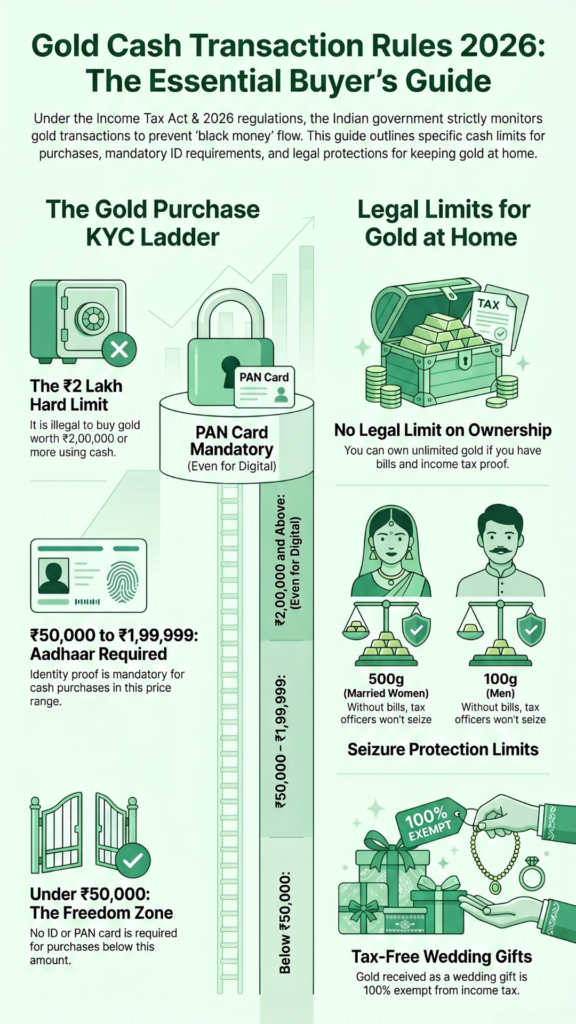
Therefore, the Gold Cash Transaction Rules have created a “KYC Ladder” based on the exact amount you spend.
Step 1: Up to ₹50,000 (The Freedom Zone)
If your total jewelry bill is ₹49,999 or less, you are in the clear. You can walk in, pay cash, take your receipt, and walk out. The jeweler is not legally required to ask for your PAN card, Aadhaar card, or any ID proof.
Step 2: ₹50,000 to ₹1,99,999 (The Aadhaar Zone)
Under the strict Prevention of Money Laundering Act (PMLA), 2002, jewelers are classified as “Reporting Entities.” If you are making a cash purchase of ₹50,000 or more, the jeweler is legally required to verify your identity.
- You will need to provide basic KYC, which usually means handing over a copy of your Aadhaar Card or Driving License.
- Note: You do not strictly need a PAN card for this bracket, but identity proof is mandatory.
Step 3: ₹2,00,000 and Above (The PAN Card Zone)
Welcome to the big leagues. Under Rule 114B of the Income Tax Rules, if your transaction crosses the ₹2 Lakh mark, it is absolutely mandatory to submit your PAN Card details to the jeweler.
- Crucial Detail: This rule applies regardless of how you pay! Even if you are an honest taxpayer and you pay ₹5 Lakhs using a completely transparent Bank RTGS transfer, the jeweler still must enter your PAN card number onto the final invoice. If you refuse to give your PAN, a reputed jeweler will legally refuse to sell you the gold.
4. How Much Gold Can You Keep at Home?
This is easily the most misunderstood rule in all of India. Every few years, a WhatsApp forward goes viral claiming: “The Modi Government has made it illegal to keep more than 500 grams of gold at home!”
This is a 100% false myth.
Let us clear this up once and for all. According to the laws of India, there is absolutely no legal limit on how much physical gold you can own or keep at home. You can keep 10 kilograms of gold under your mattress if you want to!
However, there is one major condition: You must be able to prove how you got it. If the Income Tax Department raids your house and finds 10kg of gold, you just need to show them the purchase receipts, your bank statements, and your Income Tax Returns proving you earn enough legal money to afford 10kg of gold. If you can prove it, they will salute you and walk away.
So, what is the 500g / 250g / 100g Rule?
This famous rule comes from a specific CBDT (Central Board of Direct Taxes) circular known as Instruction No. 1916, issued way back in 1994.
This rule is an “Administrative Guideline” for tax officers conducting a raid.
In India, a lot of gold is inherited from grandmothers, or gifted during weddings over decades. Obviously, you are not going to have a printed GST receipt for a bangle your grandmother gave you in 1985!
The government understands this cultural reality. So, they told their tax officers: “If you raid a house, and the family cannot show receipts for their jewelry, do not confiscate (seize) the gold if it falls within these limits:”
- Married Woman: Up to 500 grams of gold jewelry cannot be seized.
- Unmarried Woman: Up to 250 grams of gold jewelry cannot be seized.
- Any Male (Married or Unmarried): Up to 100 grams of gold jewelry cannot be seized.
Let’s say a family of a husband, a wife, and an unmarried daughter gets raided. They have 850 grams of gold (100g + 500g + 250g) without any bills. The tax officers will not touch it. It is considered legally explained by Indian tradition.
But if the officers find 1,500 grams of gold and the family has no bills, the extra 650 grams will likely be seized as “unexplained wealth.”
(Important Note: This protection only applies to worn jewelry and ornaments. If the tax officers find gold bars, raw bullion, or gold biscuits hidden in a locker without bills, they will seize it immediately, regardless of the weight limits!).
5. Do You Have to Pay Tax on Gifted or Inherited Gold?
In India, we rarely buy gold just for ourselves; we gift it. What are the Gold Cash Transaction Rules and tax implications when gold changes hands for free?
Scenario 1: The Wedding Exemption
If you get married and your relatives, friends, and in-laws shower you with 2 kilograms of gold jewelry, you are extremely lucky. And you are also tax-free!
Under Section 56(2)(x) of the Income Tax Act, any gift (including gold) received by an individual on the occasion of their marriage is 100% exempt from income tax, regardless of its value. Keep the photos of the wedding and a list of who gifted what as proof.
Scenario 2: Inheritance
If your parents or grandparents pass away and leave you their gold in a formal Will or through succession laws, there is zero tax to be paid on receiving that inheritance.
Scenario 3: Casual Gifts from Friends
If it is your birthday (not your wedding), and a rich friend gifts you a gold chain worth ₹80,000, you have a tax problem.
The law states that if you receive gifts (from non-relatives) whose total aggregate value exceeds ₹50,000 in a single financial year, the entire amount becomes taxable. You will have to declare the ₹80,000 under “Income from Other Sources” in your ITR and pay tax on it according to your slab rate.
(Note: Gifts from “Specified Relatives” like your spouse, parents, or siblings are always tax-free, no matter the value or the occasion).
6. What About Digital Gold and SGBs?
The modern Indian investor in 2026 isn’t just buying heavy physical jewelry; they are buying gold on their smartphones. Do the cash rules apply here?
Sovereign Gold Bonds (SGBs)
SGBs are issued by the Reserve Bank of India (RBI). They are paper/digital gold that pays you a 2.5% annual interest.
Can you buy government bonds with cash? Surprisingly, yes, but only up to a very strict limit. The RBI allows investors to pay in cash for SGBs up to a maximum of ₹20,000. If you want to invest more than ₹20,000 in SGBs, you must use a demand draft, cheque, or electronic banking.
Digital Gold (Apps like GPay, PhonePe)
Since Digital Gold is bought entirely through mobile applications, it is inherently a digital transaction. The ₹2 Lakh cash limit does not apply because you cannot push cash through your phone screen! However, to prevent money laundering, most digital gold platforms have internal limits (often capping purchases at ₹2 Lakhs per day) and will freeze your account if you try to make massive purchases without completing a full video-KYC and PAN verification.
7. How the Income Tax Department Tracks Your Gold
You might be sitting there thinking, “Paisaseekho, how will the government ever know I bought gold?”
Welcome to the digital age of 2026. The Income Tax Department no longer relies on physical raids to find tax evaders; they use Artificial Intelligence and big data.
When you buy gold worth more than ₹2 Lakhs and hand over your PAN card to the jeweler, the jeweler doesn’t just file it away in a drawer. Large jewelers are legally required to file a report called the Statement of Financial Transactions (SFT).
They upload your PAN card number and the exact amount of gold you bought directly to the Income Tax Department’s central server.
When you log into your income tax portal to file your returns, you will see a document called the Annual Information Statement (AIS). If you look closely at your AIS, you will clearly see: “Purchase of precious metals: ₹4,50,000 from XYZ Jewellers.”
The AI system then checks your declared salary. If your ITR says you only earn ₹3 Lakhs a year, but your AIS shows you bought gold worth ₹4.5 Lakhs, a red flag is raised in the system, and a computer automatically generates and sends you a tax notice. You cannot hide in 2026; the digital trail is permanent.
Conclusion
Buying gold should be a moment of joy and celebration for your family, not the beginning of a terrifying legal dispute with the Income Tax Department.
The Gold Cash Transaction Rules exist for a good reason: to clean up the Indian economy and ensure that taxes are paid fairly. By understanding these simple rules, you take total control of your financial life.
The next time you head to the jewelry market for Dhanteras or a wedding, leave the massive bags of cash at home. If your bill crosses ₹50,000, keep your Aadhaar ready. If it crosses ₹2 Lakhs, keep your PAN card ready and use a bank transfer. And most importantly, always demand a proper GST invoice for every gram of gold you buy. That little piece of paper is your ultimate shield against any tax scrutiny in the future.
Stay smart, invest wisely, and may your gold portfolio continue to shine bright!
Frequently Asked Questions (FAQs) About Gold Cash Transaction Rules
Q1: Can I buy gold worth ₹3 Lakhs using a mix of cash and card?
Yes, but you must be extremely careful. Under Section 269ST, the cash portion of your payment cannot exceed ₹1,99,999. So, for a ₹3 Lakh bill, you can legally pay ₹1.5 Lakhs in cash and swipe your credit card for the remaining ₹1.5 Lakhs.
Q2: Do I need to give my PAN card if I buy gold worth ₹1.5 Lakhs in cash?
No. The PAN card is only mandatory when the total transaction value crosses the ₹2,00,000 mark (Rule 114B). For ₹1.5 Lakhs, you will only need to provide an identity proof like Aadhaar for basic KYC under the Money Laundering rules.
Q3: Can my wife, my son, and I each buy ₹1.5 Lakhs of gold in cash on the same day from the same shop?
Legally, yes, because you are three separate individuals making three separate transactions. However, if the jeweler makes all three bills in the name of one single person (e.g., the father), it will be considered a single transaction of ₹4.5 Lakhs in cash, which is illegal and will attract a penalty.
Q4: Is it illegal to keep more than 500 grams of gold at home?
Absolutely not. This is a myth. You can legally own unlimited amounts of gold in India. The 500g (for married women), 250g (for unmarried women), and 100g (for men) limits are simply the amounts that tax officers will not seize during a raid if you fail to produce the purchase receipts.
Q5: What happens if a jeweler accepts ₹5 Lakhs in cash from me?
Under Section 271DA, the jeweler who accepts the cash will have to pay a 100% penalty to the government. So the jeweler loses ₹5 Lakhs. Meanwhile, your PAN will be flagged, and the Income Tax Department will investigate the source of your cash.
Q6: I am a farmer with agricultural income. Do these rules apply to me?
Yes. While agricultural income is exempt from income tax in India, the rule banning cash transactions above ₹2 Lakhs (Section 269ST) applies universally to every citizen of India, regardless of their profession or income source.
Q7: Do I have to pay tax if I inherit 2 kg of gold from my grandfather?
No. Inheritance received through a legal Will or via standard succession laws is completely exempt from income tax in India. You will only pay tax (Capital Gains Tax) if you decide to sell that 2kg of gold in the market later.
Q8: Why does the jeweler ask for my PAN card when I pay by NEFT/RTGS?
Under Income Tax Rule 114B, it is mandatory to quote a PAN for any sale or purchase of goods or services exceeding ₹2 Lakhs per transaction. It does not matter if the payment is 100% digital and transparent; the PAN rule applies to the value of the transaction, not the mode of payment.
Q9: If I buy Sovereign Gold Bonds (SGBs) at the post office, can I pay in cash?
Yes, but the limit is very small. The RBI guidelines state that SGBs can be purchased using cash, but the cash payment is strictly capped at a maximum of ₹20,000. Any investment above that must be done digitally or via cheque.
Q10: What should I do if a jeweler refuses to give me a GST bill?
Never buy gold without a GST bill. If a jeweler refuses to provide a bill, they are likely selling smuggled gold or trying to evade taxes. Without a bill, you have no legal proof of purity, no insurance claim validity, and zero defense if the Income Tax Department ever questions your assets. Walk away and find a reputed jeweler.
Last Updated on 2 weeks ago by Team Paisaseekho