

TL;DR: Key Takeaways from the Delhi EV Policy 2026
If you are standing at a car dealership right now trying to negotiate a price, here is your quick cheat sheet on the new EV rules in Delhi:
- Tax Free Driving: Electric cars priced under ₹30 Lakh get a 100% waiver on road tax and registration fees until March 2030. Cars over ₹30 Lakh get absolutely zero tax benefits.
- The Hybrid Win: Strong hybrid cars (under ₹30 Lakh) get a massive 50% discount on road tax!
- The ₹1 Lakh Scrappage Bonus: If you scrap an old BS-IV petrol/diesel car and buy a new EV under ₹30 Lakh, the government will give you a direct cash incentive of ₹1,00,000.
- Tapering Subsidies: Cash subsidies for two-wheelers and three-wheelers are huge right now but will reduce every year. Buy early to get the maximum benefit (up to ₹30,000 for a bike!).
- The Petrol Ban is Coming: Delhi will completely ban the registration of new petrol/diesel two-wheelers starting April 1, 2028.
- Direct Bank Transfer (DBT): All subsidies and scrapping incentives will be credited directly to your bank account through a fully digital, paperless system.
Introduction
If you live in the National Capital Region (NCR), you already know the drill. Every winter, the skies turn grey, the air purifiers go on full blast, and the government scrambles to implement odd-even traffic rules. Vehicular pollution contributes to nearly a quarter of Delhi’s toxic air. And for years, fixing this felt like an impossible dream.
But in April 2026, the Delhi Government finally hit the accelerator on a permanent solution.
With the release of the highly anticipated Draft Delhi Electric Vehicle (EV) Policy 2.0 (2026–2030), the message to the public and automakers is crystal clear: the future of Delhi’s roads is strictly electric. But this time, the government is playing smart. Instead of just throwing money at luxury car buyers, the new 2026 policy is laser-focused on the middle class, public transport, and getting highly polluting old cars off the road.
Whether you are planning to buy a new electric scooter for your college commute, a strong hybrid SUV for your family, or you simply want to know when petrol bikes will be officially banned in the city, you need to understand this new rulebook.
1. Delhi EV Policy 2026 Explained
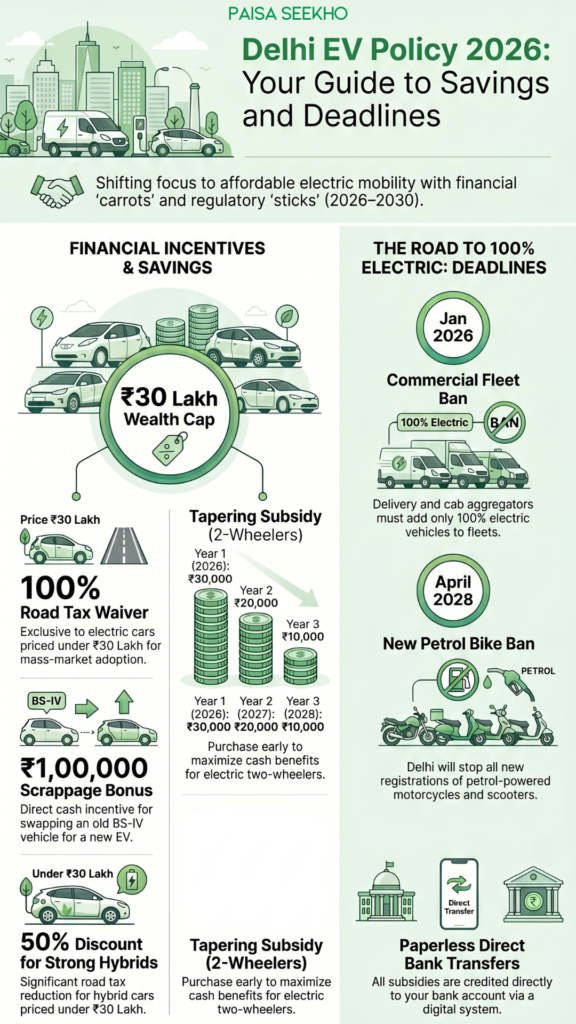
The most talked-about feature of the Delhi EV Policy 2.0 is the introduction of a strict “wealth cap.”
Under the previous policies, if you bought a luxury electric SUV for ₹1 Crore from a brand like Mercedes, BMW, or Audi, the Delhi government would waive the road tax. Since road tax in Delhi can hit 12.5%, wealthy buyers were saving a staggering ₹12.5 Lakhs on a luxury purchase, subsidized by everyday taxpayers.
The 2026 policy puts an immediate end to this.
The government assumes that if you have the financial power to buy a luxury car, you do not need state welfare to convince you to go electric.
The New Rule:
- A 100% exemption on road tax and registration fees is now exclusively reserved for electric cars priced at or below ₹30 Lakh (ex-showroom).
- If the ex-showroom price of the EV is ₹30,00,001 or higher, you pay the full standard road tax.
This policy is a goldmine for homegrown mass-market manufacturers like Tata Motors and Mahindra. Top-selling EVs like the Tata Nexon EV, Tata Curvv EV, and Mahindra XUV400 sit comfortably below the ₹30 Lakh mark. By heavily subsidizing these cars, the government creates a safe “growth zone” for affordable electric mobility, encouraging middle-class families to make the switch without destroying the state budget.
2. The Surprise Winner: 50% Off on Strong Hybrids
One of the biggest debates in the Indian auto industry over the last two years has been the “EV vs. Hybrid” war. Brands like Tata pushed for pure EVs, while brands like Toyota and Honda argued that India is not ready for 100% electric cars due to a lack of highway charging stations. They argued that “Strong Hybrids” (cars that use both petrol and a self-charging electric battery) are the perfect bridge technology.
The Delhi EV Policy 2026 officially sides with the hybrid argument.
Recognizing that many Delhi residents frequently drive to neighboring states (where fast chargers are rare), the draft policy offers a massive 50% concession on road tax and registration fees for Strong Hybrid vehicles.
- Just like pure EVs, this benefit is strictly capped for hybrid cars priced under ₹30 Lakh (ex-showroom).
- This makes highly popular cars like the Toyota Hyryder, Maruti Grand Vitara (Strong Hybrid), and Honda City e:HEV significantly cheaper to put on the road.
3. The Tapering Subsidy Structure: Buy Now or Lose Out
If you are planning to buy a two-wheeler or a commercial vehicle, the government is offering direct cash subsidies. However, the policy uses a “Tapering Structure.” This means the incentives are massive in Year 1 (2026), but they shrink in Year 2 and Year 3.
The government’s logic is simple: battery prices are dropping globally. As EVs naturally become cheaper to manufacture over the next three years, they will require less government support.
Here is the exact breakdown of the direct purchase incentives (which will be sent to your bank account via Direct Benefit Transfer):
Electric Two-Wheelers (Bikes & Scooters)
- Price Cap: The scooter must cost less than ₹2.25 Lakh.
- Year 1 (2026): ₹10,000 per kWh of battery capacity (Maximum cap of ₹30,000).
- Year 2 (2027): ₹6,600 per kWh (Maximum cap of ₹20,000).
- Year 3 (2028): ₹3,300 per kWh (Maximum cap of ₹10,000).
Electric Three-Wheelers (Auto-Rickshaws)
To clean up the last-mile connectivity, the government is pushing hard for e-autos.
- Year 1: Flat ₹50,000 incentive.
- Year 2: Flat ₹40,000 incentive.
- Year 3: Flat ₹30,000 incentive.
Four-Wheeler Goods Vehicles (N1 Category Light Trucks)
For small businesses and logistics companies replacing their old diesel delivery trucks:
- Year 1: ₹1,00,000 incentive.
- Year 2: ₹75,000 incentive.
- Year 3: ₹50,000 incentive.
(Note: There is no direct cash purchase subsidy for private 4-wheeler cars. Their benefit is entirely through the road tax waiver and scrappage bonus).
4. The Scrappage Bonus: Turn Your Old Junk into ₹1 Lakh
Delhi has a massive problem with old, highly polluting BS-IV (and older) petrol and diesel cars. To actively force these toxic vehicles off the road, the EV Policy 2.0 introduces an aggressive Scrappage-Linked Incentive.
This is how it works:
- You take your old, Delhi-registered BS-IV (or earlier) vehicle to a government-authorized scrapping facility.
- The facility destroys the car and gives you a formal “Certificate of Deposit” (CoD).
- If you buy a brand new Electric Vehicle within six months of getting that certificate, the government rewards you with a massive cash bonus!
The Scrappage Rewards:
- Electric Cars (Under ₹30 Lakh): Extra ₹1,00,000 bonus! (Limited to the first 1 lakh applicants).
- Commercial Goods Vehicles (N1): Extra ₹50,000 bonus.
- Three-Wheelers (E-Autos): Extra ₹25,000 bonus.
- Two-Wheelers: Extra ₹10,000 bonus.
If you combine this scrappage bonus with the zero road tax policy, upgrading your old polluting hatchback to a brand-new Tata Tiago EV or MG Comet suddenly becomes incredibly affordable for a middle-class family.
5. The Phased Bans: When Does the Petrol Era End?
A strong policy cannot just offer “carrots” (incentives); it must also use the “stick” (restrictions). The Delhi EV Policy 2026 lays out a strict, phased timeline to completely ban the registration of internal combustion engine (ICE) vehicles.
If you make a living driving in Delhi, pay very close attention to these deadlines:
For Delivery Companies & Cab Aggregators (Zomato, Swiggy, Uber, Ola)
- The Deadline: January 1, 2026.
- From this date, massive fleet operators and delivery aggregators will not be allowed to add any new petrol or diesel vehicles to their fleets. Any new vehicle registered for these services must be 100% electric. (There is a slight grace period for two-wheelers depending on the final notification).
For Three-Wheelers (Auto-Rickshaws)
- The Deadline: January 1, 2027.
- Only electric three-wheelers (L5 category) will be allowed for new registrations in Delhi. The era of the CNG auto is officially coming to a close.
For Two-Wheelers (Bikes & Scooters)
- The Deadline: April 1, 2028.
- This is the biggest shockwave of the policy. Two-wheelers account for nearly 67% of all vehicles on Delhi’s roads. The government has mandated that from April 2028, new registrations will be strictly limited to electric two-wheelers. You will no longer be able to buy and register a new petrol bike or scooter in the capital. (Note: This only applies to new registrations; your existing petrol bike will not be confiscated).
For Schools
- The Deadline: 2030.
- By the end of the decade, schools will be legally required to ensure that at least 30% of their transport fleet (school buses and vans) is entirely electric, protecting children from breathing toxic diesel fumes during their morning commute.
6. Fixing the Hidden Problems: Battery Recycling & Infrastructure
Subsidizing cars is easy, but maintaining an EV ecosystem is hard. The Delhi government has finally addressed the two biggest fears of EV buyers: charging anxiety and battery disposal.
1. The Battery Recycling Framework:
An EV battery typically lasts 12 to 14 years. What happens when thousands of toxic lithium-ion batteries die in Delhi? To prevent an environmental disaster, the policy mandates the Delhi Pollution Control Committee (DPCC) to set up a strict recycling framework. Vehicle manufacturers will have “Extended Producer Responsibility” (EPR), meaning they are legally required to collect dead batteries and recycle them safely to recover precious metals like lithium and cobalt.
2. EV-Ready Buildings:
Finding a public charger is annoying. The best place to charge an EV is at home while you sleep. The EV Policy 2.0 mandates that all newly constructed residential and commercial buildings in Delhi must be “EV-Ready.” They must have the electrical wiring and load capacity pre-installed in the parking areas to support EV chargers.
3. Inclusive Mobility:
To create social change along with environmental change, the policy introduces special permits. The government will issue ‘Pink e-permits’ for women auto drivers and ‘Rainbow permits’ for transgender drivers, ensuring the green transition provides employment for marginalized communities.
Conclusion
The Draft Delhi Electric Vehicle Policy 2.0 (2026–2030) is undoubtedly one of the most aggressive and well-thought-out green mobility plans in the world.
By hard-capping the tax benefits at ₹30 Lakh, the government has ensured that taxpayer money is used to clean the city’s air, not to subsidize luxury toys for the ultra-rich. The massive ₹1 Lakh scrappage bonus provides the perfect financial push for middle-class families to get rid of their old, polluting cars.
While the impending ban on petrol two-wheelers in 2028 might seem harsh, it is the only mathematical way to clear the smog that chokes the capital every winter.
If you live in Delhi and you are considering buying a new vehicle in 2026, the math heavily favors going electric. Take advantage of the Year 1 tapering subsidies, claim your road tax exemption, and be a part of the generation that finally brings blue skies back to the National Capital.
Frequently Asked Questions (FAQs) About Delhi EV Policy 2026
Q1: Will I get a road tax waiver if I buy an EV worth ₹35 Lakh in Delhi?
No. The Delhi EV Policy 2026 clearly states that the 100% road tax and registration fee exemption is strictly limited to electric cars priced at or below ₹30 Lakh (ex-showroom). Cars above this limit will not receive any tax benefits.
Q2: Do hybrid cars get any benefits under the new policy?
Yes! Strong hybrid cars (that use both a petrol engine and a self-charging battery) priced under ₹30 Lakh are eligible for a 50% concession on road tax and registration fees in Delhi.
Q3: How much subsidy will I get if I buy an electric scooter in 2026?
Under the Year 1 tapering structure, you can get an incentive of ₹10,000 per kWh of battery capacity, capped at a maximum of ₹30,000. The scooter must be priced under ₹2.25 Lakh to qualify. Note that this subsidy drops to a maximum of ₹20,000 in 2027.
Q4: How does the ₹1 Lakh EV scrappage bonus work?
If you own an old BS-IV (or older) petrol/diesel vehicle registered in Delhi, you must scrap it at an authorized facility and obtain a Certificate of Deposit (CoD). If you purchase a new electric car (under ₹30 Lakh) within 6 months of getting the CoD, the government will give you a ₹1,00,000 bonus.
Q5: Are petrol bikes really getting banned in Delhi?
Yes, but only new ones. The policy states that starting April 1, 2028, the Delhi transport department will completely stop the registration of new petrol and diesel two-wheelers. Only electric two-wheelers can be newly registered after that date.
Q6: What about Uber, Ola, and Zomato delivery drivers?
The rules are stricter for commercial fleets. Starting January 1, 2026, cab aggregators and delivery companies are legally prohibited from adding any new petrol or diesel vehicles to their Delhi fleets.
Q7: Is there a direct cash subsidy for buying an electric car?
No. The Delhi government does not provide a direct per-kWh cash purchase subsidy for private four-wheelers (cars). The financial benefits for car buyers are limited to the massive 100% road tax waiver and the scrappage bonus.
Q8: How will I receive the subsidy money?
The entire process is fully digital. Once your dealer uploads the necessary documents during registration, the subsidy amount or scrappage bonus will be transferred directly to your linked bank account via Direct Benefit Transfer (DBT).
Q9: What happens to the dead batteries of all these new EVs?
The 2026 policy includes a dedicated Battery Recycling Framework. The Delhi Pollution Control Committee (DPCC) will enforce Extended Producer Responsibility (EPR), forcing vehicle manufacturers to collect and safely recycle end-of-life batteries to prevent environmental damage.
Q10: Until when is the 100% road tax waiver valid?
The 100% road tax and registration fee exemption for eligible electric cars (under ₹30 Lakh) is proposed to remain valid until March 31, 2030.
Last Updated on 3 weeks ago by Team Paisaseekho