

TL;DR: Key Takeaways on India’s 2026 Warehousing Boom
If you are just skimming for the most important facts, here is your quick summary of the Q1 2026 warehousing surge:
- The Record Breaker: Industrial and warehousing leasing hit a 4-year high in Q1 2026, reaching 11 million sq ft across India’s top 8 cities (a 22% jump from 2025).
- The Main Drivers: E-commerce, Quick Commerce (10-minute deliveries), and 3PL (Third-Party Logistics) companies accounted for roughly two-thirds of all the space rented.
- The “Dark Store” Effect: Apps like Blinkit and Zepto are completely reshaping the map. Instead of one massive warehouse outside the city, they are renting hundreds of small “Dark Stores” right in the middle of dense residential neighborhoods.
- The 3PL Dominance: Third-party logistics companies (firms that handle shipping for other brands) anchored the market, taking up nearly 3.5 million sq ft of space alone.
- The Winning Cities: Delhi-NCR led the charge with a 28% market share, closely followed by Chennai (21%), while Bengaluru and Hyderabad saw their absorption rates double.
- The Global Threat: Despite the massive demand, builders are becoming cautious. The ongoing West Asia (Middle East) conflict has disrupted global supply chains, making construction materials expensive and causing a slight hesitation in building new warehouses.
Introduction
Think about what happened the last time you ordered groceries online. You opened an app like Zepto, Blinkit, or Swiggy Instamart, selected some milk, a packet of bread, and some chips. You hit “Pay,” and almost like magic, exactly 10 minutes later, a delivery partner was ringing your doorbell.
We are so used to this incredible convenience that we rarely stop to think about how it actually happens. Where was that milk sitting 10 minutes ago? How did it get to your house so fast?
The answer is not magic; it is Real Estate.
Behind the glowing screens of our smartphones, a massive, quiet revolution is happening in the physical world. To deliver your groceries in 10 minutes, or your Amazon packages in one day, these massive tech companies need physical space—lots and lots of it. They need giant metal boxes where they can store inventory, sort packages, and load trucks. They need Warehouses.
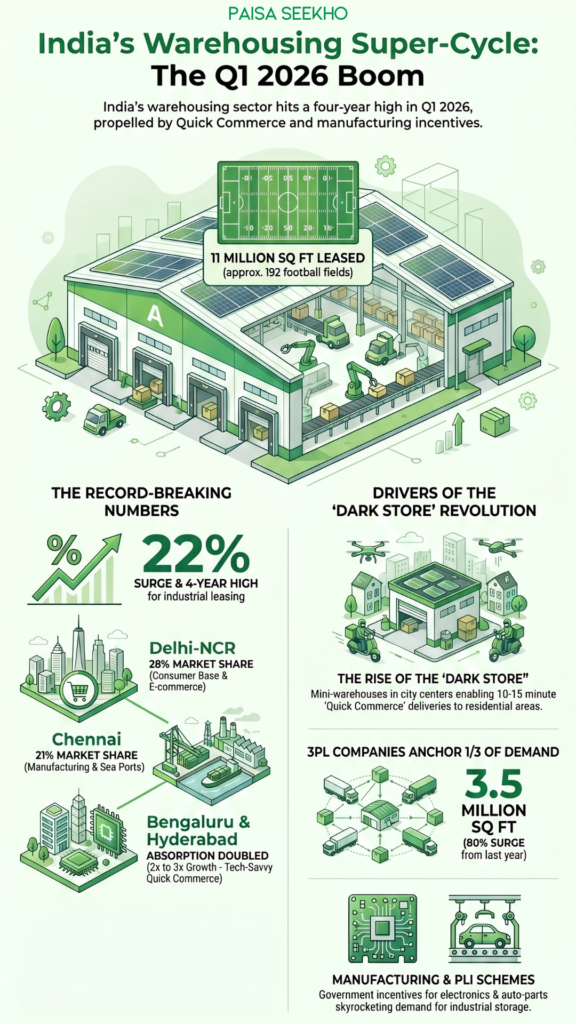
As we look at the economic data for the first quarter of 2026 (January to March), it is clear that India’s appetite for online shopping has created a full-blown boom in the commercial real estate sector. According to a landmark report by Colliers India, the country just witnessed its strongest first quarter in four years. Warehousing leasing activity skyrocketed by 22%, hitting a massive 11 million square feet in just three months!
In this comprehensive, easy-to-understand Paisaseekho guide, we are going to pull back the curtain on this massive industry. We will explain why e-commerce companies are suddenly grabbing land everywhere, what a “Dark Store” is, how global wars are affecting the construction of these buildings, and most importantly, how a regular retail investor can potentially make money from this warehousing super-cycle.
1. Decoding the Numbers: What Does “11 Million Sq Ft” Actually Look Like?
When real estate experts throw around massive numbers like “11 million square feet,” it is very hard for the human brain to visualize just how much land that is.
Let us break it down into something familiar: a standard football field. An average professional football field is roughly 57,000 square feet.
11 million square feet is equal to roughly 192 football fields!
That is the amount of new indoor, covered space that companies rented in India in just the first 90 days of 2026. This is not open land; these are “Grade A” industrial facilities. Grade A warehouses are state-of-the-art buildings. They have ceilings that are 40 feet high, super-flat concrete floors that can handle heavy robots and forklifts, modern fire safety systems, and massive loading docks for hundreds of trucks to park simultaneously.
Why are companies suddenly desperate for so much high-quality space? The answer lies in how our shopping habits have permanently changed over the last few years.
2. The E-commerce Engine and the Rise of “Quick Commerce”
According to the Colliers report, e-commerce remained a massive growth engine in Q1 2026. E-commerce companies alone leased 4.7 million sq ft, effectively doubling their share of the market from the previous year to 13%.
But the type of space they are looking for has completely changed because of the Quick Commerce revolution.
The Old Model: The Mega-Hub
Five years ago, companies like Amazon and Flipkart built massive “Mega-Hubs” on the outskirts of cities like Mumbai (in places like Bhiwandi) or Delhi (in places like Farrukhnagar). If you ordered a pair of shoes, a worker in that giant warehouse would find it, put it in a box, put it on a truck, and it would reach your house in 2 or 3 days. Because the warehouse was far outside the city, the land was cheap, and the rent was low.
The New Model: The Dark Store Network
Today, consumers do not want to wait two days for their groceries. They want their ice cream, cold drinks, and vegetables delivered in 10 to 15 minutes.
You cannot deliver an ice cream in 10 minutes if your warehouse is 40 kilometers away on a highway. You have to be physically close to the customer.
This has given birth to the Dark Store.
A Dark Store is essentially a mini-supermarket located right in the middle of a crowded city. It looks exactly like a grocery store inside (with shelves, freezers, and aisles), but it is “dark” to the public. Customers are not allowed inside. Only the employees who pack the orders (called “pickers”) walk the aisles.
In Q1 2026, platforms like Zepto, Blinkit, and Swiggy Instamart scaled up their operations aggressively. Instead of renting one massive 5 lakh sq ft warehouse outside the city, they are now renting fifty small 10,000 sq ft spaces directly inside densely populated urban clusters. This insatiable hunger for “last-mile” delivery hubs is intensifying the demand for real estate and driving rental prices up in prime city locations.
3. What is “3PL” and Why Do They Control the Market?
If you read the financial reports closely, you will see a term that keeps popping up: 3PL. In fact, the Colliers report highlights that 3PL players anchored the demand in Q1 2026, taking up nearly a third of all the space leased (3.5 million sq ft). That is an 80% surge compared to the same time last year!
But what exactly is a 3PL?
3PL stands for Third-Party Logistics. Imagine you start a successful business selling organic coffee beans online. Your coffee becomes a massive hit, and suddenly you are receiving 5,000 orders a day from all over India.
As a coffee expert, you know how to roast beans, but you have no idea how to manage a massive warehouse, hire 100 packers, negotiate with truck drivers, or handle customer returns. If you try to do it all yourself, you will go bankrupt.
Instead, you hire a 3PL company (like Delhivery, DHL, or Safexpress).
You send all your coffee beans to their massive warehouse. They store it for you. When a customer places an order on your website, the 3PL company’s software sees it, their employees pack it in a box with your logo on it, and their trucks deliver it to the customer.
Why 3PLs are Booming in 2026:
As more and more Indian brands (from cosmetics to clothing) move online, they do not want the headache of owning real estate. They want to focus on marketing and product creation. Therefore, they outsource all the heavy lifting to 3PL companies. To keep up with the demands of thousands of different brands, these 3PL companies are forced to lease millions of square feet of Grade A warehouse space across the country.
4. The Manufacturing Push: How PLI Schemes Create Warehouse Demand
While e-commerce and fast delivery take the spotlight, there is another massive pillar supporting this real estate boom: The Manufacturing Sector.
For the last few years, the Government of India has been heavily promoting the Production Linked Incentive (PLI) scheme. The government basically tells massive global companies (like Apple, Samsung, or auto-parts makers): “If you build your factory in India and manufacture your goods here instead of China, we will give you massive tax breaks and cash rewards.”
It is working. Electronics manufacturing, pharmaceutical production, and auto-component manufacturing are booming in India.
How does a factory create warehouse demand?
A factory is just a place where things are made. But before a phone is made, the factory needs a place to safely store the microchips, the glass screens, and the batteries (Raw Material Warehousing). After the phone is made, they need a safe, climate-controlled place to store the finished boxes before they are shipped to showrooms (Finished Goods Warehousing).
As India’s manufacturing output increases, the demand for high-quality industrial storage space around massive factory hubs (like Sriperumbudur near Chennai or Sanand near Ahmedabad) is skyrocketing.
5. The Geography of the Boom: Which Cities are Winning?
Not all cities are participating equally in this 11 million sq ft bonanza. Warehousing is a highly strategic game. You have to place your buildings where the highways are good, where the ports are close, and where the people have money to spend.
According to the Q1 2026 data, here is how the top cities performed:
1. Delhi-NCR (The Undisputed King)
The National Capital Region led the entire Indian market, grabbing a massive 28% share of the total leasing. Because Delhi, Gurugram, and Noida form one of the largest and wealthiest consumer bases in the country, e-commerce companies are fighting aggressively for space along the NH-8 and the Kundli-Manesar-Palwal (KMP) Expressway.
2. Chennai (The Manufacturing Hub)
Chennai came in a strong second, taking 21% of the total share. Unlike Delhi, which is driven by consumption, Chennai’s demand is heavily driven by industrial manufacturing and its massive sea ports, which are vital for companies exporting goods out of India.
3. Bengaluru and Hyderabad (The High-Growth Stars)
The tech capitals of India saw their warehousing absorption grow by 2 to 3 times compared to last year. In Bengaluru, a specific micro-market called Hoskote-Narsapura emerged as the hottest location in the country, leasing out 1.4 million sq ft all by itself, driven by the intense demand from tech-savvy consumers demanding quick-commerce deliveries.
6. The Roadblock: Why are Developers Hesitating?
Reading all these massive numbers, you might think real estate developers are celebrating and building thousands of new warehouses. However, the report highlights a surprising twist: Developers are actually adopting a highly cautious approach.
Even though demand is at a 4-year high, the supply of new warehouses is being carefully restricted. Why? The answer lies in global geopolitics.
As we discussed in our previous guides about the Iran War Price Hikes, the ongoing conflict in West Asia (the Middle East) has severely disrupted global supply chains.
- The cost of raw materials like steel and cement (which require massive amounts of energy to produce) is fluctuating wildly.
- The cost of importing specialized building materials or warehouse robotics has gone up because ships have to take longer, more expensive routes to avoid conflict zones.
If a developer starts building a 5 lakh sq ft warehouse today, they cannot accurately predict how much it will cost to finish it in 18 months. Because construction costs are unpredictable, developers are delaying new projects.
This hesitation is creating a supply-demand mismatch. With demand soaring and new supply slowing down, the vacancy levels (empty warehouses) are tightening. If this trend continues through late 2026, basic economics tells us that Rental Prices will start to shoot up sharply, which will eventually make everything we buy online slightly more expensive.
7. How Can Retail Investors Profit From This Boom?
You do not need ₹50 Crores to build a warehouse to profit from this 22% leasing surge. The modern financial market in 2026 offers clever ways for middle-class investors to get a slice of the pie.
1. Logistics and Warehousing REITs:
A REIT (Real Estate Investment Trust) is like a mutual fund, but instead of buying stocks, it buys massive commercial properties. You can buy a share of a REIT on the stock market for just a few hundred rupees. While India currently has REITs focused on office spaces (like Embassy or Mindspace), the SEBI guidelines are expanding, and specific industrial/logistics REITs are expected to gain massive traction. When Amazon pays rent to the REIT, the REIT passes that rent directly to you as a dividend!
2. Fractional Ownership Platforms:
In 2026, platforms governed by SEBI’s new SM-REIT (Small and Medium REIT) regulations allow a group of retail investors to pool their money. With an investment of ₹10 Lakhs, you can own a “fraction” of a massive Grade-A warehouse leased to a company like Flipkart, earning a steady 8% to 10% rental yield every year, plus capital appreciation.
3. Logistics and Supply Chain Stocks:
If you don’t want to buy real estate directly, you can buy the companies that are driving the demand. Look at the publicly traded 3PL companies (like Delhivery or Mahindra Logistics), or companies that build supply chain software. As the warehousing sector grows by 22%, the revenues of the companies operating inside those warehouses will also surge.
Conclusion
The Q1 2026 report from Colliers India is more than just a real estate document; it is a mirror reflecting exactly how our society is changing.
When you order a phone charger at 11:00 PM and expect it to arrive by 11:15 PM, you are actively participating in the largest supply-chain transformation in history. The 11 million square feet of space leased in just 90 days proves that the Indian consumer’s demand for speed and convenience is unstoppable.
While global conflicts and construction costs might cause temporary speedbumps, the structural foundation of India’s warehousing sector is built on solid concrete. Driven by the twin engines of E-commerce convenience and the “Make in India” manufacturing boom, industrial real estate is no longer the boring, dusty cousin of shiny corporate offices; it is the highly profitable, invisible backbone keeping the entire Indian economy moving forward.
Frequently Asked Questions (FAQs) About India’s Warehousing Boom
Q1: What does the 22% surge in warehousing leasing actually mean?
It means that in the first quarter of 2026 (Jan to March), companies rented 22% more warehouse space (hitting 11 million sq ft) than they did in the exact same three months of 2025, showing a massive increase in business expansion.
Q2: What is driving this massive demand for warehouses?
The demand is primarily driven by three sectors: E-commerce companies expanding their delivery networks, Third-Party Logistics (3PL) companies handling shipping for other brands, and the booming domestic manufacturing sector needing storage space.
Q3: What is a “Dark Store” in quick commerce?
A Dark Store is a small warehouse located in the middle of a city or residential area. It looks like a supermarket inside, but it is closed to the public. It is used exclusively by delivery apps (like Zepto or Blinkit) to pack and deliver online orders within 10 to 15 minutes.
Q4: What does 3PL stand for, and why are they so popular?
3PL stands for Third-Party Logistics. Instead of a brand buying its own trucks and warehouses, they hire a 3PL company to handle all their storage, packing, and delivery. It is cheaper and more efficient, which is why 3PLs accounted for nearly 33% of all warehouse leasing in Q1 2026.
Q5: Which Indian cities have the highest demand for warehouses?
According to the Q1 2026 data, Delhi-NCR is the top market with a 28% share, followed closely by Chennai at 21%. Bengaluru and Hyderabad are also experiencing massive, rapid growth in leasing activity.
Q6: What is a “Grade A” warehouse?
A Grade A warehouse is a modern, premium facility. Unlike old, dusty godowns, Grade A warehouses have very high ceilings (allowing for massive vertical stacking), specialized super-flat flooring for robotics, advanced fire safety systems, and excellent highway connectivity.
Q7: Why are real estate developers hesitating to build new warehouses?
Despite high demand, developers are cautious because the ongoing geopolitical crises (like the West Asia conflict) have disrupted global supply chains. This makes the cost of construction materials (like steel) unpredictable, increasing the financial risk of building massive new projects.
Q8: How does the government’s PLI scheme affect warehousing?
The Production Linked Incentive (PLI) scheme rewards companies for manufacturing goods in India. As more factories are built to produce electronics and auto parts, those factories instantly require massive nearby warehouses to store their raw materials and finished products.
Q9: Can a normal person invest in a commercial warehouse?
Yes. You can invest through Real Estate Investment Trusts (REITs) listed on the stock market, or through SEBI-regulated Fractional Ownership Platforms (SM-REITs), which allow you to own a small, fractional share of a massive warehouse for an investment of around ₹10 Lakhs.
Q10: What happens if warehouse vacancy levels drop too low?
If companies keep demanding space, but developers stop building new warehouses, the available space (vacancy) drops. When vacancy drops, landlords will drastically increase the monthly rent. Eventually, e-commerce companies will pass these higher rental costs down to consumers, making online shopping slightly more expensive.
Last Updated on 5 months ago by Team Paisaseekho