

Quick summary: The 20x rule is a simple test to check whether it makes more financial sense to rent a home or buy one. You divide the price of a property by the yearly rent of a similar home. If the answer is below 20, buying usually makes more sense. If the answer is above 20, renting usually makes more sense. This guide explains the rule with real, worked examples.
What Is the 20x Rule, in Simple Words?
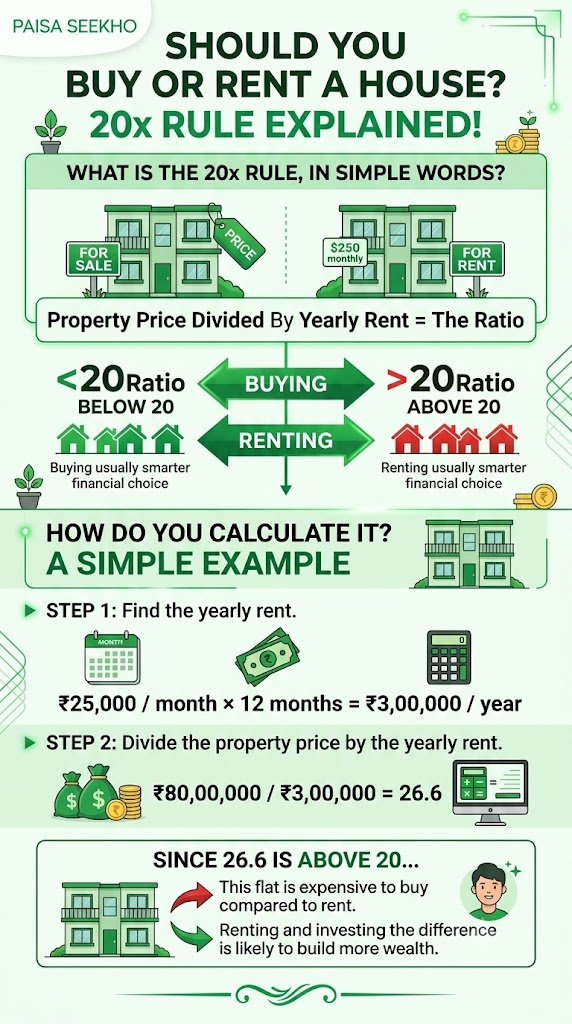
Imagine two flats that are exactly the same, same size, same location, same building. One is for sale. One is for rent. The 20x rule compares these two numbers:
Property price divided by yearly rent = the ratio
If this ratio is below 20, buying is usually the smarter financial choice.
If this ratio is above 20, renting, and investing the money you save, is usually the smarter financial choice.
This number is also called the price-to-rent ratio. The “20x” simply means the property price is 20 times the yearly rent, the tipping point where the maths starts to favour renting instead of buying.
How Do You Calculate It? A Simple Example
Let us say a flat costs ₹80 lakh to buy. A similar flat in the same area rents for ₹25,000 a month.
Step 1:
Find the yearly rent. ₹25,000 times 12 months = ₹3,00,000 per year
Step 2:
Divide the property price by the yearly rent. ₹80,00,000 divided by ₹3,00,000 = 26.6
Since 26.6 is above 20, this particular flat is expensive to buy compared to what it costs to rent. In this case, renting and investing the difference is likely to build more wealth over time than buying.
A Second Example, Where Buying Wins
Now take a flat in a Tier 2 city that costs ₹50 lakh, and rents for ₹22,000 a month.
Step 1: ₹22,000 times 12 = ₹2,64,000 per year
Step 2: ₹50,00,000 divided by ₹2,64,000 = 18.9
Since 18.9 is below 20, buying this particular flat makes more financial sense than renting it.
Notice what changed. The property price was much lower relative to the rent in the second example. This is common in Tier 2 and Tier 3 cities, where property prices have not risen as sharply as rents relative to metro cities, making the ratio more favourable to buyers.
Why Does 20 Become the Cut-Off Number?
The number 20 is not random. It comes from flipping the ratio around. If price is 20 times the yearly rent, then:
Yearly rent divided by property price = 1/20 = 5%
This 5% is your rental yield, the return you would earn each year if you bought the property purely to rent it out. A 5% rental yield roughly matches the real, ongoing cost of owning a home: home loan interest, property tax, maintenance, and the money you lose by not investing your down payment elsewhere.
In simple words: if the rent you would earn from a property, as a percentage of its price, is close to or above 5% a year, buying starts to make more financial sense. If it is well below that, below 4%, renting usually wins.
Why Metro Cities Almost Always Favour Renting
In cities like Mumbai, Delhi NCR, and Bengaluru, property prices have risen much faster than rents over the years. This has pushed the price-to-rent ratio well above 20 in many areas, sometimes as high as 30 to 45 in parts of Mumbai.
A real-world metro example: A flat in a prime Mumbai suburb costs ₹1.5 crore. A similar flat rents for ₹35,000 a month.
- Yearly rent: ₹35,000 times 12 = ₹4,20,000
- Ratio: ₹1,50,00,000 divided by ₹4,20,000 = 35.7
At a ratio of 35.7, the 20x rule strongly favours renting. Buying this specific flat would mean paying a price that is nowhere close to justified by what it could earn in rent.
Why Tier 2 and Tier 3 Cities Often Favour Buying
In smaller cities, property prices tend to be more reasonable relative to local rents. This often brings the ratio closer to, or below, 20.
A Tier 2 city example: A flat in Nagpur costs ₹45 lakh. A similar flat rents for ₹20,000 a month.
- Yearly rent: ₹20,000 times 12 = ₹2,40,000
- Ratio: ₹45,00,000 divided by ₹2,40,000 = 18.75
Below 20, so buying tends to make more sense here, especially if you plan to stay long-term.
This is a genuinely important pattern for readers in Tier 2 and Tier 3 India. The “rent is always cheaper” advice you often hear online is usually based on metro city data. In many smaller cities, the maths can point the other way.
Does the 20x Rule Apply the Same Way to Everyone?
No, and this is important to understand. The 20x rule is a quick, first-pass test, not the final word. A few things it does not capture:
How long you plan to stay.
If you plan to stay in the same home for only 3 to 4 years, buying rarely makes sense even if the ratio is below 20, since the upfront costs of buying, stamp duty, registration, brokerage, take several years to recover.
Property appreciation.
If a property is likely to rise sharply in value due to a new metro line, IT park, or highway nearby, buying can make sense even with a ratio slightly above 20.
Your own financial discipline.
The rule assumes that if you rent, you will actually invest the money you save instead of spending it. If you know you will not save that difference consistently, the “renting wins” conclusion may not hold true for you in practice.
Emotional and family factors.
Owning a home gives stability, a sense of security, and freedom from landlord uncertainty. The 20x rule only measures money, not these other genuine benefits.
A Simple Way to Use the 20x Rule in Real Life
- Find the price of a property you are considering.
- Find the monthly rent of a similar property in the same area, ask a local broker, or check listing sites.
- Multiply the rent by 12 to get the yearly rent.
- Divide the property price by the yearly rent.
- Compare your number to 20.
- Well below 20 (15 or lower): buying looks financially attractive
- Close to 20 (18 to 22): it is a close call, other factors like how long you will stay matter more
- Well above 20 (25 or higher): renting and investing the difference is likely to build more wealth
What Should You Do With the Money You Save by Renting?
If the 20x rule points you toward renting, the second half of the decision matters just as much: what you do with the money you save.
The EMI, monthly loan payment, on a home is usually much higher than the rent for a similar home. If you rent instead of buying, you have a gap between what you would have paid in EMI and what you actually pay in rent. This gap only helps you build wealth if you actually invest it, in a mutual fund SIP, for example, rather than simply spending it.
If you rent but do not save or invest the difference, the 20x rule’s benefit disappears entirely. The rule assumes discipline on your part.
Frequently Asked Questions
1. Is the 20x rule always accurate?
It is a quick, useful starting point, not a perfect answer. It works best as a first check. For a big decision like buying a home, also consider how long you plan to stay, whether the area is likely to see strong price growth, and your own comfort with either renting or owning.
2. What if my ratio comes out to exactly 20?
A ratio right around 20 is considered a close call. In this zone, other factors, like how many years you plan to stay in the home, tend to matter more than the ratio itself.
3. Why is the ratio so high in cities like Mumbai?
Property prices in prime metro areas have risen much faster than rents over many years. This pushes the price-to-rent ratio well above 20 in many parts of these cities, making renting the more attractive option purely from a financial maths perspective.
4. Does the 20x rule account for a home loan?
Not directly. The rule compares property price to rent, not your specific loan terms. However, the underlying logic, a 5% rental yield roughly matches the real cost of ownership, already accounts for a typical home loan interest cost as part of that estimate.
5. Should I use the 20x rule for every property I look at?
It is worth calculating for any property you are seriously considering, since it takes just a minute and gives you a useful, quick sense check. But do not treat it as the final decision, use it alongside your own plans for how long you will live there and your comfort with either renting or owning.
6. Is buying always better if I plan to stay for a very long time?
Generally, yes, staying longer improves the case for buying, since you recover the upfront buying costs, stamp duty, registration, brokerage, over more years, and you benefit from any property price growth over that time. Most financial experts suggest that staying 7 years or more meaningfully strengthens the case for buying, even in cities with a ratio slightly above 20.
Key Takeaways
- The 20x rule compares a property’s price to its yearly rent. Property price divided by yearly rent, below 20 favours buying, above 20 favours renting.
- This ratio is also called the price-to-rent ratio. A ratio of 20 corresponds to a 5% rental yield, which roughly matches the real annual cost of owning a home.
- Metro cities (Mumbai, Delhi NCR, Bengaluru) often show ratios well above 20, favouring renting, since property prices there have risen faster than rents.
- Tier 2 and Tier 3 cities often show ratios closer to or below 20, making buying more attractive in many cases.
- The rule does not account for how long you plan to stay, future price growth, or your own saving discipline, so use it as a starting point, not a final answer.
- If renting wins the calculation, the benefit only materialises if you actually invest the money you save instead of buying, rather than simply spending it.
Sources: Hisabhkaro: Rent vs Buy India 2026, The Real Math Nobody Shows You, April 2026; Financial Calculator: Rent vs Buy Calculator India 2026, Should You Rent or Buy a House?; Estate Hive: Renting vs Buying a Home in Bangalore 2026, The Complete Financial Breakdown, May 2026; Inflation Calculator: Rent vs Buy Calculator India, Should You Rent or Buy?.
This article is for general information only and does not give financial advice. Property prices and rents vary widely by exact location, and past trends do not guarantee future results. Consult a financial advisor before making a large decision like buying a home.