

Form 29B is a Chartered Accountant’s report certifying a company’s book-profit computation under Section 115JB. It concerns Minimum Alternate Tax (MAT). This guide covers FY 2025-26, assessed in AY 2026-27, under the Income-tax Act, 1961.
AY 2026-27 and Tax Year 2026-27 refer to different income periods. Filing after April 2026 does not automatically move a FY 2025-26 return into the new Act. See the Income Tax Department’s transition guidance.
When does MAT apply?
MAT compares tax under the normal provisions with tax on adjusted book profit. It does not compare taxable income directly with a tax amount.
Check applicability first. Companies exercising the options under Sections 115BAA or 115BAB are outside Section 115JB. Life-insurance business income under Section 115B is also excluded, and specified foreign-company exclusions exist. A loss in the accounts alone does not establish whether MAT applies. Source: Section 115JB.
For AY 2026-27, the standard MAT rate is 15% of book profit, with applicable surcharge and 4% health and education cess. A qualifying IFSC unit deriving income solely in convertible foreign exchange has a 9% MAT rate. These rules are summarised in the Department’s domestic-company guide.
If 7% surcharge applies to the standard rate, the arithmetic before marginal relief is 15% × 1.07 × 1.04 = 16.692%, not 17.01%. The applicable surcharge and marginal relief must be checked for the actual computation.
What is book profit?
Book profit starts with the profit in the relevant statement of profit and loss and applies the adjustments prescribed by Section 115JB. It is not simply taxable income or the unadjusted accounting profit.
Examples include adding back an income-tax provision debited to the accounts. Deductions also have conditions: the usual brought-forward loss/unabsorbed-depreciation adjustment uses book figures and generally the lower amount; it is unavailable under that clause if either amount is nil. Special cases have separate rules.
Do not deduct equity capital gains merely by labelling them Section 10(38) exempt income: that clause is excluded from the relevant exempt-income reduction. Ind AS companies require additional adjustments. Source: Section 115JB.
A simplified tax comparison
Assume a domestic company is subject to the standard MAT rate for AY 2026-27, its CA has already calculated book profit of ₹50 lakh, and no surcharge applies. Assume its normal tax is ₹5 lakh before cess. These are illustrative inputs, not a book-profit calculation for a real company.
| Calculation | Amount |
|---|---|
| MAT before cess: ₹50,00,000 × 15% | ₹7,50,000 |
| Cess on MAT: ₹7,50,000 × 4% | ₹30,000 |
| MAT including cess | ₹7,80,000 |
| Normal tax including 4% cess | ₹5,20,000 |
MAT is higher in this example. ₹7,80,000 is the comparison figure before applying payment credits, interest or other case-specific adjustments; it is not necessarily the remaining balance to pay.
What does Form 29B contain, and who files it?
Part A contains the general computation; Parts B and C address applicable Ind AS adjustments. The form also includes the accountant’s report.
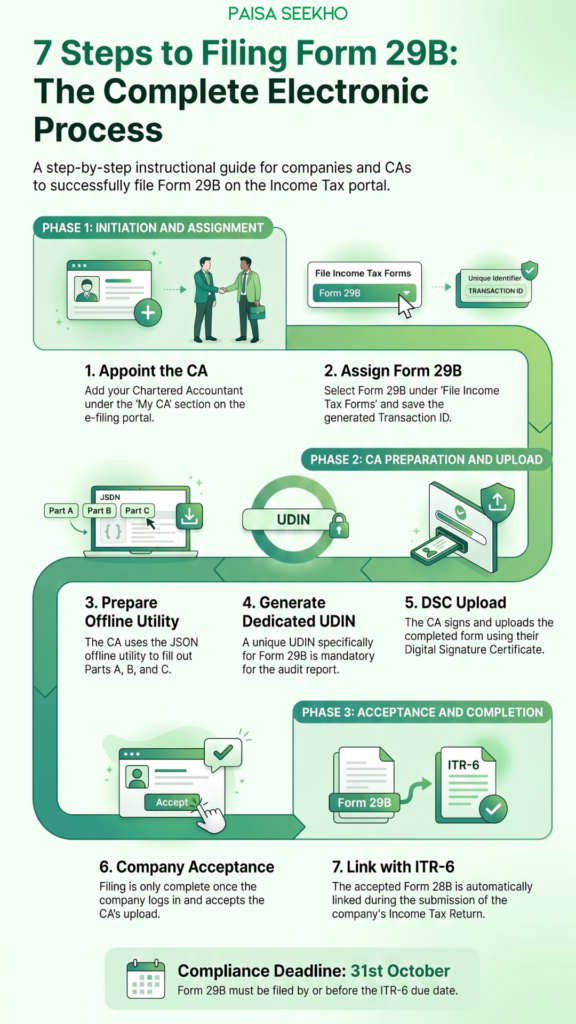
The company assigns Form 29B to its CA through the e-filing portal. The CA accepts, prepares and submits it; online and offline preparation routes are available. The taxpayer then accepts and e-verifies the submitted form. Save the acknowledgement. Follow the official Form 29B user manual for the current screens and prerequisites.
Due date: check separately from the ITR
The official manual specifies filing one month before the Section 139(1) return deadline. For a return responding to a Section 142(1)(i) notice, it specifies filing with that return. Confirm the company’s applicable deadline and any CBDT extension with the CA; a single 31 October 2026 deadline does not cover every filer. Source: Form 29B user manual.
MAT credit under the old Act
Section 115JAA provides credit for the eligible excess of MAT over normal tax. Under its rules, carry-forward cannot extend beyond the fifteenth succeeding assessment year, and set-off is limited to the excess of normal tax over MAT in the relevant year. Conditions and adjustments apply. Source: Section 115JAA.
These old-Act rules are not a promise that every balance can be used unchanged under later legislation. Check the applicable transition rules before using an earlier credit in a later tax year.
Late filing or an error in the report
Section 271BA is not a blanket ₹1 lakh penalty for missing Form 29B. It concerns the accountant’s report required by Section 92E. Ask your CA to assess the applicable provisions and remedy if Form 29B is late, missing or incorrect. Source: Section 271BA.
This guide does not promise that a fresh or revised submission is available in every case. Check the relevant year, portal facility and legal position before submitting a correction.
Form 29B and the new Act’s Form 66
The Department maps Form 29B under the 1962 Rules to Form 66 under Rule 137 of the 2026 Rules, associated with Section 206(1) of the Income-tax Act, 2025. Use the correct Act and income period when selecting the form. Do not assume the rate, deadline or credit rules are unchanged simply because the forms correspond. Source: official Form 66 FAQ.
Related guides
For background on separate tax-audit reports, see Form 3CA vs Form 3CB and Form 3CD explained.
Correction, 23 September 2026: corrected the deadline and penalty explanation; revised MAT applicability and the illustrative calculation; clarified the distinction between AY 2026-27 and the new Act’s Tax Year 2026-27. Removed unsupported blanket assertions about revisions and audit requirements.
General educational information, not company-specific tax advice. Have a practising Chartered Accountant determine applicability and complete the computation for your company.
Last Updated on 1 month ago by Team Paisaseekho