

Quick summary: A Gold ETF lets you own gold without going to a jeweller. You buy it the same way you buy shares, through a demat account. This guide walks you through every step, from opening the account to placing your first order, so that you can start investing easily!
What Is a Demat Account?
A demat account is like a digital locker for your investments. Instead of holding paper share certificates, everything is stored electronically. When you buy shares, mutual funds, or Gold ETFs, they sit safely inside this account.
You need two things to invest in a Gold ETF:
- A demat account, which holds your Gold ETF units
- A trading account, which lets you place buy and sell orders
Most brokers give you both together when you open an account. You cannot buy a Gold ETF without these two accounts, since ETFs are traded on the stock exchange, just like company shares.
How To Buy Gold ETFs Through A Demat Account?
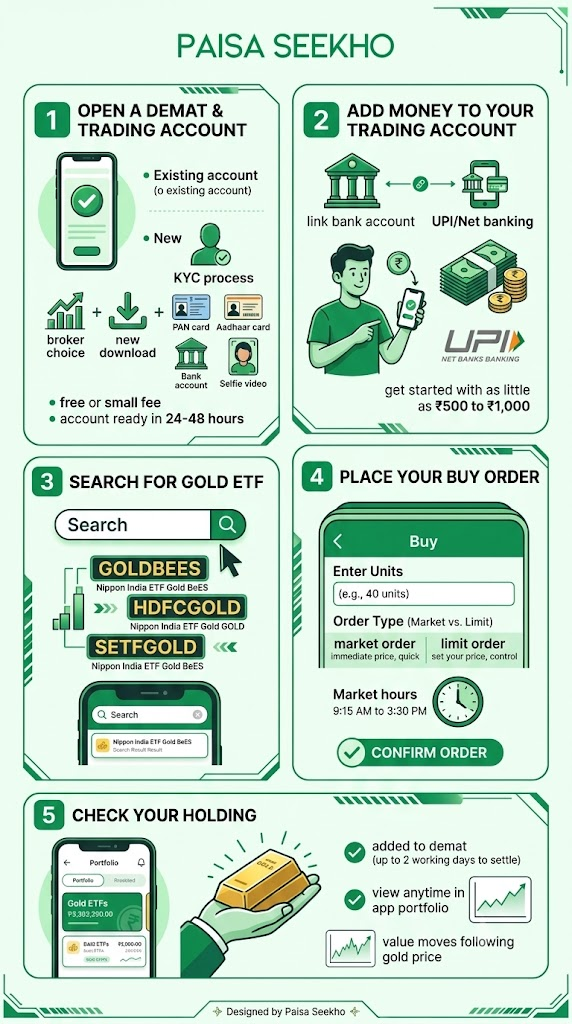
Step 1: Open a Demat and Trading Account
If you already have a demat account, maybe you already invest in shares or mutual funds, you can skip this step and use the same account.
If you do not have one, here is how to open it:
- Choose a broker. Popular choices in India include Zerodha, Groww, Upstox, ICICI Direct, HDFC Securities, and Angel One.
- Download the broker’s app or visit their website.
- Fill in your details and complete the KYC, Know Your Customer, process. You will need your PAN card, Aadhaar card, a bank account, and sometimes a short selfie video.
- Some brokers charge a small one-time fee to open the account. Many offer free account opening.
- Your account is usually ready within 24 to 48 hours.
One thing to know: KYC is done only once. Once you complete it with any SEBI-registered broker, you do not need to repeat the whole process again if you open an account with a different broker later.
Step 2: Add Money to Your Trading Account
Once your account is open, link your bank account to it. You can add money using net banking or UPI, just like you would top up any other app.
You do not need to add a huge amount. Gold ETF units can cost as little as ₹100 to ₹135 each, depending on the fund. So even ₹500 to ₹1,000 is enough to get started.
Step 3: Search for the Gold ETF You Want to Buy
Open your broker’s app and use the search bar to look for a Gold ETF. Each fund has its own short code, called a ticker symbol. For example:
- GOLDBEES is Nippon India ETF Gold BeES
- HDFCGOLD is HDFC Gold ETF
- SETFGOLD is SBI Gold ETF
You can search using either the ticker or the full fund name. Before you buy, it helps to quickly check a few things about the fund:
- The current price per unit, so you know roughly how much gold you are buying
- The expense ratio, the small yearly fee the fund charges, explained in our expense ratio comparison guide
- How much the fund trades every day, since a fund that trades a lot is usually easier to buy and sell at a fair price, explained in our Gold ETF liquidity guide
If you are unsure which fund to pick, larger, well-known funds like Nippon India ETF Gold BeES, HDFC Gold ETF, or SBI Gold ETF are common, simple starting points for beginners, since they are widely traded and easy to buy or sell.
Step 4: Place Your Buy Order
Once you have picked the fund, you place a buy order, the same way you would buy a stock.
- Tap “Buy” on the fund’s page.
- Enter the number of units you want to buy. If you want to invest ₹5,000 and the unit price is ₹125, you can buy about 40 units.
- Choose your order type:
- Market order: buys immediately at the current price. Simple and quick, good for small purchases.
- Limit order: you set the highest price you are willing to pay. The order only goes through if the price is at or below what you set. This gives you more control, especially for larger purchases.
- Confirm the order.
That is it. Your order gets placed during market hours, which are 9:15 AM to 3:30 PM on trading days.
Step 5: Check Your Holding
After your order goes through, the units are added to your demat account. This can take up to two working days to fully settle, though most brokers show the units in your account right away.
You can check your holdings anytime by opening your broker’s app and looking at your portfolio or holdings section. The value will move up or down slightly every day, following the price of gold.
How Do You Sell a Gold ETF Later?
Selling works exactly like buying, in reverse.
- Open your broker’s app and find the Gold ETF in your holdings.
- Tap “Sell.”
- Enter the number of units you want to sell.
- Choose market order or limit order, same as before.
- Confirm.
The money from your sale is usually credited to your linked bank account within one to two working days. There is no lock-in period. You can sell your units any time the market is open, even the same day you bought them, if you wish.
What Does It Cost to Buy and Sell?
Besides the fund’s own yearly expense ratio, brokers charge a small fee every time you place an order. This is called brokerage. For Gold ETFs, this is usually either a flat amount, like ₹20, or a small percentage of the order value, like 0.03%, whichever is lower. This fee is charged both when you buy and when you sell.
There is no extra GST charged when you buy or sell a Gold ETF, unlike digital gold platforms which charge 3% GST on every purchase.
Common Mistakes First-Time Buyers Make
Buying without checking the price first.
Always glance at the current unit price before placing your order, especially if using a market order, so you know roughly what you are paying.
Choosing a fund with very low trading volume.
If very few people are buying and selling a particular Gold ETF that day, you might end up paying a slightly higher price to buy, or getting a slightly lower price to sell. Stick to well-known, actively traded funds when you are starting out.
Forgetting that Gold ETFs pay no income.
Unlike a fixed deposit, a Gold ETF does not pay you any interest or dividend. Your only gain comes from the price of gold going up over time. This is completely normal for gold investments.
Selling too soon and paying more tax.
If you sell your Gold ETF within 12 months of buying it, your profit is taxed at your regular income tax rate, which can be quite high. If you wait more than 12 months, your profit is taxed at a lower, flat rate of 12.5% instead. Keep this in mind if you plan to sell.
Is There a Simpler Way if I Don’t Want a Demat Account?
Yes. If opening a demat account feels like too much effort right now, you can invest in a Gold Mutual Fund instead, sometimes called a Fund of Funds. This is a mutual fund that itself invests in a Gold ETF on your behalf. You can invest through any mutual fund app, without needing a demat account, and you can even set up an automatic monthly SIP easily.
The trade-off is that Gold Mutual Funds usually charge a slightly higher total fee than buying a Gold ETF directly, since there is an extra layer of fund management involved. For more on this comparison, see our guide on Gold ETF SIP vs lump sum investment.
Frequently Asked Questions
1. Do I need a demat account to buy a Gold ETF?
Yes. A Gold ETF is bought and sold on the stock exchange, just like company shares, so you need both a demat account, to hold the units, and a trading account, to place your buy and sell orders.
2. How much money do I need to start?
Very little. Since one unit of a Gold ETF usually costs somewhere between ₹100 and ₹135, you can start with as little as ₹500 to ₹1,000.
3. Can I buy and sell a Gold ETF on the same day?
Yes. There is no lock-in period. You can sell your units any time the market is open, even the same day you bought them, though most investors treat gold as a long-term holding rather than a quick trade.
4. Which Gold ETF should a beginner choose?
Larger, well-known funds like Nippon India ETF Gold BeES, HDFC Gold ETF, or SBI Gold ETF are common starting points, since they trade actively and are easy to buy or sell without much price difference.
5. What happens if I don’t have a demat account and don’t want to open one?
You can invest in a Gold Mutual Fund instead. It invests in a Gold ETF on your behalf, and you can buy it through any regular mutual fund app, without needing a demat account.
6. Does buying a Gold ETF mean I actually own real gold?
Yes, in the sense that the fund itself holds real, pure gold, 99.5% purity, in secure vaults, and your units represent a small share of that gold. You do not receive a physical gold bar yourself, but your investment is backed by real gold, not just a paper promise.
Key Takeaways
- You need a demat account and a trading account to buy a Gold ETF, the same accounts used to buy shares.
- Opening an account takes 24 to 48 hours and needs your PAN, Aadhaar, and a linked bank account.
- You can start with as little as ₹500 to ₹1,000, since one unit typically costs ₹100 to ₹135.
- Search for the fund using its ticker symbol (like GOLDBEES), check the price, and place a buy order, just like buying a stock.
- There is no lock-in period. You can sell any time the market is open.
- Brokers charge a small fee (brokerage) on each order, but there is no GST on Gold ETF purchases.
- If you do not want a demat account, a Gold Mutual Fund lets you invest without one, though usually at a slightly higher cost.
- Hold for more than 12 months to get the lower, flat 12.5% tax rate on your profit, instead of your regular income tax slab rate.
Sources: IPO Market: How to Invest in Gold ETF in India 2026, Step-by-Step Beginner Guide, May 2026; Zerodha Fund House: How to Invest in Gold and Silver ETFs, A Simple Guide, January 2026; StarTrader: How to Buy a Gold ETF in India, Step-by-Step Guide, May 2026; Fi Money: Gold ETF Investment Guide, How to Buy and Invest Wisely.
This article is for general information only and does not give investment advice. Gold prices can go up or down, and past performance does not predict future results. Talk to a SEBI-registered investment advisor before making a decision.