
TL;DR: Key Takeaways on the High Oil Prices Impact Warning
If you are commuting to work and just need the fast facts, here is the quick summary of the situation:
- The Big Warning: IMF Chief Kristalina Georgieva warned that the global economy will face “tough times” if the Middle East conflict continues and oil prices stay high.
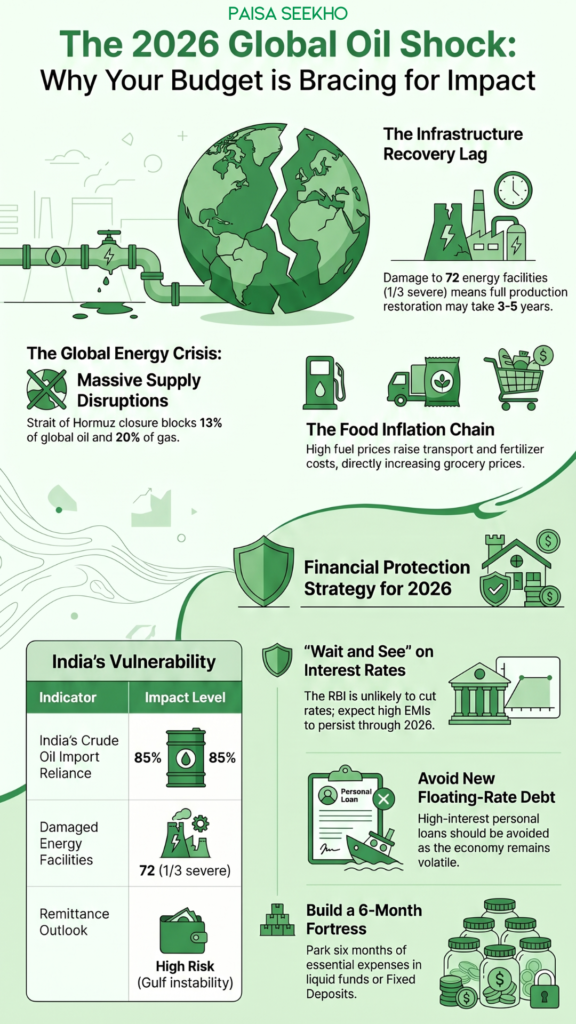
- The Root Cause: The conflict has virtually closed the Strait of Hormuz, a massive shipping route. This has disrupted 13% of global oil supplies and 20% of global gas supplies.
- The Food Threat: It is not just about petrol. The shipping blockage is also stopping the delivery of cheap fertilizers. If farmers pay more for fertilizer, you pay more for food (inflation).
- The Recovery Delay: Even if a peace treaty is signed tomorrow, damaged oil refineries and disrupted supply chains will take years to fix. High fuel prices are here to stay for a while.
- The IMF’s Advice to India: The IMF has told central banks (like the RBI) not to rush into cutting interest rates just yet. They need to wait and see if inflation gets worse before making money cheaper to borrow.
- The NRI Impact: Countries that rely on energy imports (like India) are taking a massive hit. Furthermore, Indians working in the Gulf might face job insecurity, which could lower the money (remittances) they send back home.
Have you noticed your monthly budget stretching a little thinner lately? Maybe filling up your car or bike with petrol feels a bit heavier on the pocket. Or perhaps your weekly trip to the grocery store is suddenly costing a few hundred rupees more than it used to.
If you are feeling this financial pinch, you are not alone. And unfortunately, according to the top financial experts in the world, things might get a little bumpier before they get better.
In April 2026, the global financial world gathered in Washington, D.C., for the International Monetary Fund (IMF) and World Bank Spring Meetings. During this massive event, the head of the IMF, Kristalina Georgieva, dropped a very serious warning: “We must brace for tough times ahead.”
Her warning was specifically focused on the ongoing conflict in the Middle East and how it is causing global oil prices to skyrocket. But why should a war happening thousands of miles away affect the price of your vegetables in India? How do global oil supplies dictate the Reserve Bank of India’s interest rates? And most importantly, what can you do to protect your family’s savings during this economic storm?
1. What Exactly Did the IMF Chief Say About the High Oil Prices Impact?
To understand the gravity of the situation, we need to look at exactly what happened at the IMF and World Bank Spring Meetings in April 2026.
The International Monetary Fund (IMF) is basically the financial doctor of the world. They monitor the health of every country’s economy and provide loans to countries that are struggling. The head of this massive organization is Managing Director Kristalina Georgieva.
During a major press briefing, she did not sugarcoat the reality. She stated clearly that the ongoing conflict in the Middle East is no longer just a regional political issue; it is a major global economic shock.
She noted that the impact on the global economy is already large. But her biggest fear is what happens next. If the conflict persists and oil prices stay high for an extended period, she warned that inflation risks could seep directly into food prices, creating a massive cost-of-living crisis for everyday citizens across the globe.
She also pointed out that this crisis is highly “uneven.” A country like the United States, which produces its own oil, will survive. But countries that have to import their energy from other nations (like India, South Korea, and the Philippines) are going to bear the heaviest burden.
2. Why Are Oil Prices Skyrocketing in 2026?
To understand why your petrol bill is going up, we need a quick geography and economics lesson.
The Middle East is essentially the world’s massive petrol pump. Millions of barrels of crude oil are pumped out of the ground there every single day. But pumping the oil is only step one. Step two is getting that oil onto massive cargo ships and sailing it across the ocean to countries like India, China, and Europe.
The Choke Point: The Strait of Hormuz
Almost all of these massive oil ships have to pass through a very narrow body of water called the Strait of Hormuz. It is a tiny strip of ocean located right between Iran and Oman. It is the most important “choke point” for global energy.
Due to the severe escalation in the conflict in early 2026, this strait has been virtually closed off. Military strikes and port blockades have made it incredibly dangerous for commercial cargo ships to pass through.
What happens when the ships cannot sail?
- According to the IMF, this blockage has disrupted approximately 13% of all global oil supplies and 20% of global gas supplies.
- In economics, the rule of “Supply and Demand” is absolute law. The world still demands the same amount of oil to run cars, factories, and airplanes. But suddenly, the supply of that oil has dropped massively.
- When demand is high and supply is low, the price shoots straight up. This is exactly why global crude oil prices have surged, creating an “energy shock” that is shaking the foundation of the global economy.
3. How Does This Impact the Indian Economy?
Alright, so oil is stuck in the Middle East and global prices are high. But how does that actually trickle down to affect a middle-class family living in Mumbai, Delhi, or Bangalore?
India is uniquely vulnerable to this crisis. We are a massive, rapidly growing country, but we do not have enough oil of our own. India imports roughly 85% of its crude oil requirements. When global oil prices jump, our entire economy feels the shockwave. Here is how it impacts you directly:
A. The Direct Hit: Petrol and Diesel Prices
This is the most obvious impact. When the Indian government and oil marketing companies (like Indian Oil or Bharat Petroleum) have to pay more dollars to buy crude oil from the international market, they eventually have to pass that extra cost down to the consumer. If crude oil stays expensive, you will see the price per liter of petrol and diesel at your local pump start to creep up.
B. The Silent Killer: Freight and Transportation Costs
Let’s say you do not own a car and you travel by metro. You might think high oil prices do not affect you. You are wrong.
Think about how your groceries get to your local supermarket. Tomatoes, rice, electronics, and clothes do not magically appear in stores. They are transported in massive trucks that run on diesel.
If diesel becomes expensive, the truck driver charges the transport company more. The transport company charges the farmer or factory more. The farmer charges the supermarket more. Finally, the supermarket charges you more. This chain reaction is how expensive oil causes widespread Inflation.
C. The Food Threat: The Fertilizer Connection
This was a major point highlighted by the IMF chief. The blocked ships in the Middle East are not just carrying oil; they are carrying essential fertilizers used by farmers around the world.
If Indian farmers cannot get cheap fertilizers, their crop yield might drop, or their cost of farming will skyrocket. Georgieva specifically warned that if the delivery of fertilizers at a reasonable price is not restarted soon, we will see inflation move directly into food prices. A spike in food prices is the most painful type of inflation because everybody, regardless of their income, has to eat.
D. The Threat to Remittances
India receives over $130 billion every year from Non-Resident Indians (NRIs) sending money back home. A massive portion of this money comes from Indians working in the Gulf countries (like the UAE, Saudi Arabia, etc.).
While oil-producing countries usually make more money when prices are high, a full-scale war disrupts all normal business. Construction projects stop, tourism drops, and businesses shut down. If Indian expats lose their jobs due to the conflict, the flow of foreign money back into India will shrink, hurting millions of families who rely on that monthly cash to survive.
4. Why the IMF Says “Wait and See” for Interest Rates
Whenever inflation gets out of control, everyday citizens look to the central bank for help. In India, that is the Reserve Bank of India (RBI).
The main weapon a central bank uses to fight inflation is the Interest Rate (the Repo Rate).
- If they raise interest rates, loans become expensive. People borrow less, spend less, and prices eventually drop.
- If they lower interest rates, loans become cheap. People borrow more, businesses expand, and the economy grows fast.
For the last year, everyone in India has been hoping the RBI would finally lower interest rates so that their Home Loan EMIs and Car Loan EMIs would get cheaper.
However, the IMF chief gave a very clear instruction to central banks around the world: Do not rush.
Georgieva urged central banks to maintain a “wait and see” approach before adjusting interest rates. Why? Because the global situation is too volatile. If the RBI cuts interest rates today to make loans cheaper, but oil prices shoot up tomorrow and cause massive inflation, the economy will overheat and crash.
The IMF advises that until the energy shock is completely resolved and inflation is permanently dead, central banks must keep interest rates high to protect the value of the currency.
What this means for you:
If you were planning to take a massive home loan hoping that interest rates would magically drop next month, you need to adjust your expectations. Thanks to the Middle East conflict, expensive loans and high EMIs are likely going to stick around for the rest of 2026.
5. The Danger of “Untargeted Subsidies”
When prices go up, citizens naturally get angry at the government. To win favor and calm the public, governments often panic and announce massive subsidies. They might cut the tax on petrol completely or offer free electricity to everyone.
During her speech in Washington, the IMF chief strictly warned against this. She cautioned that governments must avoid rushing into broad measures like “untargeted tax cuts, energy subsidies, and price controls.”
Why are broad subsidies bad?
If the government artificially makes petrol cheap by completely removing taxes, everyone will keep driving their cars as if nothing happened. They will keep burning imported oil. But the government still has to pay the high international price for that oil. This drains the national treasury. Eventually, the government will run out of money and will have to take massive loans or print more currency, which ultimately causes even worse inflation down the line.
Instead, the IMF suggests that governments should only give financial help to the most vulnerable, low-income citizens (targeted subsidies), while letting the broader market adjust to the high prices naturally.
6. Why Won’t Prices Drop Immediately When the War Ends?
Here is the most depressing part of the IMF report. We all hope for peace. We hope a ceasefire is signed tomorrow and the conflict ends. But even if the war stops today, the economic pain will not vanish overnight.
The IMF warned that the “Middle East conflict shock will persist through 2026, with no quick return to pre-crisis oil prices.”
Why? Because physical damage takes time to fix.
The report noted that 72 major energy facilities have sustained damage during the conflict, with one-third of them suffering severe destruction. You cannot rebuild a massive, complex oil refinery in a week. Restoring full production at certain locations will take anywhere from three to five years!
Furthermore, global supply chains have been entirely re-routed. Massive shipping companies have signed long-term contracts to sail their ships around the continent of Africa to avoid the danger zone. It will take months, if not years, for the complex web of global logistics to return to normal. The era of ultra-cheap fuel is temporarily on pause.
7. What Should You Do to Protect Your Finances?
Reading about global wars and energy shocks can make you feel helpless. You cannot control the price of crude oil or the decisions made in Washington. But you can control how you manage your own household budget.
If the IMF says “tough times are ahead,” you need to prepare your financial fortress. Here is a simple, actionable Paisaseekho action plan for 2026:
Step 1: Re-Evaluate Your Monthly Budget
Assume that your daily expenses (groceries, transport, electricity) are going to go up by 10% to 15% over the next few months. Sit down with your family and find areas where you can cut back. Can you carpool to work? Can you reduce dining out at restaurants? Create a buffer in your budget to absorb the shock of inflation without having to dip into your savings.
Step 2: Avoid Floating-Rate Personal Debt
If the RBI is keeping interest rates high to fight inflation, this is the worst possible time to take on unnecessary debt. Avoid taking high-interest personal loans to buy luxury items. If you have credit card debt, aggressively pay it off right now. High-interest debt is a wealth-killer during inflationary times.
Step 3: Build a Cash Emergency Fund
When the economy gets rocky, companies often try to cut costs by freezing hiring or even laying off employees. You need an emergency fund more than ever. Ensure you have at least six months’ worth of mandatory living expenses (rent, EMIs, food) parked safely in a high-interest Fixed Deposit (FD) or a liquid mutual fund.
Step 4: Keep Investing, Don’t Panic
While inflation hurts your wallet, the stock market actually offers a hedge against it. Great Indian companies will eventually pass the higher costs down to consumers and maintain their profits. Do not stop your monthly Systematic Investment Plans (SIPs) in mutual funds out of fear. In fact, if the market crashes because of bad global news, view it as a discount sale and keep buying good quality assets.
Conclusion
The warning from IMF Chief Kristalina Georgieva is clear and serious. The global economy is heavily interconnected. A blocked strait in the Middle East translates directly into an expensive basket of vegetables in an Indian market.
While the “energy shock” of 2026 is creating a tough environment with high oil prices, sticky inflation, and delayed interest rate cuts, it is important to remember that the Indian economy is incredibly resilient. We have survived global shocks before.
The government and the RBI have strong financial buffers to prevent a total collapse. Your job is not to panic, but to be prudent. By understanding the root causes of this inflation, avoiding unnecessary debt, and managing your household budget tightly, you can safely navigate your family through these tough times and come out stronger on the other side.
Frequently Asked Questions (FAQs) About High Oil Prices and the Economy
Q1: What did the IMF Chief warn about the global economy in 2026?
IMF Managing Director Kristalina Georgieva warned that the global economy must “brace for tough times ahead” if the Middle East conflict persists, as it is causing oil prices to stay high and threatening to push global inflation into food prices.
Q2: Why are global oil prices rising so fast?
The ongoing conflict has virtually closed the Strait of Hormuz, a massive shipping route. This disruption has blocked approximately 13% of global oil supplies and 20% of global gas supplies, causing a massive shortage that drives prices up.
Q3: How does a war in the Middle East affect my grocery bill in India?
Expensive crude oil makes diesel expensive. Because all our vegetables, grains, and goods are transported in diesel-run trucks, the high transport cost is added to the final price of the items in your local supermarket, causing food inflation.
Q4: Will oil prices drop immediately if a ceasefire is signed?
No. The IMF report notes that dozens of oil refineries and energy facilities have been severely damaged during the conflict. Rebuilding this infrastructure and restoring full supply chains will take years, meaning high prices will likely persist even after the fighting stops.
Q5: What is the connection between fertilizer and high oil prices?
The same cargo ships that transport oil also transport agricultural fertilizers. Because the shipping routes are blocked, fertilizers are becoming expensive and scarce. If farmers pay more for fertilizer, the cost of growing crops increases, leading directly to higher food prices.
Q6: Why did the IMF tell central banks to “wait and see”?
The IMF advised central banks (like India’s RBI) not to rush into lowering interest rates. If they lower rates to make loans cheaper, it might cause the economy to overheat while inflation is still a massive threat due to unpredictable oil prices.
Q7: Will my Home Loan EMI decrease in 2026?
It is highly unlikely in the short term. Because global energy shocks are threatening to keep domestic inflation high, the RBI is expected to keep the Repo Rate unchanged. Therefore, your floating-rate home loan EMIs will likely remain at their current high levels for the rest of the year.
Q8: Why is the IMF against governments giving broad petrol subsidies?
The IMF warns that “untargeted subsidies” (like completely removing all tax on petrol to make it cheap for everyone) drain the government’s treasury. It encourages people to keep burning expensive imported fuel, which ultimately harms the national economy and prolongs the inflation crisis.
Q9: How does the conflict affect NRIs and remittances?
A massive regional conflict stops normal business operations in the Gulf countries. If construction and tourism halt, Indian expats working there might lose their jobs or see salary cuts, which directly reduces the amount of money (remittances) they send back to their families in India.
Q10: What is the best way for a middle-class family to survive high inflation?
The best defense is financial discipline. Re-evaluate your monthly budget to cut unnecessary spending, avoid taking high-interest personal loans, build an emergency cash fund of at least six months’ expenses, and continue investing in long-term assets like mutual funds to beat inflation.
Last Updated on 1 month ago by Team Paisaseekho