

Quick summary: If you are an employee, note that Form 16 cannot simply be clicked and downloaded like a regular file. TRACES generates it through a multi-step request-validation-conversion process, and only after your quarterly TDS return (Form 24Q) has been successfully processed.
This is purely a step-by-step, employer-facing technical guide. We cover the exact screens, the KYC validation options, the specific password formats for each utility, and the most common errors that stall the process partway through. If you are looking for what Form 16 actually contains or how to read it as an employee, our Form 16 Part A vs Part B guide covers that. This article is the practical download mechanics for employers and HR.
Before You Start: What Must Already Be True
TRACES will not let you request Form 16 unless certain conditions are already satisfied. Checking these first saves you from getting partway through the process only to hit a wall.
Your Form 24Q for the relevant quarter must show a specific status.
The request for Form 16 can only be submitted when the statement status for your filed Form 24Q is either “Statement Processed with Default” or “Statement Processed without Default.” If your return is still showing “Submitted” or “In Process,” you need to wait until TRACES finishes processing it before a Form 16 request will even be accepted. For the full Form 24Q filing process and annexure structure, see our Form 24Q guide.
Every employee’s PAN must be valid and correctly reported.
A valid PAN is mandatory for generation of Form 16 (Part A). PAN must be present both in the PAN database and in the latest Form 24Q statements, specifically in Annexure I and Annexure II. If an employee’s PAN is invalid, missing, or was not reported correctly, Form 16 simply will not generate for that employee until a correction statement is filed to fix the PAN.
Part B eligibility depends on when you filed Annexure II.
Deductors can download Form 16 Part B through TRACES for FY 2018-19 onwards, per CBDT Notification 36/2019. If you filed your Form 24Q Annexure II before 12 May 2019 in the old format, you would have needed to file a revision in the new format to become eligible; this is largely a historical constraint now but is worth knowing if you are ever troubleshooting an unusually old filing.
You need either a registered Digital Signature Certificate (DSC) or specific challan and PAN details on hand for Normal KYC. More on this below.
Have your TRACES login credentials ready: User ID, Password, your TAN, and be prepared to complete a captcha.
Step-by-Step: Requesting Form 16 on TRACES
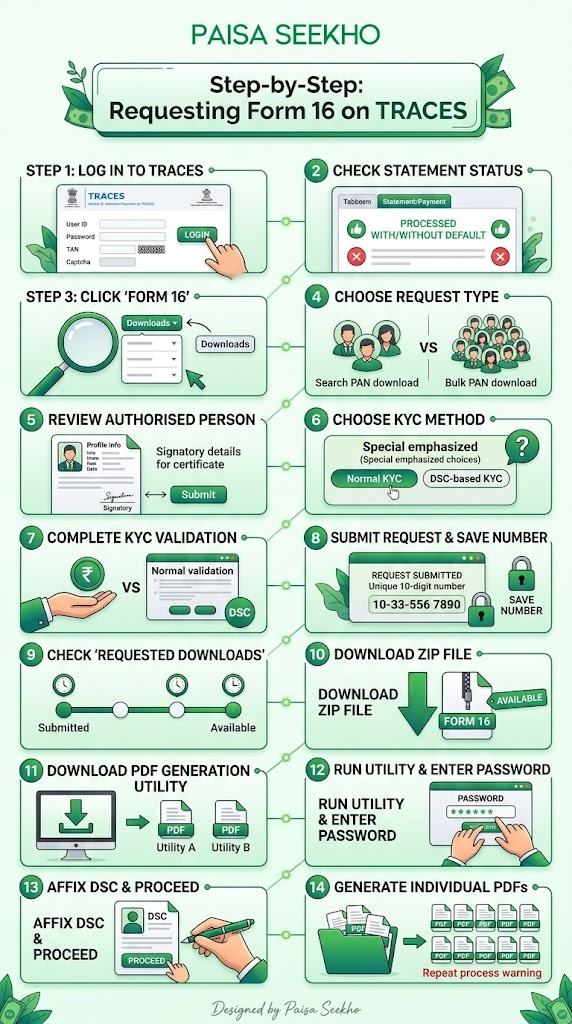
- Step 1: Log in to TRACES (tdscpc.gov.in) using your registered User ID, Password, TAN, and the verification code (captcha) displayed on screen.
- Step 2: From the landing page, check your statement status. Before raising the request, verify under the “Statement/Payment” tab that your relevant Form 24Q return shows “Statement Processed with Default” or “Statement Processed without Default.” Do not proceed if it shows any other status.
- Step 3: Click on “Form 16” under the “Downloads” tab.
- Step 4: Choose your request type: “Search PAN download” or “Bulk PAN download.” Search PAN is suited to requesting Form 16 for a small number of specific employees; Bulk PAN allows you to request for many employees at once, useful when processing your entire workforce at financial year-end.
- Step 5: Review the Authorised Person details that appear on screen. These details, populated from your TRACES profile information, will be printed on the Form 16 certificate itself as the signatory. Click “Submit” to proceed.
- Step 6: Choose your KYC validation method. This is the step where most first-time users get confused, so it deserves its own detailed section below.
- Step 7: Complete the KYC validation (DSC-based or Normal, as chosen).
- Step 8: Submit the request. TRACES will generate a unique Request Number for tracking. Save this number; you will need it later for the password when converting the downloaded file to PDF.
- Step 9: Check “Requested Downloads” periodically. Processing is not instant. Visit the “Requested Downloads” section under the “Downloads” menu to monitor status. It typically moves from “Submitted” to “Available” (ready to download) within a period ranging from a few hours to a couple of days, depending on system load.
- Step 10: Download the ZIP file once status shows “Available.”
- Step 11: Download the TRACES PDF Generation Utility. The downloaded file from TRACES is not a plain PDF; it must be converted using a separate utility. Note that different utilities are required for Form 16 Part A and Form 16 Part B; you will need to download both separately if you want the complete certificate.
- Step 12: Run the PDF Generation Utility, browse to your downloaded ZIP file, and enter the password when prompted.
- Step 13: Affix your Digital Signature Certificate (DSC), if applicable, to digitally sign the certificates, and click “Proceed” or the equivalent conversion button.
- Step 14: The utility generates individual Form 16 PDFs, one per employee, in your selected output folder. Repeat the process separately for Part A and Part B utilities if you are generating both.
DSC-Based KYC vs Normal KYC: Which Should You Choose?
This is the single decision point in the process that most affects how smoothly things go, so it is worth understanding both options clearly before you start.
Digital Signature Support KYC Validation
If your organisation already has a Digital Signature Certificate registered on TRACES (registered under your Profile section), this is generally the quicker path. You select the Financial Year, Quarter, and Form Type, click “Validate DSC,” enter your DSC password, select the specific DSC certificate, and sign. Once validated, an authenticated KYC session is established for that specific FY, Quarter, and Form Type combination.
Requirements for this route: a properly configured DSC, and often the TRACES emSigner (WebSigner) utility installed and running on your machine. This utility is a common source of technical friction, covered in the troubleshooting section below.
Normal KYC Validation (Without Digital Signature)
If you do not have a registered DSC, or prefer not to use it for this specific request, Normal KYC validation is available instead. For this route, you will need:
- The Token Number of the regular Form 24Q statement filed for the relevant Financial Year, Quarter, and Form Type
- CIN/BIN details (Challan Identification Number or Book Identification Number) for a challan or book entry mentioned in that statement
- Details of up to three PANs of employees (deductees) along with the corresponding TDS amounts, drawn from your filed Form 24Q statement for that quarter
An Authentication Code is generated once this KYC information is successfully validated, and this code remains valid for the same calendar day, for the same specific combination of Form Type, Financial Year, and Quarter. If you need to submit multiple Form 16 requests across different quarters or PANs on the same day, you can reuse this authentication code within that day for the matching quarter and form type, rather than re-validating from scratch each time.
The most common cause of Normal KYC failure:
Entering challan details or PAN/TDS amounts that do not exactly match what is on record with the Income Tax Department for that specific Form 24Q statement. Cross-check every figure against your actual filed return and challan receipts before submitting, rather than relying on memory or rounded figures.
What Are the Exact Password Formats You Will Need?
This trips up a surprising number of users, since the passwords differ depending on which specific utility or file you are opening, and instructions are not always displayed prominently at the exact moment you need them.
For the downloaded ZIP file containing the Form 16 request output:
The password is typically your TAN followed by an underscore and the Request Number generated when you submitted the request (for example, ABCD12345E_123456). Some variations exist depending on the specific file within the ZIP; always check the exact instructions displayed on the TRACES portal screen at the time of your specific download, since minor format details can shift between portal updates.
For the PDF Generation Utility input file:
Enter your TAN as the password for the input file when prompted by the utility.
The output PDF files themselves, once generated by the utility, are typically not password protected by default, though your organisation’s own document management policy may add password protection separately before distributing them to employees.
A separate consideration for employees receiving the final Form 16 PDF:
if you as an employer are distributing digitally generated Form 16 to employees and choose to add password protection for security during transit, a common convention is the employee’s PAN followed by their date of birth, though this is a matter of your organisation’s own practice rather than a TRACES-mandated format.
Common Errors and How to Fix Them
“Statement not processed” or request rejected outright.
Your Form 24Q for the relevant quarter has not yet reached “Statement Processed with Default” or “Statement Processed without Default” status. Wait for processing to complete; check the Statement/Payment tab periodically rather than resubmitting the Form 16 request repeatedly, which will not speed anything up.
PAN not appearing in the request, or Form 16 not generating for a specific employee.
The employee’s PAN is either invalid, missing, or was not correctly reported in the latest Form 24Q Annexure I and Annexure II for that year. A correction statement must be filed to report the valid PAN before Form 16 (Part A) can be generated for that specific employee.
DSC-related connection errors
This is a commonly reported message resembles “Error in establishing connection with TRACES Websocket Esigner”. This typically points to an issue with the local emSigner/WebSigner utility installation rather than TRACES itself. Common fixes include: uninstalling any previous Java or emSigner versions before reinstalling, using a specific compatible Java version (Java 8 with an appropriate update, 32-bit, has been commonly cited as compatible), ensuring no browser proxy settings are interfering, confirming the emSigner service is actively running in the background, and using an up-to-date but not bleeding-edge version of your browser. If the signature pop-up window simply does not appear when you navigate to the Profile/Signature section, this usually indicates the local WebSigner service is not running correctly rather than a TRACES account issue.
Normal KYC validation failing repeatedly.
Almost always caused by a mismatch between the challan details, PAN, or TDS amounts entered and what is actually on record for that specific Form 24Q statement. Pull the exact figures directly from your filed return and bank challan receipt rather than approximating.
Request status shows “Failed.”
Per TRACES’ own status definitions, a “Failed” status means the user should contact CPC-TDS directly, since this typically indicates a backend processing issue rather than something correctable by resubmitting the request yourself.
Request status shows “Disabled.”
This indicates a duplicate request was submitted for the same download; check your Requested Downloads list for an earlier, still-valid request before submitting a fresh one.
Form 16 (Part B) request rejected even though Part A worked fine.
Check whether your Form 24Q Annexure II for that year was filed before 12 May 2019 in the old format; if so, a revision in the updated format is required to unlock Part B download eligibility for that specific year, per CBDT Notification 36/2019.
What Should You Verify Before Issuing Form 16 to Employees?
Once you have successfully generated the PDFs, a few checks are worth doing before distribution, both for compliance and to avoid a wave of employee queries afterward.
- Confirm the digital signature is valid and intact on each certificate, since a digitally signed Form 16 whose signature has been tampered with or corrupted during file handling loses its validity as an authentic certificate. Per CBDT Circular 04/2013 dated 17 April 2013, Form 16 downloaded only from TRACES is considered a valid TDS certificate; manually typed or self-prepared versions carry no such standing.
- Cross-check salary figures and TDS amounts in the generated Part B against your internal payroll records for a sample of employees, to catch any Annexure II data entry errors before they reach the workforce.
- Confirm employees who worked only part of the year, or who had multiple employers, have the correct partial-year figures reflected, particularly relevant if your organisation had mid-year joiners or leavers during the financial year.
- Distribute well before the statutory deadline. Form 16 for FY 2025-26 must be issued to employees by 15 June 2026. Building in a buffer of at least a week before this date for your own internal verification is sensible, rather than generating and distributing on the deadline itself.
What About Form 16A? Is the Process the Same?
Form 16A, the TDS certificate for non-salary payments (professional fees, rent, commission, contractual payments, and similar), follows a very similar TRACES process, with a few practical differences worth flagging.
The eligibility precondition is the corresponding Form 26Q return showing “Statement Processed with Default” or “Statement Processed without Default,” rather than Form 24Q. The request process (Search PAN or Bulk PAN, Authorised Person details, KYC validation via DSC or Normal method) mirrors Form 16 closely. One notable difference: for the ZIP file containing Form 16A, entering your TAN as the password for the input file, and the resulting individual PDF’s own opening password, is commonly the TAN number in capital letters. Form 16A is a genuinely different certificate from Form 16 Part A, despite the similar-sounding names; the former covers non-salary payments under Form 26Q, the latter covers salary under Form 24Q. For the full breakdown of what Form 16A covers, see our Form 16A guide.
Frequently Asked Questions
1. Can an employee download their own Form 16 directly from TRACES?
No. TRACES access for downloading Form 16 is restricted to the employer/deductor using their TAN-based login. Employees cannot log in and pull their own Form 16 from TRACES directly; they must receive it from their employer. If an employer fails to provide it, the employee’s recourse is to formally request it from their employer, or, in its absence, file their return using salary slips and Form 26AS/AIS data instead.
2. Why does my Form 16 request keep failing even though I entered the challan details correctly?
Double-check that the challan and PAN/TDS amount details entered for Normal KYC validation correspond to the exact Financial Year, Quarter, and Form Type combination you selected on the previous screen, not just any challan from your records generally. A mismatch on any single field, even if the underlying data is correct for a different quarter, will cause validation to fail.
3. Do I need to generate Form 16 Part A and Part B separately?
Yes. TRACES generates two unique Request Numbers for a single Form 16 request submission, one for Part A and one for Part B, and you download and convert each using its own separate PDF Generation Utility. They are not combined into a single automatic download.
4. What if an employee’s PAN was wrongly reported in my Form 24Q filing?
You must file a correction statement to report the correct, valid PAN before Form 16 (Part A) can be generated for that employee. Attempting to request Form 16 with an incorrect or unreported PAN will simply not produce a valid certificate for that individual.
5. Is Form 16 downloaded from TRACES the only valid version?
Yes. Per CBDT Circular 04/2013, only Form 16 downloaded from the TRACES portal is treated as a valid TDS certificate. A manually typed document claiming to be Form 16, without the TRACES-generated structure and digital signature, does not carry the same legal standing and will not be accepted as proof of TDS during ITR processing or scrutiny.
6. My organisation’s DSC keeps failing to register on TRACES. What should I check first?
Start with the local technical environment rather than assuming a TRACES account issue: confirm the correct, compatible Java version is installed (older guidance has pointed to Java 8 with a specific update, 32-bit), that any previous conflicting Java or emSigner installations have been fully removed, that the WebSigner/emSigner service is actually running in the background, that your browser is reasonably up to date, and that no proxy settings on the browser are interfering with the local connection the signer utility needs to establish.
Key Takeaways
- Form 16 cannot be directly downloaded as a finished PDF; it must be requested on TRACES, then converted using a separate PDF Generation Utility, with distinct utilities for Part A and Part B.
- Your Form 24Q return must show “Statement Processed with Default” or “Statement Processed without Default” status before a Form 16 request will even be accepted.
- Every employee PAN must be valid and correctly reported in the latest Annexure I and Annexure II filings; an invalid or missing PAN blocks Form 16 generation for that specific employee until corrected.
- Part B download eligibility from TRACES applies from FY 2018-19 onwards, per CBDT Notification 36/2019; older filings made before 12 May 2019 in the old format require a revision first.
- Choose between DSC-based KYC (faster if your DSC is properly configured) or Normal KYC (requiring a token number, challan/CIN details, and up to three PAN-TDS amount combinations from your filed return).
- Passwords differ by file and utility: typically TAN plus an underscore and Request Number for the request ZIP, and TAN alone for the PDF Generation Utility’s input file; always confirm the exact current format displayed on the TRACES screen.
- Only Form 16 downloaded from TRACES is a legally valid TDS certificate, per CBDT Circular 04/2013; this reinforces why the process, however multi-step, cannot be shortcut with a manually prepared document.
- The statutory deadline to issue Form 16 to employees for FY 2025-26 is 15 June 2026; build in time for internal verification before this date.
Sources: Income Tax Department, Government of India: Form 16 and Form 16A; TRACES: E-Tutorial, Download Form 16 (Part-A and Part-B); TRACES: FAQs, Form 16 General; TaxBuddy: TRACES Login Form 16, A Complete Guide to Downloading Your TDS Certificate, June 2025; Quicko: Download Form 16 (Part A and Part B) from TRACES.
This article is for general information only and does not constitute tax or professional advice. For guidance specific to your TDS compliance, consult a practising Chartered Accountant or your payroll service provider.