
Quick summary: If you are buying a flat, house, plot, or any other immovable property worth ₹50 lakh or more in India, the law makes you, the buyer, responsible for deducting 1% TDS from the payment made to the seller, depositing it with the government, and then issuing a TDS certificate called Form 16B to the seller. This is not something your bank, the property registrar, or the builder does for you. It is entirely your obligation. Missing it can attract interest, penalties, and legal consequences. This article explains everything a property buyer needs to know about Form 16B, step by step.
What Is Form 16B?
Form 16B is a TDS (Tax Deducted at Source) certificate issued by the buyer of an immovable property to the seller, as proof that TDS was deducted from the sale consideration and deposited with the Central Government.
It is issued under Section 194-IA of the Income Tax Act, 1961, which mandates that any person purchasing immovable property (other than agricultural land) for a value of ₹50 lakh or more must deduct TDS at the rate of 1% of the sale consideration before making payment to the seller.
In simple terms: when you buy a property worth, say, ₹70 lakh, you must pay ₹70,000 (1% of ₹70 lakh) to the government as TDS, and only then pay the remaining ₹69,30,000 to the seller. Form 16B is the proof of this deduction, which you generate and hand over to the seller.
This obligation applies to all buyers, individuals, HUFs, companies, and firms, without exception, as long as the property value crosses ₹50 lakh.
Why Does This Rule Exist?
High-value property transactions are a significant source of undisclosed income in India. By making the buyer responsible for deducting TDS, the government creates a paper trail at the point of the transaction itself. The seller cannot later avoid reporting the sale, because the government already has a record of the TDS deposited against their PAN.
For the seller, Form 16B is important because it allows them to claim TDS credit when filing their ITR, reducing the tax they owe on capital gains from the property sale. If the buyer doesn’t deposit TDS and issue Form 16B, the seller cannot claim that credit and may end up paying the same tax twice.
What Property Does This Apply To?
Section 194-IA covers the purchase of any immovable property (i.e., land or building or part of a building) from a resident seller where the sale consideration is ₹50 lakh or more.
This includes: residential flats and apartments, independent houses and bungalows, commercial offices and shops, plots of land (non-agricultural), and under-construction properties.
What is excluded:
- Agricultural land, TDS under Section 194-IA does not apply to agricultural land. However, note that only rural agricultural land is fully exempt from capital gains tax; urban agricultural land may still attract capital gains for the seller.
- Property purchased from a non-resident seller, if the seller is an NRI, the rules are different (TDS is governed by Section 195 of the Income Tax Act and requires a TAN, which is outside the scope of Section 194-IA).
- Property with a sale consideration below ₹50 lakh, no TDS is required if the total value is under this threshold, regardless of the property type.
The TDS Rate and What It Applies On
The TDS rate under Section 194-IA is 1%. But there is an important change introduced by the Finance Act, 2024, effective from 1 October 2024: the 1% TDS must now be computed on the higher of the sale consideration (the actual price agreed between buyer and seller) or the stamp duty value (the government’s circle rate valuation of the property). Earlier, TDS was calculated only on the sale price.
Pro tip: Use our free TDS calculator to find out how much TDS you need to pay.
Example: Rohan buys a flat in Pune for ₹75 lakh. The stamp duty value (circle rate valuation) of the flat as assessed by the government is ₹82 lakh. Since the stamp duty value (₹82 lakh) is higher than the sale consideration (₹75 lakh), TDS is calculated on ₹82 lakh.
TDS = 1% × ₹82,00,000 = ₹82,000
Rohan must deposit ₹82,000 as TDS and pay the seller ₹75,00,000 − ₹82,000 = ₹74,18,000.
Note on PAN: If the seller does not provide their PAN, TDS must be deducted at 20% (instead of 1%) under Section 206AA. Always collect the seller’s PAN before the transaction.
No TAN Required for the Buyer
This is one of the key features that makes Section 194-IA different from most other TDS provisions. Normally, any person who deducts TDS must obtain a TAN (Tax Deduction Account Number). However, under Section 194-IA, the buyer is specifically exempted from obtaining a TAN. The buyer’s PAN is sufficient to complete this compliance. This was introduced to reduce the compliance burden on individual buyers who are unlikely to have a TAN.
The Compliance Process: Form 26QB Comes Before Form 16B
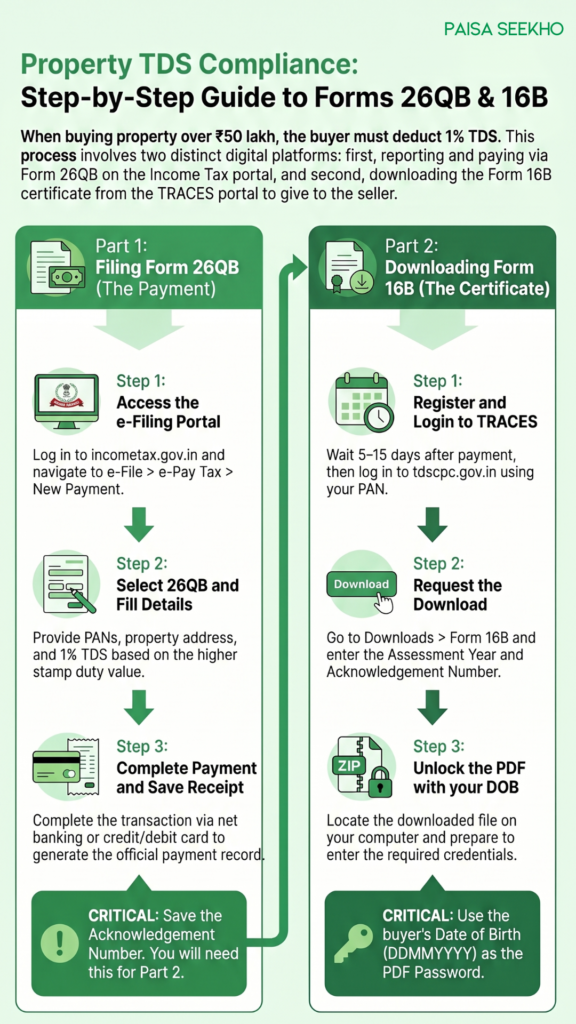
Before you can issue Form 16B to the seller, you must first file Form 26QB, a combined challan-cum-statement that simultaneously reports the property transaction details to the Income Tax Department and deposits the TDS with the government.
Think of it this way:
- Form 26QB = the payment + the report you send to the government
- Form 16B = the receipt/certificate you generate from TRACES after that payment, and hand to the seller
You cannot issue Form 16B without first completing Form 26QB.
What Is Form 26QB?
Form 26QB is an online challan-cum-statement filed on the Income Tax Department’s e-filing portal (incometax.gov.in). It serves as the TDS return for property purchases under Section 194-IA and simultaneously allows payment of the TDS.
Due date for filing Form 26QB: Within 30 days from the end of the month in which the TDS was deducted. For example, if you make a payment to the seller on 15 May, Form 26QB must be filed by 30 June.
Important: If you pay the seller in installments (which is common in under-construction projects), you must file a separate Form 26QB for each installment. This means:
- If you pay ₹20 lakh as a booking amount and ₹50 lakh later, you need to check whether the total consideration crosses ₹50 lakh, and deduct TDS on each payment proportionately.
Multiple buyers or sellers: If there are two buyers and two sellers, a separate Form 26QB must be filed for each buyer-seller combination. So two buyers and two sellers would require four Form 26QB filings.
How to File Form 26QB (Step-by-Step)
- Go to the Income Tax e-filing portal (incometax.gov.in) and log in using your PAN and password.
- Navigate to e-File → e-Pay Tax → New Payment. Select 26QB (TDS on sale of property).
- Fill in the form carefully:
- Buyer and seller PAN details (both mandatory)
- Buyer and seller names and addresses
- Property details, type of property, address, and date of agreement
- Residential status of the seller (resident or non-resident)
- Total sale consideration and stamp duty value (enter the higher value as the base for TDS calculation)
- TDS amount (1% of the higher of consideration or stamp duty value)
- Mode of payment
- Choose your payment method, net banking, debit card, RTGS/NEFT, etc.
- On successful payment, an acknowledgement number is generated. Save this carefully, you’ll need it to download Form 16B.
- A challan counterfoil confirming payment is also generated. Download and save it.
Critical warning about Form 26QB: Double-check every detail before submitting, especially the PAN numbers of the buyer and seller. Unlike other forms, corrections to Form 26QB after submission are very difficult and require contacting the Income Tax Department directly. A wrong PAN in Form 26QB is one of the most common mistakes in property TDS compliance, it can prevent the seller from claiming TDS credit and result in notices for both parties.
How to Download Form 16B from TRACES
After filing Form 26QB and making the payment, you can download Form 16B from the TRACES portal (tdscpc.gov.in). Allow 5 to 15 working days after payment for the transaction to be processed and appear in TRACES.
Step-by-step to download Form 16B:
- Go to TRACES (tdscpc.gov.in). If you haven’t registered as a taxpayer (not the same as your income tax portal login), register first using your PAN, date of birth, and the Form 26QB acknowledgement number or challan details.
- Log in using your PAN and TRACES password.
- Go to Downloads → Form 16B (For Buyer).
- Enter the Assessment Year, the seller’s PAN, and the Form 26QB acknowledgement number.
- Click Submit. The request is processed, check status under Downloads → Requested Downloads.
- Once the status shows “Available,” download the PDF file. The file is in a password-protected ZIP folder. The password to open it is the buyer’s date of birth in DDMMYYYY format.
- Inside the ZIP, you’ll find the Form 16B PDF. Print it out or save the digital copy.
Due date for issuing Form 16B to the seller: Within 15 days from the due date for filing Form 26QB. For example, if Form 26QB was due by 30 June, Form 16B must reach the seller by 15 July.
What Does Form 16B Contain?
According to the Income Tax Department, Form 16B contains the following details:
- Name and PAN of the buyer (the deductor)
- Name and PAN of the seller (the deductee)
- Assessment year for which TDS applies
- Property details: address and nature of the property
- Amount paid or credited: the total sale consideration
- TDS deducted: the amount of tax deducted
- Date of deduction and date of deposit with the government
- Challan Identification Number (CIN) linking the TDS to the specific government payment
- Acknowledgement number of the Form 26QB filing
- A TRACES certificate number (unique to the certificate)
Form 16B is generated exclusively from the TRACES portal. A manually prepared document is not a valid TDS certificate.
What If Payment Is Made in Installments?
For under-construction properties especially, payments are typically spread over time. The rule is:
- TDS must be deducted at the time of each payment to the seller or when the amount is credited, whichever is earlier
- A separate Form 26QB must be filed for each installment
- A separate Form 16B must be issued to the seller for each installment payment
This means a buyer paying in, say, five installments for an under-construction flat must file five Form 26QBs and issue five Form 16Bs across the course of the project. Each filing is independent, with its own due date 30 days from the end of the month of payment.
Note: The ₹50 lakh threshold is judged on the total transaction value, not on the individual installment size. If the total agreed price is ₹70 lakh paid in installments of ₹15–20 lakh each, TDS applies from the very first installment because the total crosses ₹50 lakh.
Penalties for Non-Compliance
The Income Tax Act is strict about TDS on property transactions. Here is what happens if a buyer defaults:
| Default | Consequence |
| Failure to deduct TDS | Interest at 1% per month for the period of non-deduction under Section 201(1A) |
| Deducting TDS but not depositing it | Interest at 1.5% per month for the period of delay under Section 201(1A) |
| Failure to file Form 26QB on time | Late fee at ₹200 per day under Section 234E (capped at the TDS amount) |
| Penalty for non-deduction or non-deposit | Up to 100% of the TDS amount under Section 271C |
| Failure to issue Form 16B on time | Penalty at ₹100 per day under Section 272A(2)(g) |
It is also worth noting that a buyer who fails to deduct TDS may be treated as an assessee in default under Section 201, meaning the Income Tax Department can demand the TDS amount directly from the buyer, along with interest.
What the Seller Should Do With Form 16B
If you are the seller of a property and receive Form 16B from the buyer, here is what to do:
- Verify the details: Check that your PAN, the property details, and the TDS amount are all correct on the form.
- Cross-check with Form 26AS: Log into incometax.gov.in and check Part F of your Form 26AS (or your AIS). The TDS deducted by the buyer should appear there. Allow 7 to 15 days after the buyer files Form 26QB for the credit to reflect.
- Claim the TDS credit in your ITR: When you file your ITR for the financial year in which the property sale took place, report the capital gains from the sale and claim the TDS credit (shown in Form 16B and Form 26AS) in Schedule TDS-2.
- If TDS is not showing in Form 26AS: Contact the buyer immediately. The buyer may not have filed Form 26QB correctly. A mismatch or missing TDS credit cannot be fixed by the seller, only the buyer can file a correction.
Form 16B vs Form 26QB: What’s the Difference?
People often confuse the two. Here’s the simplest way to think about it:
| Form 26QB | Form 16B | |
| What it is | TDS payment + report filed by the buyer with the government | TDS certificate issued by the buyer to the seller |
| Filed by | Buyer | Buyer (downloads from TRACES and gives to seller) |
| When | Within 30 days from end of month of payment | Within 15 days from due date of Form 26QB |
| Where | Income Tax e-filing portal (incometax.gov.in) | TRACES portal (tdscpc.gov.in) |
| What happens after | TDS credit appears in seller’s Form 26AS | Seller uses it to claim TDS credit in ITR |
Important: Form 16B Is Becoming Form 132
Under India’s Income Tax Act, 2025 (effective from 1 April 2026) and the Income Tax Rules, 2026, Form 16B is being replaced. According to the Income Tax Department’s official FAQ:
- Form No. 132 is the new TDS certificate that replaces not just Form 16B, but also Forms 16C, 16D, and 16E, four separate old certificates merged into one.
- It is issued under Section 395(4) of the Income Tax Act, 2025 (corresponding to the old Section 203).
- The corresponding challan-cum-statement also changes from Form 26QB to Form No. 141 (Schedule B) under the new framework.
- Form 132 must still be issued within 15 days from the due date of filing the challan-cum-statement and can only be downloaded from TRACES.
- A manually prepared Form 132 has no legal validity, just like Form 16B today.
For all property transactions with payments made on or before 31 March 2026: the old framework applies, use Form 26QB and issue Form 16B.
For transactions from 1 April 2026 onwards (Tax Year 2026-27): buyers must use Form 141 (Schedule B) instead of Form 26QB, and issue Form 132 instead of Form 16B. The core obligation, deducting 1% TDS on the higher of sale consideration or stamp duty value, remains unchanged.
Frequently Asked Questions
1. Do I need a TAN to deduct TDS on property purchase?
No. Under Section 194-IA, property buyers are specifically exempt from obtaining a TAN. Your PAN is sufficient to file Form 26QB and download Form 16B.
2. What if the seller doesn’t give me their PAN?
If the seller’s PAN is not available, you must deduct TDS at 20% instead of 1%, as per Section 206AA. Insist on the seller’s PAN before completing the transaction.
3. The property is worth ₹48 lakh. Do I need to deduct TDS?
No. Section 194-IA applies only when the sale consideration (or stamp duty value, whichever is higher) is ₹50 lakh or more. Below this threshold, no TDS is required.
4. I paid the booking amount before the total value was confirmed. Do I deduct TDS on the booking amount?
The threshold check is on the total agreed consideration, not individual payments. If the total property price is ₹60 lakh and you paid ₹10 lakh as a booking amount, TDS applies from the first payment itself. File Form 26QB for the booking amount and each subsequent installment.
5. Can I file Form 26QB offline or at the bank directly?
No. Form 26QB must be filed online on the Income Tax e-filing portal. Physical filing is not available for this form.
6. What if I made a mistake in Form 26QB, wrong PAN or wrong amount?
Corrections to Form 26QB after filing are very limited and involve contacting the Income Tax Department directly. Prevention is critical, verify the seller’s PAN, property details, and TDS amount carefully before submitting.
7. As the seller, what if the buyer refuses to give me Form 16B?
Form 16B is the buyer’s legal obligation under Section 194-IA. If they refuse, you can still check whether the TDS has been deposited against your PAN in Form 26AS. If TDS is not showing, report the non-compliance to the Income Tax Department. You may also be able to claim TDS credit based on Form 26AS even without Form 16B, but it is best to resolve the issue with the buyer first.
8. Does Form 16B apply to properties bought from NRI sellers?
No. If the seller is a non-resident, Section 194-IA does not apply. Instead, TDS is governed by Section 195, which requires the buyer to obtain a TAN and follow a different (and more complex) set of rules. Consult a tax professional before buying from an NRI seller.
Key Takeaways
- Form 16B is the TDS certificate a property buyer must give to the seller for any immovable property purchase worth ₹50 lakh or more.
- The buyer must deduct 1% TDS on the higher of the sale consideration or the stamp duty value (rule effective from 1 October 2024).
- No TAN is needed, the buyer’s PAN is sufficient.
- The process: deduct TDS → file Form 26QB online within 30 days → download Form 16B from TRACES → issue it to the seller within 15 days of the Form 26QB due date.
- For installment payments (common in under-construction projects): a separate Form 26QB and Form 16B is required for each installment.
- For joint transactions: a separate Form 26QB is needed for each buyer-seller combination.
- Non-compliance attracts interest, late fees, and penalties, including up to 100% of the TDS amount as penalty under Section 271C.
- From Tax Year 2026-27 (transactions from April 2026), Form 26QB is replaced by Form 141 (Schedule B) and Form 16B is replaced by the merged Form No. 132, under the new Income Tax Act, 2025.
Sources: Income Tax Department, Government of India, TDS on Purchase of Immovable Property; Income Tax Department, Form 16B Download; Income Tax Department, Form No. 132 (Earlier Form No. 16B/16C/16D/16E) FAQ; Taxguru.in, New Forms under Income Tax Act, 2025 and Rules 2026: A Comparative Guide.
This article is for general information and does not constitute tax or legal advice. For your specific situation, consult a chartered accountant or tax professional.