
TL;DR: Quick Facts on the Bharat Maritime Insurance Pool
If you are short on time, here is the absolute fast-track summary of what you need to know:
- The Problem: 95% of India’s international trade (by value) moves by sea. If Western insurance firms cancel their coverage due to global sanctions or wars, India’s supply of oil, gas, and fertilizers gets paralyzed.
- The Solution: The government launched the Bharat Maritime Insurance Pool (BMIP), a domestic insurance ecosystem backed by a massive $1.5 billion (₹12,980 crore) sovereign guarantee.
- How it Works: Smaller insurance claims are paid by a pool of local insurers managed by GIC Re. If a catastrophic disaster happens and the claim crosses $100 million, the Indian government steps in to pay it.
- The Russian Oil Factor: BMIP ensures that even if global insurers refuse to cover ships carrying Russian oil to India, our domestic insurance system will step in to keep the oil flowing.
- The Forex Win: Instead of paying millions of US Dollars in insurance premiums to companies in London, the money now stays inside India, boosting our own financial sector.
Introduction
Imagine a massive cargo ship sailing across the Indian Ocean. It is carrying millions of barrels of crude oil. This oil is destined for India, meant to be refined into the petrol and diesel that keeps your car running, your local grocery delivery trucks moving, and the nation’s factories humming.
Suddenly, a geopolitical conflict breaks out thousands of miles away in Europe or the Middle East. The ship is nowhere near the conflict zone. The physical sea route is completely safe. Yet, the ship is forced to stop.
Why? Because a man sitting in an office in London or Singapore sent an email canceling the ship’s insurance policy.
Without insurance, the ship cannot legally dock at any port. The oil cannot be unloaded. The entire supply chain of a nation of 1.4 billion people is brought to a grinding halt, not by pirates, not by missiles, but by a piece of paper.
This terrifying scenario is not a plot from a Hollywood movie; it is a very real vulnerability that the Indian government has recognized. For decades, the invisible financial plumbing of global sea trade has been entirely controlled by Western countries. But in 2026, India finally decided to take control of its own destiny.
Enter the Bharat Maritime Insurance Pool (BMIP).
In this comprehensive Paisaseekho masterclass, we are going to decode the fascinating, high-stakes world of global shipping insurance. We will explain why India is creating a massive $1.5 Billion (₹12,980 Crore) maritime safety net, how it protects our oil supply from foreign sanctions, and why this move is one of the most brilliant strategic masterstrokes for the Indian economy this decade.
1. Why Does The World Still Rely on Ships for Trade?
To understand why the Bharat Maritime Insurance initiative is so revolutionary, you first have to understand how heavily the world relies on ships.
Whenever we talk about globalization, we usually think about airplanes, the internet, or trade agreements. But the physical reality of the global economy is wet, salty, and slow. Massive cargo ships carry the absolute essentials of modern life.
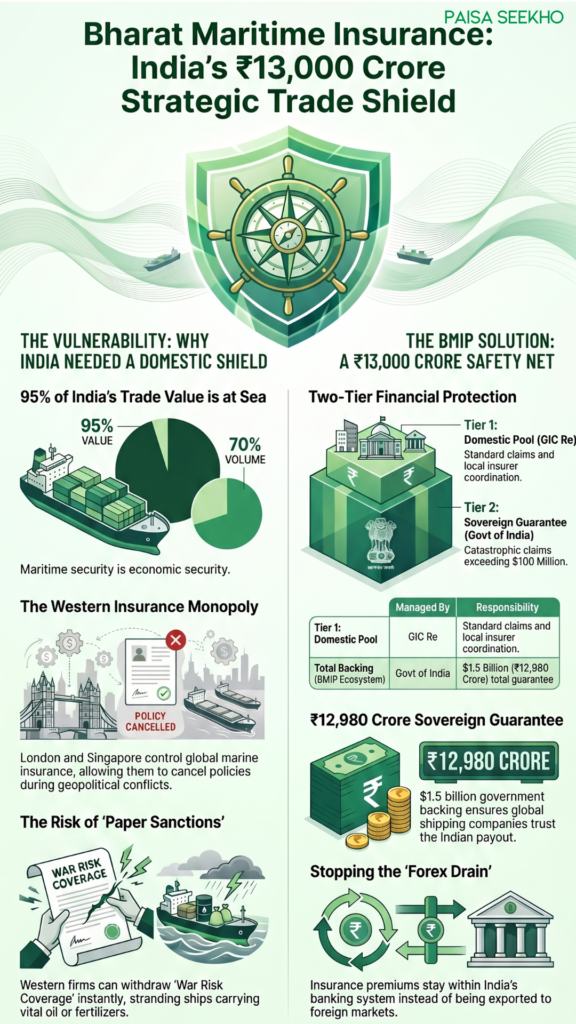
For India specifically, the numbers are staggering. A massive 70% of India’s trade by volume and 95% by value moves through maritime corridors. Every drop of crude oil, every tank of Liquefied Natural Gas (LNG), and every sack of agricultural fertilizer arrives on a ship.
The Law of the Sea (No Insurance, No Entry)
You wouldn’t drive a brand-new Mercedes on a highway without car insurance, right? A cargo ship is a million times riskier.
These ships cost hundreds of millions of dollars. They carry cargo worth billions. If a ship sinks, causes an oil spill, or damages a port, the financial liability is astronomical. Therefore, international maritime law dictates that no commercial vessel can enter a port without comprehensive marine insurance.
The Western Monopoly
For the last 300 years, this marine insurance market has been a near-absolute monopoly controlled by the West.
Cities like London (home to the famous Lloyd’s of London) and, more recently, Singapore, control the global shipping insurance market. They have the deepest pockets, the best shipping lawyers, and the most established risk-assessment models.
For decades, India was perfectly happy to pay these Western firms to insure the ships bringing goods to our shores. But recently, the world became a much more dangerous place.
2. Need for BMIP: Sanctions, War Risks, and the Red Sea
In the world of marine insurance, there is a special clause called “War Risk Coverage.”
Imagine you buy a comprehensive car insurance policy. But buried in the fine print, the insurance company states: “If you drive into a neighborhood where a riot is happening, we will instantly cancel your policy.”
This is exactly how global shipping insurance works. When geopolitical conditions deteriorate, such as a conflict escalating in the Red Sea, the Strait of Hormuz, or Eastern Europe, Western insurers can withdraw their war-risk coverage with extremely short notice, sometimes within just a few days.
The Russian Crisis:
The true wake-up call for India happened during the geopolitical sanctions against Russia.
India needed cheap Russian crude oil to keep its domestic petrol prices low and control inflation. However, Western countries imposed strict sanctions, and suddenly, Western insurance companies refused to provide coverage for any ship carrying Russian oil.
If India relied entirely on London for insurance, the ships would have stopped, and India would have faced a massive energy crisis. To survive, India quietly expanded the list of Russian insurance companies it allowed at Indian ports.
However, this temporary “hack” made the Indian government realize a terrifying truth: For a country deeply dependent on imported energy, relying entirely on foreign-controlled insurance systems poses a massive national security risk.
We needed our own system. We needed an “Atmanirbhar” (self-reliant) safety net.
3. What is the Bharat Maritime Insurance Pool (BMIP)?
To solve this strategic vulnerability, the government and the Indian financial sector came together to build the Bharat Maritime Insurance Pool (BMIP).
At its core, BMIP is a massive financial safety net. It is a domestic insurance arrangement designed to step in and provide coverage to ships and cargo when global insurers are either unwilling or legally unable to do so.
Here is exactly how the architecture of this ₹13,000 Crore system works:
Tier 1: The Domestic Insurance Pool
Instead of one single company taking all the risk, several Indian insurance companies pool their money together. This pool is managed by GIC Re (General Insurance Corporation of India), which is the state-owned reinsurance company.
If a ship gets damaged, cargo is lost, or an oil spill occurs, this pool pays out the claim.
Tier 2: The Sovereign Guarantee (The $100 Million Limit)
In the shipping world, disasters can be unimaginably expensive. What if a massive oil tanker sinks and the cleanup costs $500 Million? A newly formed domestic insurance pool might go bankrupt trying to pay that.
To solve this, the Indian government attached a massive $1.5 Billion (₹12,980 Crore) Sovereign Guarantee to the BMIP.
The rule is simple: The domestic pool handles all standard claims. But if a single catastrophic claim crosses $100 million, the Government of India steps in and pays the rest.
Who Can Use It?
The brilliance of the BMIP is that it is not just restricted to Indian ships. Even foreign vessels carrying goods to or from Indian ports can purchase this insurance.
By offering this massive financial guarantee, the government is sending a loud, clear message to global shipping companies: “Do not worry about Western sanctions or sudden cancellations. The Government of India guarantees that if your ship crashes while bringing oil to our country, you will be paid.”
4. How BMIP Helps With Stopping the Forex Drain
While national security and energy independence are the headline reasons for building the Bharat Maritime Insurance Pool, there is a massive secondary benefit that makes economists incredibly happy: Foreign Exchange (Forex) savings.
As we have discussed in previous Paisaseekho guides about the economy, protecting our US Dollar reserves is critical for the stability of the Indian Rupee.
The Old System (Capital Export)
Until the BMIP was created, a massive share of India’s marine insurance coverage was handled by foreign insurers.
When an Indian importer wanted to insure a cargo of fertilizers coming from the Middle East, they had to pay the insurance premium in US Dollars to a company in London or Singapore.
At first glance, a few million dollars in premiums might not seem like a big deal. But when you aggregate the insurance premiums of thousands of ships over a decade, it becomes a massive, continuous drain of capital out of India. We were essentially exporting our wealth to build the financial sectors of foreign countries.
The New System (Moving up the Value Chain)
With the BMIP in place, those insurance premiums are now paid to Indian insurance companies, often in Indian Rupees.
- The capital stays inside the Indian banking system.
- It creates high-paying jobs for Indian actuaries, risk assessors, and maritime lawyers.
- It helps India move up the “Globalization Value Chain.” We are no longer just buying the goods; we are now owning the highly profitable financial plumbing that moves the goods.
5. The Real Challenge: Earning Global Trust
While the math behind the Bharat Maritime Insurance Pool looks fantastic on a spreadsheet, the reality of global shipping is much more brutal.
The $1.5 Billion sovereign guarantee is a massive flex of financial muscle. But in the world of marine insurance, money alone does not buy you a seat at the head table.
The entire global insurance industry runs on one single, fragile commodity: Trust.
When a multi-billion dollar shipping company chooses an insurance provider, they are asking very difficult questions:
- If my ship crashes, will the claim be settled quickly, or will I be stuck in court for ten years?
- Does the insurer have top-tier marine lawyers who understand international maritime law?
- Is the government backing the policy stable, or will they change the rules next year?
Established shipping hubs like London (Lloyd’s) and Singapore did not become global insurance centers overnight. They spent decades, sometimes centuries, building a reputation for flawless execution, deep legal expertise, and absolute policy stability.
What India Needs Next
If India wants the BMIP to be more than just a temporary “backup plan” during crises, it has a massive mountain to climb.
- Policy Stability: The Indian financial market has occasionally seen sudden policy shifts that spook international investors. For the BMIP to gain global credibility, the government must guarantee long-term stability in its insurance regulations.
- Building Institutions: We need to aggressively train and develop a new generation of maritime lawyers, risk assessors, and claims adjusters.
- Global Adoption: Ultimately, the success of the BMIP will be measured by whether a neutral shipping company (say, a Japanese company moving goods to Australia) decides to buy Indian insurance purely because it is the best product on the market.
Conclusion
For the average citizen, marine insurance sounds like a boring, bureaucratic topic. But in reality, it is the invisible shield that protects the food on your plate and the fuel in your car.
The launch of the Bharat Maritime Insurance Pool is a clear signal that India is no longer content with just participating in global trade; it intends to control its own destiny within it. By building a ₹13,000 Crore safety net, we have ensured that our vital supply lines, especially crude oil, fertilizers, and LNG, cannot be held hostage by sudden Western sanctions or geopolitical wars.
As the world becomes increasingly fragmented and unpredictable, having our own sovereign-backed maritime insurance system is not just a smart financial move; it is a critical pillar of national security. The foundation has been laid. Now, the challenge is to build the trust, talent, and expertise to make India a true heavyweight in the global shipping economy.
Frequently Asked Questions (FAQs) About Bharat Maritime Insurance Pool
Q1: What is the Bharat Maritime Insurance Pool (BMIP)?
The BMIP is a massive $1.5 billion (₹12,980 crore) domestic insurance arrangement launched by India. It provides marine insurance to cargo ships, ensuring that Indian trade does not stop even if global insurers withdraw coverage due to geopolitical sanctions or wars.
Q2: Why did India need its own maritime insurance system?
A staggering 95% of India’s international trade by value moves by sea. During the recent geopolitical crises, Western insurers threatened to pull coverage for ships carrying Russian oil. India realized that relying purely on foreign insurers was a massive threat to our energy security.
Q3: How does the government’s sovereign guarantee work in the BMIP?
The BMIP has a two-tier system. Standard claims are handled by a pool of domestic insurance companies managed by GIC Re. However, if a catastrophic event occurs and a single claim crosses the $100 million mark, the Indian Government steps in with its $1.5 billion guarantee to cover the rest.
Q4: Can foreign ships use the Bharat Maritime Insurance Pool?
Yes. The insurance pool is not restricted to Indian-flagged vessels. Any foreign vessel carrying vital cargo to or from an Indian port can utilize the BMIP, ensuring trade continues seamlessly regardless of global sanctions.
Q5: What is “War Risk Coverage” in marine insurance?
War Risk Coverage is a specific clause that insures ships traveling through dangerous, conflict-prone areas (like the Red Sea). However, global insurers can cancel this coverage with very short notice if a sudden war breaks out, instantly stranding the cargo ships. BMIP acts as a backup for these scenarios.
Q6: How does the BMIP help India save foreign exchange (Forex)?
Historically, Indian importers paid millions of US Dollars in insurance premiums to companies based in London or Singapore. With the BMIP, those premiums are paid to domestic Indian insurers, keeping the capital inside the country and strengthening the Indian financial sector.
Q7: Who manages the domestic insurance pool for the BMIP?
The initial tier of the insurance pool is managed by GIC Re (General Insurance Corporation of India), which is the state-owned reinsurance company responsible for coordinating the domestic insurers.
Q8: Will the BMIP completely replace Western marine insurance?
Not immediately. The BMIP currently acts as a massive “safety net” or domestic backup. Earning global trust to completely replace established hubs like Lloyd’s of London will take decades of building legal expertise and proving reliability in paying out massive claims.
Q9: Does this insurance cover oil spills and ship damage?
Yes. Comprehensive marine insurance under the BMIP covers a wide range of liabilities, including physical damage to the ship (Hull and Machinery), lost cargo, and catastrophic environmental events like oil spills in the ocean.
Q10: Why is policy stability important for the success of BMIP?
Global shipping companies deal with multi-billion dollar risks. They need absolute certainty that an insurance system will pay out during a crisis. If India frequently changes its financial or insurance policies, foreign shipping companies will hesitate to trust the BMIP. Long-term consistency is required to build international credibility.
Last Updated on 4 months ago by Team Paisaseekho